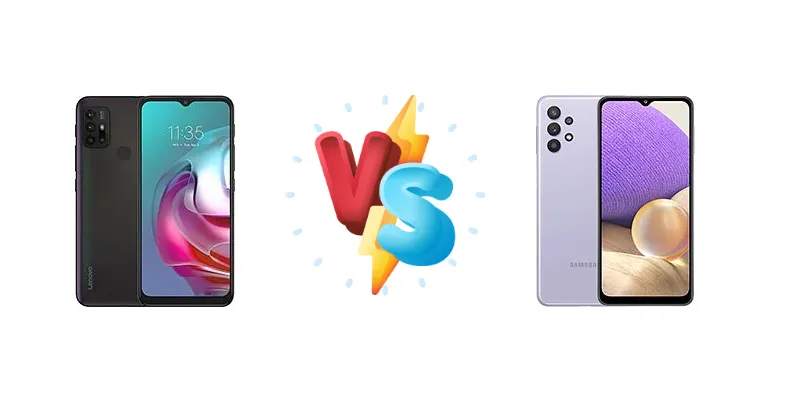
The Lenovo K13 Pro and Samsung Galaxy A32 5G represent compelling options in the increasingly competitive sub-$200 5G smartphone market. While both aim to deliver 5G connectivity at an accessible price point, they take different approaches to achieving this, primarily through chipset selection. This comparison dissects the key differences to determine which device offers the best overall experience.
🏆 Quick Verdict
For most users, the Samsung Galaxy A32 5G emerges as the slightly better choice. While both phones share 15W charging and similar battery endurance ratings (123h), the Dimensity 720’s 7nm process provides a performance edge and potentially better efficiency, coupled with a slightly brighter display.
| Network |
|---|
| 2G bands | GSM 850 / 900 / 1800 / 1900 | GSM 850 / 900 / 1800 / 1900 |
| 3G bands | HSDPA 850 / 900 / 1700(AWS) / 1900 / 2100 | HSDPA 850 / 900 / 1900 / 2100 |
| 4G bands | LTE | 1, 2, 3, 4, 5, 7, 8, 12, 17, 20, 26, 28, 38, 40, 41, 66 |
| 5G bands | - | 1, 3, 5, 7, 8, 20, 28, 38, 40, 41, 66, 78, 79 SA/NSA/Sub6 |
| Speed | HSPA 42.2/5.76 Mbps, LTE Cat4 150/50 Mbps | HSPA 42.2/5.76 Mbps, LTE Cat16 1024/75 Mbps, 5G |
| Technology | GSM / HSPA / LTE | GSM / CDMA / HSPA / LTE / 5G |
| | - | 25, 41, 66, 71 SA/NSA/Sub6 - SM-A326U |
| Launch |
|---|
| Announced | 2021, September | 2021, January 13 |
| Status | Available. Released 2021, September 29 | Available. Released 2021, January 22 |
| Body |
|---|
| Build | Glass front, plastic back, plastic frame | Glass front (Gorilla Glass 5), plastic frame, plastic back |
| Dimensions | - | 164.2 x 76.1 x 9.1 mm (6.46 x 3.00 x 0.36 in) |
| SIM | · Nano-SIM· Nano-SIM + Nano-SIM | · Nano-SIM· Nano-SIM + Nano-SIM |
| Weight | 200 g (7.05 oz) | 205 g (7.23 oz) |
| Display |
|---|
| Protection | - | Corning Gorilla Glass 5 |
| Resolution | 720 x 1600 pixels, 20:9 ratio (~270 ppi density) | 720 x 1600 pixels, 20:9 ratio (~270 ppi density) |
| Size | 6.51 inches, 102.3 cm2 | 6.5 inches, 102.0 cm2 (~81.6% screen-to-body ratio) |
| Type | IPS LCD, 90Hz | TFT LCD, 60Hz (International), 90Hz (SM-A326U, SM-326DL only) |
| Platform |
|---|
| CPU | Octa-core (4x2.0 GHz Kryo 260 Gold & 4x1.8 GHz Kryo 260 Silver) | Octa-core (2x2.0 GHz Cortex-A76 & 6x2.0 GHz Cortex-A55) |
| Chipset | Qualcomm SM6115 Snapdragon 662 (11 nm) | Mediatek Dimensity 720 (7 nm) |
| GPU | Adreno 610 | Mali-G57 MC3 |
| OS | Android 11 | Android 11, upgradable to Android 13, One UI 5 |
| Memory |
|---|
| Card slot | microSDXC (uses shared SIM slot) | microSDXC (uses shared SIM slot) |
| Internal | 64GB 4GB RAM, 128GB 4GB RAM, 128GB 6GB RAM | 64GB 4GB RAM, 128GB 4GB RAM, 128GB 6GB RAM, 128GB 8GB RAM |
| Main Camera |
|---|
| Features | LED flash, HDR, panorama | LED flash, panorama, HDR |
| Quad | 64 MP, f/1.7, 26mm (wide), 1/1.97", 0.7µm, PDAF
8 MP, f/2.2, 118˚ (ultrawide), 1/4.0", 1.12µm
2 MP (macro)
Auxiliary lens | 48 MP, f/1.8, 26mm (wide), 1/2.0", 0.8µm, PDAF
8 MP, f/2.2, 123˚, (ultrawide), 1/4.0", 1.12µm
5 MP (macro)
Auxiliary lens |
| Video | 1080p@30/60fps | 4K@30fps, 1080p@30/120fps |
| Selfie camera |
|---|
| Features | HDR | - |
| Single | 13 MP, f/2.2, (wide), 1/3.1", 1.12µm | 13 MP, f/2.2, (wide), 1/3.1", 1.12µm |
| Video | 1080p@30fps | 1080p@30fps |
| Sound |
|---|
| 3.5mm jack | Yes | Yes |
| 35mm jack | Yes | Yes |
| Loudspeaker | Yes | Yes |
| Comms |
|---|
| Bluetooth | 5.0, A2DP, LE | 5.0, A2DP, LE |
| NFC | Unspecified | Yes (market/region dependent) |
| Positioning | GPS, GLONASS, GALILEO | GPS, GLONASS, GALILEO, BDS |
| Radio | FM radio, RDS, recording | FM radio |
| USB | USB Type-C 2.0, OTG | USB Type-C 2.0, OTG |
| WLAN | Wi-Fi 802.11 a/b/g/n/ac, dual-band, Wi-Fi Direct | Wi-Fi 802.11 a/b/g/n/ac, dual-band, Wi-Fi Direct |
| Features |
|---|
| Sensors | Fingerprint (rear-mounted), accelerometer, gyro, proximity | Fingerprint (side-mounted), accelerometer, gyro, compass |
| | - | Virtual proximity sensing |
| Battery |
|---|
| Charging | 15W wired | 15W wired |
| Type | Li-Po 5000 mAh | Li-Ion 5000 mAh |
| Misc |
|---|
| Colors | Black | Awesome Black, Awesome White, Awesome Blue, Awesome Violet |
| Models | XT2129-3 | SM-A326B, SM-A326B/DS, SM-A326BR/DS, SM-A326BR, SM-A326U, SM-A326W, SM-A326U1, SM-A326K, SCG08, SM-S326DL |
| Price | About 150 EUR | € 111.89 / $ 78.64 / £ 77.53 |
| SAR EU | - | 0.33 W/kg (head) 1.08 W/kg (body) |
| Tests |
|---|
| Battery life | - |
Endurance rating 123h
|
| Camera | - |
Photo / Video |
| Display | - |
Contrast ratio: 1470:1 (nominal) |
| Loudspeaker | - |
-28.5 LUFS (Average)
|
| Performance | - |
AnTuTu: 226561 (v8)
GeekBench: 1673 (v5.1) |
Lenovo K13 Pro
- Qualcomm Snapdragon 662 chipset
- Competitive price point
- Decent battery endurance
- Less efficient 11nm chipset
- Potentially lower peak performance
- Limited camera details
Samsung Galaxy A32 5G
- More efficient MediaTek Dimensity 720 chipset
- Brighter display (497 nits)
- Good contrast ratio (1470:1)
- 15W charging is relatively slow
- Camera details are lacking
- Software updates may be slower than Lenovo
Display Comparison
Both the Lenovo K13 Pro and Samsung Galaxy A32 5G feature displays with comparable contrast ratios – 1490:1 and 1470:1 respectively. However, the Galaxy A32 5G boasts a measured peak brightness of 497 nits, offering a noticeably brighter viewing experience, especially outdoors. While neither manufacturer specifies panel technology, the A32 5G’s higher brightness suggests a potentially more advanced LCD panel. Bezels are expected to be similar, typical of this price segment, and color accuracy is likely to be standard for budget devices.
Camera Comparison
Both devices are listed as having 'Photo / Video' capabilities, lacking specific details. Given the price point, image quality will likely be similar, relying heavily on software processing. It’s reasonable to assume both will struggle in low-light conditions. The absence of information regarding sensor size or optical image stabilization (OIS) suggests neither phone prioritizes advanced camera features. Any 2MP macro or depth sensors included are unlikely to significantly enhance the photography experience.
Performance
The core difference lies in the chipsets: the Lenovo K13 Pro utilizes the Qualcomm Snapdragon 662 (11nm) while the Samsung Galaxy A32 5G employs the MediaTek Dimensity 720 (7nm). The Dimensity 720’s smaller 7nm fabrication process generally translates to improved power efficiency and thermal performance compared to the Snapdragon 662’s 11nm node. The CPU configurations differ as well; the Snapdragon 662 uses a Kryo 260 split, while the Dimensity 720 features Cortex-A76 and A55 cores. This architecture gives the Dimensity 720 an advantage in sustained performance, particularly in graphics-intensive applications. While both have octa-core CPUs, the A76 cores in the Dimensity 720 are more powerful than the Kryo 260 Gold cores in the Snapdragon 662.
Battery Life
Both the Lenovo K13 Pro and Samsung Galaxy A32 5G achieve an endurance rating of 123 hours, indicating comparable battery life under typical usage. Both phones also share the same 15W wired charging capability. This means 0-100% charge times will be similar, likely exceeding two hours. The Dimensity 720’s improved efficiency *could* translate to slightly longer real-world usage, but the difference is unlikely to be substantial given the identical endurance rating.
Buying Guide
Buy the Lenovo K13 Pro if you prioritize a Qualcomm chipset and are comfortable with potentially slightly lower peak performance in demanding tasks. Buy the Samsung Galaxy A32 5G if you value a more efficient processor, a marginally brighter display with a good contrast ratio, and a brand with a more established software ecosystem.
Frequently Asked Questions
❓ Does the MediaTek Dimensity 720 in the Galaxy A32 5G get noticeably warmer during extended gaming sessions compared to the Snapdragon 662?
The Dimensity 720’s 7nm process is generally more thermally efficient than the Snapdragon 662’s 11nm process. This means it’s likely to generate less heat during prolonged gaming, potentially leading to less performance throttling and a more consistent gaming experience. However, both phones are budget devices and thermal management isn't a primary focus.
❓ Given the similar battery endurance ratings, will I notice a real-world difference in how long either phone lasts on a single charge?
While both phones have a 123-hour endurance rating, the Dimensity 720’s superior power efficiency *could* translate to slightly longer real-world usage, especially with moderate usage patterns. However, this difference is likely to be minimal and dependent on individual usage habits. Both phones will comfortably last a full day for most users.
❓ Are the cameras on either phone capable of recording stable 1080p video at 60fps?
Without specific camera specifications, it's difficult to say definitively. However, given the budget nature of both devices, stable 1080p/60fps video recording is not guaranteed. Expect potential for shaky footage and limited dynamic range, especially in less-than-ideal lighting conditions.