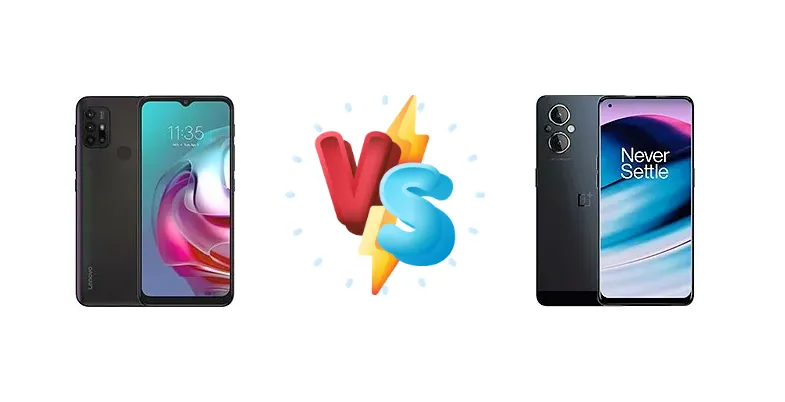
The sub-$300 smartphone market is fiercely competitive. The Lenovo K13 Pro and OnePlus Nord N20 5G both aim to deliver 5G connectivity and essential features at an accessible price point. However, they take different approaches, with the Nord N20 5G leveraging a newer chipset and faster charging, while the K13 Pro focuses on a more conservative, potentially longer-supported platform. This comparison dissects the key differences to determine which device offers the best value.
🏆 Quick Verdict
For the average user prioritizing performance and convenience, the OnePlus Nord N20 5G is the better choice. Its Snapdragon 695 chipset, built on a 6nm process, provides a noticeable performance uplift over the K13 Pro’s Snapdragon 662, and the 33W charging significantly reduces downtime. While both phones offer similar battery endurance ratings, the N20 5G’s faster charging is a key advantage.
| Network |
|---|
| 2G bands | GSM 850 / 900 / 1800 / 1900 | GSM 850 / 900 / 1800 / 1900 |
| 3G bands | HSDPA 850 / 900 / 1700(AWS) / 1900 / 2100 | HSDPA 850 / 900 / 1700(AWS) / 1900 / 2100 |
| 4G bands | LTE | 1, 2, 3, 4, 5, 7, 8, 12, 13, 17, 20, 25, 26, 28, 38, 39, 40, 41, 66, 71 |
| 5G bands | - | 2, 25, 41, 66, 71 SA/NSA |
| Speed | HSPA 42.2/5.76 Mbps, LTE Cat4 150/50 Mbps | HSPA 42.2/5.76 Mbps, LTE Cat15 800/200 Mbps, 5G |
| Technology | GSM / HSPA / LTE | GSM / HSPA / LTE / 5G |
| Launch |
|---|
| Announced | 2021, September | 2022, April 28 |
| Status | Available. Released 2021, September 29 | Available. Released 2022, April 28 |
| Body |
|---|
| Build | Glass front, plastic back, plastic frame | Glass front (Schott Xensation Up), plastic frame, plastic back |
| Dimensions | - | 159.9 x 73.2 x 7.5 mm (6.30 x 2.88 x 0.30 in) |
| SIM | · Nano-SIM· Nano-SIM + Nano-SIM | Nano-SIM |
| Weight | 200 g (7.05 oz) | 173 g (6.10 oz) |
| Display |
|---|
| Protection | - | Schott Xensation Up |
| Resolution | 720 x 1600 pixels, 20:9 ratio (~270 ppi density) | 1080 x 2400 pixels, 20:9 ratio (~409 ppi density) |
| Size | 6.51 inches, 102.3 cm2 | 6.43 inches, 99.8 cm2 (~85.3% screen-to-body ratio) |
| Type | IPS LCD, 90Hz | AMOLED |
| | - | Always-on display |
| Platform |
|---|
| CPU | Octa-core (4x2.0 GHz Kryo 260 Gold & 4x1.8 GHz Kryo 260 Silver) | Octa-core (2x2.2 GHz Kryo 660 Gold & 6x1.7 GHz Kryo 660 Silver) |
| Chipset | Qualcomm SM6115 Snapdragon 662 (11 nm) | Qualcomm SM6375 Snapdragon 695 5G (6 nm) |
| GPU | Adreno 610 | Adreno 619 |
| OS | Android 11 | Android 11, OxygenOS 11 |
| Memory |
|---|
| Card slot | microSDXC (uses shared SIM slot) | microSDXC (dedicated slot) |
| Internal | 64GB 4GB RAM, 128GB 4GB RAM, 128GB 6GB RAM | 128GB 6GB RAM |
| | - | UFS 2.2 |
| Main Camera |
|---|
| Features | LED flash, HDR, panorama | LED flash, HDR, panorama |
| Quad | 64 MP, f/1.7, 26mm (wide), 1/1.97", 0.7µm, PDAF
8 MP, f/2.2, 118˚ (ultrawide), 1/4.0", 1.12µm
2 MP (macro)
Auxiliary lens | - |
| Single | - | 16 MP, f/2.4, (wide) |
| Triple | - | 64 MP, f/1.8, (wide), PDAF
2 MP (macro)
Auxiliary lens |
| Video | 1080p@30/60fps | 1080p@30fps |
| Selfie camera |
|---|
| Features | HDR | HDR |
| Single | 13 MP, f/2.2, (wide), 1/3.1", 1.12µm | 16 MP, f/2.4, (wide) |
| Video | 1080p@30fps | 1080p@30fps |
| Sound |
|---|
| 3.5mm jack | Yes | Yes |
| 35mm jack | Yes | Yes |
| Loudspeaker | Yes | Yes |
| Comms |
|---|
| Bluetooth | 5.0, A2DP, LE | 5.1, A2DP, LE |
| NFC | Unspecified | Yes |
| Positioning | GPS, GLONASS, GALILEO | GPS (L1+L5), GLONASS, GALILEO, BDS |
| Radio | FM radio, RDS, recording | No |
| USB | USB Type-C 2.0, OTG | USB Type-C 2.0, OTG |
| WLAN | Wi-Fi 802.11 a/b/g/n/ac, dual-band, Wi-Fi Direct | Wi-Fi 802.11 a/b/g/n/ac, dual-band, Wi-Fi Direct |
| Features |
|---|
| Sensors | Fingerprint (rear-mounted), accelerometer, gyro, proximity | Fingerprint (under display, optical), accelerometer, gyro, proximity, compass, barometer |
| Battery |
|---|
| Charging | 15W wired | 33W wired |
| Type | Li-Po 5000 mAh | Li-Po 4500 mAh |
| Misc |
|---|
| Colors | Black | Blue |
| Models | XT2129-3 | GN2200, CPH2459 |
| Price | About 150 EUR | About 120 EUR |
| Tests |
|---|
| Battery life | - |
Endurance rating 129h
|
| Display | - |
Contrast ratio: Infinite (nominal) |
| Performance | - |
AnTuTu: 316974 (v8), 380672 (v9)
GeekBench: 1945 (v5.1)
GFXBench: 16fps (ES 3.1 onscreen) |
Lenovo K13 Pro
- Potentially longer software support due to a more established chipset.
- Proven Snapdragon 662 platform offers reliable performance for basic tasks.
- May be available at a slightly lower price point.
- Slower Snapdragon 662 chipset struggles with demanding tasks.
- Significantly slower 15W charging.
- Display brightness likely lower than the N20 5G.
OnePlus Nord N20 5G
- Faster Snapdragon 695 5G chipset delivers smoother performance.
- 33W fast charging significantly reduces charging times.
- Brighter display enhances visibility in outdoor conditions.
- Snapdragon 695 is a newer platform, potentially with a shorter software support lifecycle.
- May be slightly more expensive than the K13 Pro.
- No information on camera sensor size or quality.
Display Comparison
The OnePlus Nord N20 5G boasts a brighter display, reaching a measured 647 nits, compared to an unspecified brightness for the Lenovo K13 Pro. This higher peak brightness translates to better visibility outdoors under direct sunlight. Both displays are advertised with an 'infinite' contrast ratio, typical for OLED/AMOLED panels, but the N20 5G’s higher brightness is a tangible advantage. While both likely utilize similar panel technologies, the N20 5G’s superior brightness makes it the clear winner for media consumption.
Camera Comparison
Without detailed camera specs beyond the chipsets, a direct comparison is limited. However, the Snapdragon 695 generally offers improved image signal processing (ISP) capabilities compared to the 662, potentially leading to better image quality in various lighting conditions on the N20 5G. The absence of information regarding sensor sizes and lens apertures makes a definitive judgment impossible, but the newer chipset provides a foundational advantage for camera performance.
Performance
The core difference lies in the chipsets. The OnePlus Nord N20 5G’s Snapdragon 695 5G (6nm) represents a significant architectural leap over the Lenovo K13 Pro’s Snapdragon 662 (11nm). The 6nm process node allows for greater transistor density and improved power efficiency, resulting in better sustained performance and reduced thermal throttling. The N20 5G’s CPU configuration (2x2.2 GHz Kryo 660 Gold & 6x1.7 GHz Kryo 660 Silver) also offers a clock speed advantage over the K13 Pro’s (4x2.0 GHz Kryo 260 Gold & 4x1.8 GHz Kryo 260 Silver). This translates to snappier app launches, smoother multitasking, and a more responsive user experience on the N20 5G.
Battery Life
Both devices share an endurance rating of 129 hours, suggesting similar real-world battery life. However, the charging speeds are drastically different. The OnePlus Nord N20 5G supports 33W wired charging, allowing for significantly faster top-ups compared to the Lenovo K13 Pro’s 15W charging. This means the N20 5G can replenish its battery much quicker, minimizing downtime and offering greater convenience. While battery capacity isn't specified, the faster charging speed is a substantial benefit for users who frequently need to recharge their phones.
Buying Guide
Buy the Lenovo K13 Pro if you prioritize a proven, if older, chipset with potentially longer software support and are comfortable with slower 15W charging. Buy the OnePlus Nord N20 5G if you prefer a more modern 5G experience with a faster processor for smoother multitasking and gaming, coupled with the convenience of 33W fast charging. The N20 5G is ideal for users who frequently stream video or play mobile games.
Frequently Asked Questions
❓ Does the Snapdragon 695 in the OnePlus Nord N20 5G get noticeably warmer during extended gaming sessions compared to the Snapdragon 662 in the Lenovo K13 Pro?
While the Snapdragon 695 is more powerful, its 6nm process node is more efficient, meaning it generally produces less heat than the 11nm Snapdragon 662 under similar loads. However, thermal performance also depends on the phone's cooling system. The N20 5G is likely to sustain higher performance for longer periods before throttling due to its more efficient chipset.
❓ How much faster is the 33W charging on the OnePlus Nord N20 5G compared to the 15W charging on the Lenovo K13 Pro in real-world usage?
The 33W charging on the N20 5G can realistically reduce charging times by 40-60% compared to the K13 Pro’s 15W charging. A full 0-100% charge on the N20 5G could take around 60-75 minutes, while the K13 Pro could take upwards of 2-3 hours.
❓ Will the OnePlus Nord N20 5G receive more software updates and security patches than the Lenovo K13 Pro?
OnePlus generally provides a more consistent and timely software update schedule than Lenovo. While both phones will receive updates, the N20 5G is likely to receive them for a longer period, though this isn't guaranteed. Lenovo's focus is often on providing stable, long-term support for existing software versions.