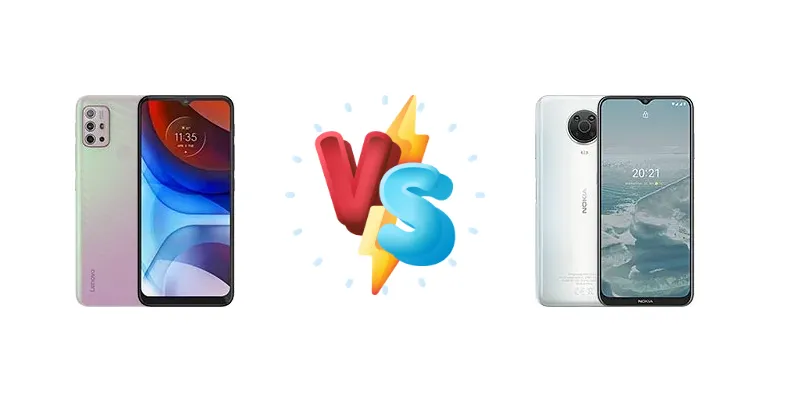
The Lenovo K13 Note and Nokia G20 represent the fiercely competitive sub-$150 smartphone market. Both aim to deliver essential smartphone functionality at an accessible price, but they take different approaches to achieving this. The K13 Note leverages Qualcomm's Snapdragon 460, while the Nokia G20 opts for MediaTek's Helio G35. This comparison dissects these choices, revealing which device offers the best balance of performance, battery life, and overall value.
🏆 Quick Verdict
For the average user prioritizing consistent performance and a slightly more efficient processor, the Lenovo K13 Note emerges as the better choice. While both phones offer similar 10W charging and basic functionality, the Snapdragon 460's architecture provides a smoother experience, particularly in multitasking and app loading.
| Network |
|---|
| 2G bands | GSM 850 / 900 / 1800 / 1900 | GSM 850 / 900 / 1800 / 1900 |
| 3G bands | HSDPA 850 / 900 / 1900 / 2100 | HSDPA 850 / 900 / 1900 / 2100 - International |
| 4G bands | LTE | 1, 3, 5, 7, 8, 20, 28, 38, 40, 41 - International |
| Speed | HSPA 42.2/5.76 Mbps, LTE Cat4 150/50 Mbps | HSPA 42.2/5.76 Mbps, LTE Cat4 150/50 Mbps |
| Technology | GSM / HSPA / LTE | GSM / HSPA / LTE |
| | - | 1, 2, 3, 4, 5, 7, 8, 12, 17, 28, 66 - LATAM |
| Launch |
|---|
| Announced | 2021, June 22 | 2021, April 08 |
| Status | Available. Released 2021, June 22 | Available. Released 2021, May 17 |
| Body |
|---|
| Build | Glass front, plastic frame, plastic back | - |
| Dimensions | 165.2 x 75.7 x 9.1 mm (6.50 x 2.98 x 0.36 in) | 164.9 x 76 x 9.2 mm (6.49 x 2.99 x 0.36 in) |
| SIM | Nano-SIM + Nano-SIM | · Nano-SIM· Nano-SIM + Nano-SIM |
| Weight | 200 g (7.05 oz) | 197 g (6.95 oz) |
| | - | Splash protection |
| Display |
|---|
| Resolution | 720 x 1600 pixels, 20:9 ratio (~270 ppi density) | 720 x 1600 pixels, 20:9 ratio (~269 ppi density) |
| Size | 6.5 inches, 102.0 cm2 (~81.6% screen-to-body ratio) | 6.52 inches, 102.6 cm2 (~81.9% screen-to-body ratio) |
| Type | IPS LCD | IPS LCD |
| Platform |
|---|
| CPU | Octa-core (4x1.8 GHz Kryo 240 & 4x1.6 GHz Kryo 240) | Octa-core (4x2.3 GHz Cortex-A53 & 4x1.8 GHz Cortex-A53) |
| Chipset | Qualcomm SM4250 Snapdragon 460 (11 nm) | Mediatek MT6765G Helio G35 (12 nm) |
| GPU | Adreno 610 | PowerVR GE8320 |
| OS | Android 11 | Android 11, upgradable to Android 13 |
| Memory |
|---|
| Card slot | microSDXC (uses shared SIM slot) | microSDXC (dedicated slot) |
| Internal | 128GB 4GB RAM | 64GB 4GB RAM, 128GB 4GB RAM |
| Main Camera |
|---|
| Features | LED flash, HDR, panorama | LED flash, HDR, panorama |
| Quad | 48 MP, f/1.7, (wide), 1/2.0", 0.8µm, PDAF
8 MP, f/2.2, 118˚ (ultrawide), 1/4.0", 1.12µm
2 MP (macro)
Auxiliary lens | 48 MP, f/1.8, (wide), PDAF
5 MP, (ultrawide)
2 MP (macro)
Auxiliary lens |
| Single | - | 8 MP, (wide) |
| Video | 1080p@30fps | 1080p@30fps |
| Selfie camera |
|---|
| Features | HDR | - |
| Single | 8 MP, f/2.2, (wide), 1/4.0", 1.12µm | 8 MP, (wide) |
| Video | 1080p@30fps | 1080p@30fps |
| Sound |
|---|
| 3.5mm jack | Yes | Yes |
| 35mm jack | Yes | Yes |
| Loudspeaker | Yes | Yes |
| Comms |
|---|
| Bluetooth | 5.0, A2DP, LE | 5.0, A2DP, LE |
| NFC | Yes | Yes (market/region dependent) |
| Positioning | GPS, GLONASS, GALILEO | GPS, GLONASS, BDS |
| Radio | FM radio | FM radio |
| USB | USB Type-C 2.0 | USB Type-C 2.0, OTG |
| WLAN | Wi-Fi 802.11 a/b/g/n/ac, dual-band, Wi-Fi Direct | Wi-Fi 802.11 b/g/n |
| Features |
|---|
| Sensors | Fingerprint (rear-mounted), accelerometer, gyro, proximity | Fingerprint (side-mounted), accelerometer, gyro, proximity |
| Battery |
|---|
| Charging | 10W wired | 10W wired |
| Type | Li-Po 5000 mAh | Li-Po 5050 mAh |
| Misc |
|---|
| Colors | Aurora Gray, Pearl Sakura | Glacier, Night |
| Models | - | TA-1336, TA-1343, TA-1347, TA-1372, TA-1365 |
| Price | About 120 EUR | About 90 EUR |
| SAR | - | 1.01 W/kg (head) 1.02 W/kg (body) |
| SAR EU | - | 0.49 W/kg (head) 1.13 W/kg (body) |
Lenovo K13 Note
- More responsive performance due to Snapdragon 460
- Potentially better thermal management
- Slightly smoother user experience
- 10W charging is slow
- Likely basic camera performance
Nokia G20
- Potentially longer battery life under light use
- Affordable price point
- Simple and straightforward Android experience
- Slower performance compared to Snapdragon 460
- 10W charging is slow
Display Comparison
Neither device boasts a standout display. Both likely feature LCD panels, typical for this price bracket. The key difference lies under the hood. While specific display specs are unavailable, the processor powering the display is relevant. The Snapdragon 460 in the K13 Note will likely provide a slightly smoother scrolling experience due to its more capable GPU, even if the panel itself is similar. Bezels are expected to be substantial on both, and color accuracy will likely be standard for budget phones.
Camera Comparison
Both phones are unlikely to excel in photography. Without detailed sensor information, it's safe to assume both feature basic camera setups. The focus should be on usability rather than image quality. The presence of a 2MP macro lens on either device is largely a marketing gimmick and offers limited practical benefit. Image processing will likely be basic on both, prioritizing speed over detail. The Snapdragon 460’s ISP (Image Signal Processor) might offer slightly faster processing times, but the overall image quality will be heavily dependent on the sensor itself, which remains unknown.
Performance
The core of the difference lies in the chipsets. The Lenovo K13 Note’s Qualcomm Snapdragon 460 (11nm) utilizes Kryo 240 cores, offering a balance of performance and efficiency. The Nokia G20’s MediaTek Helio G35 (12nm) employs Cortex-A53 cores. While the G35 has a higher clock speed (2.3 GHz vs 1.8 GHz), the Snapdragon 460’s architecture is more modern and efficient. The 11nm process node of the Snapdragon 460 generally translates to better thermal management and sustained performance compared to the 12nm Helio G35. This means the K13 Note is less likely to throttle under sustained load. The G35's Cortex-A53 cores, while capable, are older and less efficient per clock cycle.
Battery Life
Both devices are equipped with 10W wired charging, indicating a similar charging experience – slow by modern standards. The Nokia G20’s Helio G35, built on a 12nm process, *could* offer slightly better battery efficiency under light loads. However, the Snapdragon 460’s optimized architecture and potentially more efficient software integration might close the gap during typical usage. Expect a 0-100% charge to take well over 2 hours on both devices. Battery life will ultimately depend on usage patterns, but the G30's potentially more efficient chipset gives it a slight edge in longevity.
Buying Guide
Buy the Lenovo K13 Note if you need a phone that feels responsive for everyday tasks like browsing, social media, and light app usage. Its Qualcomm chipset offers a noticeable advantage in general performance. Buy the Nokia G20 if you prioritize a potentially longer battery life due to the more efficient 12nm process, and are willing to accept slightly slower performance in exchange. It's a good option for users who primarily make calls, send texts, and occasionally browse the web.
Frequently Asked Questions
❓ Will the Nokia G20 struggle with multitasking or running multiple apps simultaneously?
Yes, the MediaTek Helio G35, while capable for basic tasks, is likely to show its limitations when multitasking. The older Cortex-A53 cores and less powerful GPU will result in slower app switching and potential lag when running several apps concurrently. The Lenovo K13 Note with its Snapdragon 460 will handle multitasking more smoothly.
❓ Is the 10W charging on either phone acceptable for daily use?
No, 10W charging is quite slow by today's standards. Expect to spend over two hours to fully charge either device from 0%. This is a significant drawback for users accustomed to faster charging technologies. It's best to charge these phones overnight.
❓ Can either of these phones handle basic mobile gaming?
Both phones can handle *basic* mobile gaming, but don't expect high frame rates or demanding graphics settings. The Snapdragon 460 in the Lenovo K13 Note will offer a slightly better gaming experience due to its more capable GPU, allowing for slightly higher settings in some games. However, neither phone is designed for serious gaming.