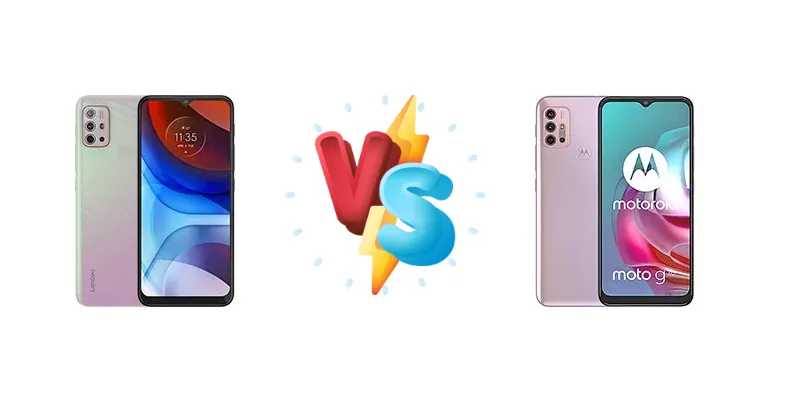
The Lenovo K13 Note and Motorola Moto G30 represent compelling options in the ultra-budget smartphone space. Both aim to deliver essential features at a low price point, but they diverge in their core hardware choices, particularly in their respective Qualcomm Snapdragon chipsets. This comparison dissects those differences, and others, to determine which device offers the best value.
🏆 Quick Verdict
For most users, the Motorola Moto G30 emerges as the better choice. Its Snapdragon 662 chipset provides a noticeable performance uplift over the K13 Note’s Snapdragon 460, making it more responsive for everyday tasks and light gaming. While both offer similar battery endurance, the G30’s faster charging capabilities add convenience.
| Network |
|---|
| 2G bands | GSM 850 / 900 / 1800 / 1900 | GSM 850 / 900 / 1800 / 1900 |
| 3G bands | HSDPA 850 / 900 / 1900 / 2100 | HSDPA 850 / 900 / 1700(AWS) / 1900 / 2100 |
| 4G bands | LTE | 1, 2, 3, 5, 7, 8, 18, 19, 20, 26, 28, 38, 40, 41 - International |
| Speed | HSPA 42.2/5.76 Mbps, LTE Cat4 150/50 Mbps | HSPA 42.2/5.76 Mbps, LTE Cat4 150/50 Mbps |
| Technology | GSM / HSPA / LTE | GSM / HSPA / LTE |
| | - | 1, 2, 3, 4, 5, 7, 8, 20, 38, 40, 41 - India |
| Launch |
|---|
| Announced | 2021, June 22 | 2021, February 16 |
| Status | Available. Released 2021, June 22 | Available. Released 2021, March 17 |
| Body |
|---|
| Build | Glass front, plastic frame, plastic back | Glass front, plastic back, plastic frame |
| Dimensions | 165.2 x 75.7 x 9.1 mm (6.50 x 2.98 x 0.36 in) | 165.2 x 75.7 x 9.1 mm (6.50 x 2.98 x 0.36 in) |
| SIM | Nano-SIM + Nano-SIM | · Nano-SIM· Nano-SIM + Nano-SIM |
| Weight | 200 g (7.05 oz) | 200 g (7.05 oz) |
| | - | Water-repellent design |
| Display |
|---|
| Resolution | 720 x 1600 pixels, 20:9 ratio (~270 ppi density) | 720 x 1600 pixels, 20:9 ratio (~269 ppi density) |
| Size | 6.5 inches, 102.0 cm2 (~81.6% screen-to-body ratio) | 6.5 inches, 102.8 cm2 (~82.2% screen-to-body ratio) |
| Type | IPS LCD | IPS LCD, 90Hz |
| Platform |
|---|
| CPU | Octa-core (4x1.8 GHz Kryo 240 & 4x1.6 GHz Kryo 240) | Octa-core (4x2.0 GHz Kryo 260 Gold & 4x1.8 GHz Kryo 260 Silver) |
| Chipset | Qualcomm SM4250 Snapdragon 460 (11 nm) | Qualcomm SM6115 Snapdragon 662 (11 nm) |
| GPU | Adreno 610 | Adreno 610 |
| OS | Android 11 | Android 11, upgradable to Android 12 |
| Memory |
|---|
| Card slot | microSDXC (uses shared SIM slot) | microSDXC (uses shared SIM slot) |
| Internal | 128GB 4GB RAM | 64GB 4GB RAM, 128GB 4GB RAM, 128GB 6GB RAM |
| | - | eMMC 5.1 |
| Main Camera |
|---|
| Features | LED flash, HDR, panorama | LED flash, HDR, panorama |
| Quad | 48 MP, f/1.7, (wide), 1/2.0", 0.8µm, PDAF
8 MP, f/2.2, 118˚ (ultrawide), 1/4.0", 1.12µm
2 MP (macro)
Auxiliary lens | 64 MP, f/1.7, 26mm (wide), 1/1.97", 0.7µm, PDAF
8 MP, f/2.2, 118˚ (ultrawide), 1/4.0", 1.12µm
2 MP (macro)
Auxiliary lens |
| Video | 1080p@30fps | 1080p@30/60fps |
| Selfie camera |
|---|
| Features | HDR | HDR |
| Single | 8 MP, f/2.2, (wide), 1/4.0", 1.12µm | 13 MP, f/2.2, (wide), 1/3.1", 1.12µm |
| Video | 1080p@30fps | 1080p@30fps |
| Sound |
|---|
| 3.5mm jack | Yes | Yes |
| 35mm jack | Yes | Yes |
| Loudspeaker | Yes | Yes |
| Comms |
|---|
| Bluetooth | 5.0, A2DP, LE | 5.0, A2DP, LE |
| NFC | Yes | Yes (market/region dependent) |
| Positioning | GPS, GLONASS, GALILEO | GPS, GLONASS, GALILEO |
| Radio | FM radio | FM radio, RDS, recording |
| USB | USB Type-C 2.0 | USB Type-C 2.0, OTG |
| WLAN | Wi-Fi 802.11 a/b/g/n/ac, dual-band, Wi-Fi Direct | Wi-Fi 802.11 a/b/g/n/ac, dual-band, Wi-Fi Direct |
| Features |
|---|
| Sensors | Fingerprint (rear-mounted), accelerometer, gyro, proximity | Fingerprint (rear-mounted), accelerometer, gyro, proximity |
| Battery |
|---|
| Charging | 10W wired | 15W / 20W wired (market dependent) |
| Type | Li-Po 5000 mAh | Li-Po 5000 mAh |
| Misc |
|---|
| Colors | Aurora Gray, Pearl Sakura | Phantom Black (Dark Pearl), Pastel Sky |
| Models | - | XT2129-1, XT2129-2, PAML0000IN |
| Price | About 120 EUR | About 170 EUR |
| SAR | - | 1.11 W/kg (head) 1.32 W/kg (body) |
| Tests |
|---|
| Battery life | - |
Endurance rating 131h
|
| Camera | - |
Photo / Video |
| Display | - |
Contrast ratio: 1984:1 (nominal) |
| Loudspeaker | - |
-28.7 LUFS (Average)
|
| Performance | - |
AnTuTu: 170968 (v8)
GeekBench: 1265 (v5.1)
GFXBench: 13fps (ES 3.1 onscreen) |
Lenovo K13 Note
- Lowest possible price point
- Acceptable battery life
- Simple and straightforward user experience
- Significantly weaker performance
- Slow 10W charging
- Limited display brightness
Motorola Moto G30
- Noticeably faster performance
- Faster 15W/20W charging
- Brighter display for outdoor visibility
- Slightly higher price
- Camera performance likely similar to K13 Note
- Still a budget device with inherent limitations
Display Comparison
The Motorola Moto G30 boasts a measured peak brightness of 468 nits, a significant advantage over the Lenovo K13 Note, which lacks published brightness data. Both displays share a similar contrast ratio around 1975:1 to 1984:1, suggesting comparable color reproduction. However, the G30’s higher brightness translates to better visibility outdoors, a crucial factor for many users. The lack of detailed display specifications for the K13 Note makes a comprehensive comparison difficult, but the G30 clearly holds an advantage in usability.
Camera Comparison
Both devices feature 'Photo / Video' capabilities, but lack specific details regarding sensor size or image processing. Given the price bracket, expectations should be tempered. The absence of detailed camera specs makes a direct comparison challenging. However, the Moto G30’s slightly more powerful chipset may allow for faster image processing and potentially better low-light performance. It's likely both phones rely heavily on software algorithms to enhance image quality, and the 662's processing power could give the G30 an edge.
Performance
The core difference lies in the chipsets: the Lenovo K13 Note utilizes the Qualcomm SM4250 Snapdragon 460, while the Moto G30 features the SM6115 Snapdragon 662. The 662, with its Kryo 260 Gold and Silver cores clocked up to 2.0 GHz, represents a substantial performance improvement over the 460’s Kryo 240 cores at 1.8 GHz. This translates to faster app loading times, smoother multitasking, and a more enjoyable gaming experience on the Moto G30. While both are 11nm chips, the architectural improvements in the 662 are significant. The K13 Note will handle basic tasks, but the G30 offers a more fluid user experience.
Battery Life
Both the Lenovo K13 Note and Motorola Moto G30 achieve an endurance rating of 131 hours, indicating comparable battery life under similar usage conditions. However, the Moto G30 offers a charging advantage with support for 15W/20W wired charging (market dependent), while the K13 Note is limited to 10W. This faster charging capability significantly reduces the time required to replenish the battery, offering greater convenience for users who frequently need to top up their devices.
Buying Guide
Buy the Lenovo K13 Note if your primary need is absolute minimal cost and you prioritize a simple, no-frills experience. It’s suitable for users who primarily make calls, send texts, and occasionally browse the web. Buy the Motorola Moto G30 if you value smoother performance for social media, streaming, and casual gaming, and appreciate the added benefit of faster charging, even if it comes at a slightly higher price.
Frequently Asked Questions
❓ Will the Snapdragon 662 in the Moto G30 handle popular games like PUBG Mobile?
The Snapdragon 662 can run PUBG Mobile, but expect to play at medium settings to maintain a stable frame rate. It's not a gaming powerhouse, but it's significantly more capable than the Snapdragon 460 in the K13 Note for gaming.
❓ How long will it take to fully charge the Motorola Moto G30 with the 20W charger?
With a 20W charger, the Moto G30 should fully charge from 0% to 100% in approximately 1 hour and 45 minutes to 2 hours, depending on usage during charging. The K13 Note, limited to 10W, will take considerably longer.
❓ Is the camera on either phone good enough for casual social media photos?
Both phones will produce acceptable photos for casual social media use in good lighting conditions. However, don't expect exceptional detail or low-light performance. The Moto G30's slightly more powerful processor may offer a small advantage in image processing.
❓ Does the Lenovo K13 Note support fast charging at all?
No, the Lenovo K13 Note is limited to 10W wired charging. There is no support for faster charging protocols.