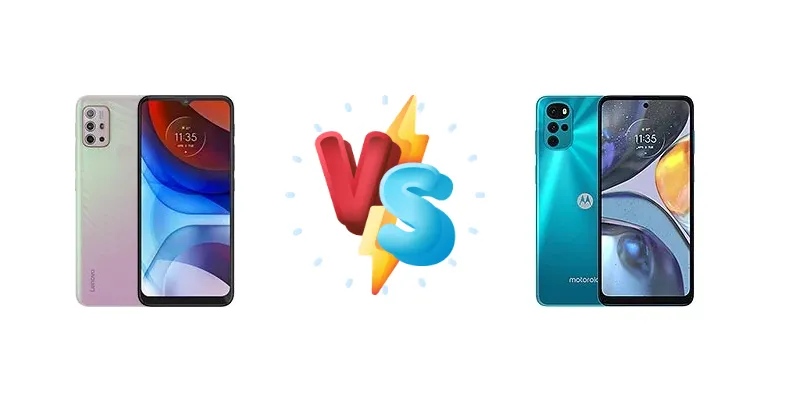
The Lenovo K13 Note and Motorola Moto G22 represent compelling options in the ultra-budget smartphone segment. While both aim to deliver essential smartphone functionality at a low price point, they diverge in their core hardware choices, particularly in their chipsets and charging capabilities. This comparison dissects these differences to determine which device offers the best value for specific user needs.
🏆 Quick Verdict
For the average user prioritizing consistent performance and a slightly more efficient processor, the Lenovo K13 Note is the better choice. However, the Motorola Moto G22’s faster charging (in India) and potentially more aggressive pricing make it a viable alternative for those who prioritize quick top-ups and are less demanding of sustained performance.
| Network |
|---|
| 2G bands | GSM 850 / 900 / 1800 / 1900 | GSM 850 / 900 / 1800 / 1900 |
| 3G bands | HSDPA 850 / 900 / 1900 / 2100 | HSDPA 850 / 900 / 1900 / 2100 |
| 4G bands | LTE | 1, 3, 5, 7, 8, 20, 38, 40, 41 |
| Speed | HSPA 42.2/5.76 Mbps, LTE Cat4 150/50 Mbps | HSPA 42.2/5.76 Mbps, LTE Cat4 150/50 Mbps |
| Technology | GSM / HSPA / LTE | GSM / HSPA / LTE |
| Launch |
|---|
| Announced | 2021, June 22 | 2022, March 04 |
| Status | Available. Released 2021, June 22 | Available. Released 2022, March 04 |
| Body |
|---|
| Build | Glass front, plastic frame, plastic back | Glass front, plastic frame, plastic back |
| Dimensions | 165.2 x 75.7 x 9.1 mm (6.50 x 2.98 x 0.36 in) | 164 x 75 x 8.5 mm (6.46 x 2.95 x 0.33 in) |
| SIM | Nano-SIM + Nano-SIM | · Nano-SIM· Nano-SIM + Nano-SIM |
| Weight | 200 g (7.05 oz) | 185 g (6.53 oz) |
| | - | Water-repellent design |
| Display |
|---|
| Resolution | 720 x 1600 pixels, 20:9 ratio (~270 ppi density) | 720 x 1600 pixels, 20:9 ratio (~268 ppi density) |
| Size | 6.5 inches, 102.0 cm2 (~81.6% screen-to-body ratio) | 6.5 inches, 103.5 cm2 (~84.2% screen-to-body ratio) |
| Type | IPS LCD | IPS LCD, 90Hz |
| Platform |
|---|
| CPU | Octa-core (4x1.8 GHz Kryo 240 & 4x1.6 GHz Kryo 240) | Octa-core (4x2.3 GHz Cortex-A53 & 4x1.8 GHz Cortex-A53) |
| Chipset | Qualcomm SM4250 Snapdragon 460 (11 nm) | Mediatek MT6765V/CB Helio G37 (12 nm) |
| GPU | Adreno 610 | PowerVR GE8320 |
| OS | Android 11 | Android 12 |
| Memory |
|---|
| Card slot | microSDXC (uses shared SIM slot) | microSDXC (dedicated slot) |
| Internal | 128GB 4GB RAM | 64GB 4GB RAM, 128GB 4GB RAM |
| Main Camera |
|---|
| Features | LED flash, HDR, panorama | LED flash, HDR, panorama |
| Quad | 48 MP, f/1.7, (wide), 1/2.0", 0.8µm, PDAF
8 MP, f/2.2, 118˚ (ultrawide), 1/4.0", 1.12µm
2 MP (macro)
Auxiliary lens | 50 MP, f/1.8, (wide), 0.64µm, PDAF
8 MP, f/2.2, 118˚ (ultrawide), 1/4.0", 1.12µm
2 MP (macro)
Auxiliary lens |
| Video | 1080p@30fps | 1080p@30fps |
| Selfie camera |
|---|
| Features | HDR | HDR |
| Single | 8 MP, f/2.2, (wide), 1/4.0", 1.12µm | 16 MP, f/2.5, (wide), 1.0µm |
| Video | 1080p@30fps | 1080p@30fps |
| Sound |
|---|
| 3.5mm jack | Yes | Yes |
| 35mm jack | Yes | Yes |
| Loudspeaker | Yes | Yes |
| Comms |
|---|
| Bluetooth | 5.0, A2DP, LE | 5.0, A2DP, LE |
| NFC | Yes | Yes (market/region dependent) |
| Positioning | GPS, GLONASS, GALILEO | GPS, GLONASS, GALILEO |
| Radio | FM radio | Unspecified |
| USB | USB Type-C 2.0 | USB Type-C 2.0 |
| WLAN | Wi-Fi 802.11 a/b/g/n/ac, dual-band, Wi-Fi Direct | Wi-Fi 802.11 a/b/g/n/ac, dual-band, Wi-Fi Direct |
| Features |
|---|
| Sensors | Fingerprint (rear-mounted), accelerometer, gyro, proximity | Fingerprint (side-mounted), accelerometer, gyro, proximity, compass |
| Battery |
|---|
| Charging | 10W wired | 20W wired (India)
15W wired (Global) |
| Type | Li-Po 5000 mAh | Li-Po 5000 mAh |
| Misc |
|---|
| Colors | Aurora Gray, Pearl Sakura | Pearl White, Iceberg Blue, Cosmic Black, Mint Green |
| Models | - | XT2231-1, XT2231-2, XT2231-5 |
| Price | About 120 EUR | About 120 EUR |
Lenovo K13 Note
- More efficient Snapdragon 460 chipset
- Potentially better sustained performance
- Stable and reliable Qualcomm platform
- Slower 10W charging
- Likely less aggressive pricing compared to Moto G22
Motorola Moto G22
- Faster 20W charging (India)
- Potentially higher peak CPU performance
- Competitive pricing
- Less efficient MediaTek Helio G37 chipset
- Older Cortex-A53 CPU architecture
Display Comparison
Neither device boasts a standout display. Both likely utilize LCD panels, common in this price bracket. The key difference lies under the hood. Without specific display specs, we can infer that the Moto G22’s slightly newer chipset *may* support a higher refresh rate, though this is not confirmed. Color accuracy and peak brightness are likely similar, targeting basic readability rather than media consumption excellence. Bezels are expected to be substantial on both.
Camera Comparison
Camera performance is likely to be similar, with both phones relying on budget sensors. Without detailed sensor information, it’s safe to assume both will struggle in low-light conditions. The presence of a 2MP macro lens on the Moto G22 is a common, but often underwhelming, addition. Image processing will likely be the differentiating factor, with Motorola’s software potentially offering more aggressive sharpening and color boosting. Expect both to deliver acceptable results in good lighting, but don’t anticipate flagship-level image quality.
Performance
The core battleground is the chipset. The Lenovo K13 Note’s Qualcomm Snapdragon 460 (11nm) is a known quantity, offering a balanced approach to performance and efficiency. Its octa-core configuration, split between 1.8GHz and 1.6GHz Kryo 240 cores, provides adequate power for daily tasks. The Motorola Moto G22 counters with the MediaTek Helio G37 (12nm). While the G37’s cores clock higher – 2.3GHz and 1.8GHz Cortex-A53 – the 12nm process is less efficient than the Snapdragon’s 11nm node. This means the G37 may deliver slightly better peak performance in short bursts, but the K13 Note is likely to maintain performance for longer under sustained load and exhibit better thermal management. The G37’s Cortex-A53 cores are also older architecture than the Kryo 240 cores, impacting per-clock performance.
Battery Life
Battery capacity is not specified, but both phones likely house around a 5000mAh battery, standard for this segment. The crucial difference is charging speed. The Motorola Moto G22 supports 20W wired charging in India, a significant advantage over the Lenovo K13 Note’s 10W charging. Globally, the Moto G22 drops to 15W. This means the Moto G22 can potentially top up much faster, reducing downtime. However, the Snapdragon 460’s efficiency may offset some of this advantage, resulting in comparable overall battery life despite the slower charging on the K13 Note.
Buying Guide
Buy the Lenovo K13 Note if you need a phone for everyday tasks like browsing, social media, and light messaging, and value a chipset known for its stability and power efficiency. Buy the Motorola Moto G22 if you frequently find yourself needing to quickly recharge your phone and are willing to trade a small amount of processing power for that convenience, especially if you are in India where 20W charging is available.
Frequently Asked Questions
❓ Will the Motorola Moto G22 overheat during extended gaming sessions?
The MediaTek Helio G37, while capable of higher clock speeds, is built on a less efficient 12nm process. This means it's more prone to thermal throttling during prolonged gaming. While it can handle casual gaming, demanding titles may experience performance drops as the phone heats up. The Lenovo K13 Note's Snapdragon 460 is likely to maintain more consistent performance over longer periods.
❓ Is the 20W charging on the Moto G22 (India) a significant advantage over the K13 Note's 10W charging?
Yes, it is. 20W charging can significantly reduce charging times, potentially taking a phone from 0% to 50% in around 30-45 minutes, compared to over an hour with 10W charging. This is particularly beneficial for users who frequently need to top up their battery throughout the day. However, the global version of the Moto G22 only supports 15W charging, reducing this advantage.
❓ Which phone is better for multitasking?
The Lenovo K13 Note, with its Snapdragon 460, is likely to handle multitasking slightly better. The Snapdragon 460's more modern architecture and efficient power management contribute to smoother app switching and less lag when running multiple applications simultaneously.