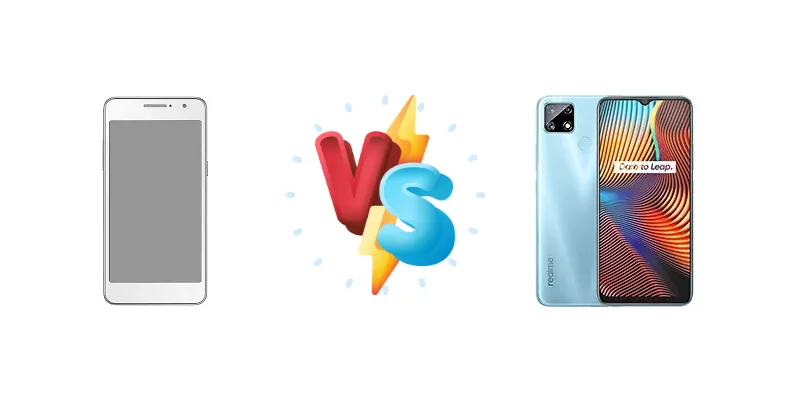
The sub-$150 smartphone market is fiercely competitive. Both the Lenovo K12 and Realme 7i (Global) aim to deliver essential features at an accessible price point. However, they take different approaches to achieving this, with the Realme 7i prioritizing faster charging and a more powerful chipset, while the Lenovo K12 focuses on a more basic, streamlined experience. This comparison will dissect their key differences to help you choose the right device.
🏆 Quick Verdict
For most users, the Realme 7i emerges as the better choice. Its Helio G85 chipset offers a noticeable performance uplift over the K12’s Helio G25, and the 18W charging significantly reduces downtime. While the K12 is a functional device, the 7i provides a more responsive and convenient user experience.
| Network |
|---|
| 2G bands | GSM 850 / 900 / 1800 / 1900 | GSM 850 / 900 / 1800 / 1900 |
| 3G bands | HSDPA 850 / 900 / 1900 / 2100 | HSDPA 850 / 900 / 1700(AWS) / 1900 / 2100 |
| 4G bands | LTE | 1, 2, 3, 4, 5, 7, 8, 20, 28, 38, 40, 41 |
| Speed | HSPA 42.2/5.76 Mbps, LTE Cat4 150/50 Mbps | HSPA, LTE |
| Technology | GSM / HSPA / LTE | GSM / HSPA / LTE |
| Launch |
|---|
| Announced | Not announced yet | 2020, December 22. Released 2020, December 23 |
| Status | Cancelled | Discontinued |
| Body |
|---|
| Build | Glass front, plastic frame, plastic back | - |
| Dimensions | 164.9 x 75.7 x 8.9 mm (6.49 x 2.98 x 0.35 in) | 164.5 x 75.9 x 9.8 mm (6.48 x 2.99 x 0.39 in) |
| SIM | Nano-SIM + Nano-SIM | Nano-SIM + Nano-SIM |
| Weight | 180 g (6.35 oz) | 208 g (7.34 oz) |
| | Water-repellent coating | - |
| Display |
|---|
| Resolution | 720 x 1600 pixels, 20:9 ratio (~270 ppi density) | 720 x 1600 pixels, 20:9 ratio (~270 ppi density) |
| Size | 6.5 inches, 102.0 cm2 (~81.7% screen-to-body ratio) | 6.5 inches, 102.0 cm2 (~81.7% screen-to-body ratio) |
| Type | IPS LCD | IPS LCD, 450 nits (typ), 560 nits (peak) |
| Platform |
|---|
| CPU | Octa-core (4x2.0 GHz Cortex-A53 & 4x1.5 GHz Cortex-A53) | Octa-core (2x2.0 GHz Cortex-A75 & 6x1.8 GHz Cortex-A55) |
| Chipset | Mediatek MT6762G Helio G25 (12 nm) | Mediatek MT6769Z Helio G85 (12 nm) |
| GPU | PowerVR GE8320 | Mali-G52 MC2 |
| OS | Android 10 | Android 10, Realme UI |
| Memory |
|---|
| Card slot | microSDXC (uses shared SIM slot) | microSDXC (dedicated slot) |
| Internal | 32GB 2GB RAM | 64GB 4GB RAM |
| | eMMC 5.1 | eMMC 5.1 |
| Main Camera |
|---|
| Dual | 48 MP, f/1.7, 26mm (wide), 1/2.0", 0.8µm, PDAF
2 MP (macro) | - |
| Features | LED flash, HDR, panorama | LED flash, HDR, panorama |
| Triple | - | 48 MP, f/1.8, 26mm (wide), 1/2.0", 0.8µm, PDAF
8 MP, f/2.3, 16mm, 119˚ (ultrawide), 1/4.0", 1.12µm
2 MP (macro) |
| Video | 1080p@30fps | 1080p@30/60fps |
| Selfie camera |
|---|
| Features | HDR | HDR, panorama |
| Single | 5 MP, f/2.2 | 8 MP, f/2.0, 26mm (wide), 1/4.0", 1.12µm |
| Video | 1080p@30fps | 1080p@30fps |
| Sound |
|---|
| 3.5mm jack | Yes | Yes |
| 35mm jack | Yes | Yes |
| Loudspeaker | Yes | Yes |
| Comms |
|---|
| Bluetooth | 5.0, A2DP, LE | 5.0, A2DP, LE, aptX HD |
| NFC | No | No |
| Positioning | GPS, GLONASS, GALILEO | GPS, GLONASS, BDS |
| Radio | FM radio | FM radio |
| USB | USB Type-C 2.0 | USB Type-C 2.0, OTG |
| WLAN | Wi-Fi 802.11 b/g/n | Wi-Fi 802.11 a/b/g/n/ac, dual-band, Wi-Fi Direct |
| Features |
|---|
| Sensors | Fingerprint (rear-mounted), accelerometer, proximity | Fingerprint (rear-mounted), accelerometer, proximity, compass |
| Battery |
|---|
| Charging | 10W wired | 18W wired
5W reverse wired |
| Type | Li-Po 4000 mAh | 6000 mAh |
| Misc |
|---|
| Colors | Mineral Gray, Aqua Blue | Glory Silver, Victory Blue |
| Models | XT2095-4 | - |
| Price | - | About 190 EUR |
Lenovo K12
- Potentially lower price point
- Simple and straightforward user experience
- Functional for basic tasks
- Significantly weaker performance
- Slow 10W charging
- Less responsive user interface
Realme 7i (Global)
- Faster Helio G85 processor
- 18W fast charging
- More responsive gaming experience
- Slightly higher price
- May not have the absolute longest battery life (offset by faster charging)
- Camera performance is still limited by the budget segment
Display Comparison
Neither device boasts a standout display. Both utilize standard LCD panels, and detailed specifications like resolution and peak brightness are not provided. However, the Realme 7i’s slightly larger market positioning suggests a potentially more refined panel, though this is speculative. Bezels are likely comparable, given the similar price brackets. Color accuracy is expected to be standard for this segment, prioritizing saturation over fidelity.
Camera Comparison
Camera performance is likely to be similar in real-world usage, as both phones target the budget segment. Detailed sensor information is lacking, but the Realme 7i’s positioning suggests a potentially more refined image processing pipeline. The absence of Optical Image Stabilization (OIS) on either device means low-light photography will be challenging. Focusing on the main sensor is crucial; any secondary 2MP macro or depth sensors are unlikely to deliver significant value. The G85’s ISP (Image Signal Processor) may offer slightly better noise reduction and dynamic range.
Performance
The core difference lies in the chipsets. The Realme 7i’s MediaTek Helio G85 is a significant step up from the Lenovo K12’s Helio G25. The G85 features two Cortex-A75 cores clocked at 2.0 GHz alongside six Cortex-A55 cores at 1.8 GHz, offering a substantial boost in single-core and multi-core performance compared to the K12’s four Cortex-A53 cores at 2.0 GHz and four at 1.5 GHz. This translates to smoother app launches, faster multitasking, and a more enjoyable gaming experience on the 7i. The G85’s GPU is also more capable, allowing for higher frame rates in demanding games. While both use 12nm process technology, the architectural improvements in the G85 provide a clear advantage.
Battery Life
Both phones likely feature similar battery capacities (estimated around 5000mAh, based on market trends), but the Realme 7i’s 18W wired charging is a game-changer. The Lenovo K12 is limited to 10W charging, resulting in significantly longer charge times. This means the 7i can go from 0-100% much faster, minimizing downtime. While a larger battery capacity is desirable, the convenience of faster charging often outweighs a modest increase in overall runtime, especially for users who frequently use their phones throughout the day.
Buying Guide
Buy the Lenovo K12 if you prioritize absolute simplicity and are on the tightest of budgets, needing a functional phone for basic communication and light tasks. Buy the Realme 7i (Global) if you value faster performance for gaming and streaming, and appreciate the convenience of quicker charging – even if it means spending a little more upfront.
Frequently Asked Questions
❓ Will the Realme 7i handle demanding games like PUBG Mobile smoothly?
The Helio G85 in the Realme 7i is capable of running PUBG Mobile at medium settings with reasonable frame rates. While it won't deliver a flagship-level experience, it provides a significantly smoother gaming experience compared to the Lenovo K12’s Helio G25, which will struggle with higher settings.
❓ How long will it take to fully charge the Realme 7i with the 18W charger?
With the included 18W charger, the Realme 7i should fully charge from 0% to 100% in approximately 2-2.5 hours. This is considerably faster than the Lenovo K12, which will take upwards of 4-5 hours with its 10W charger.
❓ Is the difference in CPU architecture (Cortex-A75 vs A53) noticeable in everyday use?
Yes, the difference is quite noticeable. The Cortex-A75 cores in the Realme 7i’s Helio G85 are significantly more powerful than the Cortex-A53 cores in the Lenovo K12’s Helio G25. This translates to faster app loading times, smoother scrolling, and a more responsive overall user experience, especially when multitasking.