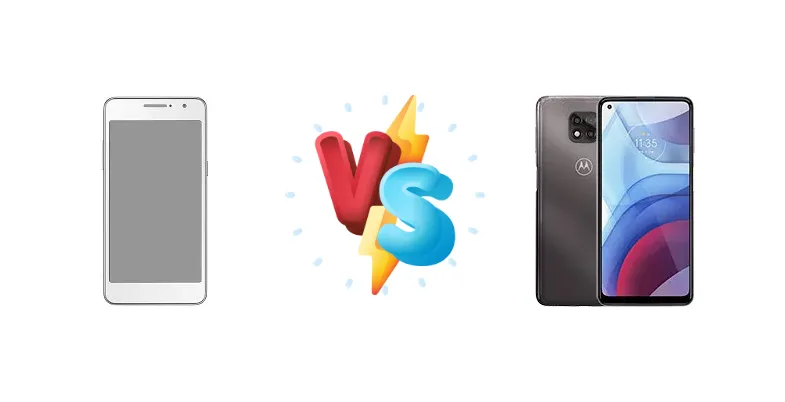
The Lenovo K12 and Motorola Moto G Power (2021) represent two compelling options in the crowded budget smartphone market. Both prioritize long battery life, but they diverge significantly in their core processing power. This comparison dissects the key differences, focusing on the chipset architecture and real-world implications for users.
🏆 Quick Verdict
For the average user prioritizing consistent performance and future-proofing, the Motorola Moto G Power (2021) is the better choice. Its Snapdragon 662, built on an 11nm process, offers a noticeable efficiency and performance advantage over the Lenovo K12’s Helio G25, despite the K12’s slightly lower price point.
| Network |
|---|
| 2G bands | GSM 850 / 900 / 1800 / 1900 | GSM 850 / 900 / 1800 / 1900 |
| 3G bands | HSDPA 850 / 900 / 1900 / 2100 | HSDPA 850 / 900 / 1700(AWS) / 1900 / 2100 |
| 4G bands | LTE | 1, 2, 3, 4, 5, 7, 8, 12, 13, 14, 17, 25, 26, 29, 30, 38, 41, 66, 71 |
| Speed | HSPA 42.2/5.76 Mbps, LTE Cat4 150/50 Mbps | HSPA, LTE |
| Technology | GSM / HSPA / LTE | GSM / CDMA / HSPA / EVDO / LTE |
| | - | CDMA2000 1xEV-DO |
| Launch |
|---|
| Announced | Not announced yet | 2021, January 08 |
| Status | Cancelled | Available. Released 2021, January 14 |
| Body |
|---|
| Build | Glass front, plastic frame, plastic back | Glass front, plastic back, plastic frame |
| Dimensions | 164.9 x 75.7 x 8.9 mm (6.49 x 2.98 x 0.35 in) | 165.3 x 75.9 x 9.5 mm (6.51 x 2.99 x 0.37 in) |
| SIM | Nano-SIM + Nano-SIM | Nano-SIM |
| Weight | 180 g (6.35 oz) | 206.5 g (7.30 oz) |
| | Water-repellent coating | Water-repellent coating |
| Display |
|---|
| Resolution | 720 x 1600 pixels, 20:9 ratio (~270 ppi density) | 720 x 1600 pixels, 20:9 ratio (~266 ppi density) |
| Size | 6.5 inches, 102.0 cm2 (~81.7% screen-to-body ratio) | 6.6 inches, 105.2 cm2 (~83.8% screen-to-body ratio) |
| Type | IPS LCD | IPS LCD |
| Platform |
|---|
| CPU | Octa-core (4x2.0 GHz Cortex-A53 & 4x1.5 GHz Cortex-A53) | Octa-core (4x2.0 GHz Kryo 260 Gold & 4x1.8 GHz Kryo 260 Silver) |
| Chipset | Mediatek MT6762G Helio G25 (12 nm) | Qualcomm SM6115 Snapdragon 662 (11 nm) |
| GPU | PowerVR GE8320 | Adreno 610 |
| OS | Android 10 | Android 10 |
| Memory |
|---|
| Card slot | microSDXC (uses shared SIM slot) | microSDXC (dedicated slot) |
| Internal | 32GB 2GB RAM | 32GB 3GB RAM, 64GB 4GB RAM |
| | eMMC 5.1 | eMMC 5.1 |
| Main Camera |
|---|
| Dual | 48 MP, f/1.7, 26mm (wide), 1/2.0", 0.8µm, PDAF
2 MP (macro) | - |
| Features | LED flash, HDR, panorama | LED flash, HDR, panorama |
| Triple | - | 48 MP, f/1.7, (wide), 1/2.0", 0.8µm, PDAF
2 MP (macro)
Auxiliary lens |
| Video | 1080p@30fps | 1080p@30/60fps, gyro-EIS |
| Selfie camera |
|---|
| Features | HDR | HDR |
| Single | 5 MP, f/2.2 | 8 MP, f/2.0, 1.12µm |
| Video | 1080p@30fps | 1080p@30fps, gyro-EIS |
| Sound |
|---|
| 3.5mm jack | Yes | Yes |
| 35mm jack | Yes | Yes |
| Loudspeaker | Yes | Yes |
| Comms |
|---|
| Bluetooth | 5.0, A2DP, LE | 5.0, A2DP, LE |
| NFC | No | No |
| Positioning | GPS, GLONASS, GALILEO | GPS, GLONASS, GALILEO |
| Radio | FM radio | FM radio |
| USB | USB Type-C 2.0 | USB Type-C 2.0 |
| WLAN | Wi-Fi 802.11 b/g/n | Wi-Fi 802.11 a/b/g/n/ac, dual-band, Wi-Fi Direct |
| Features |
|---|
| Sensors | Fingerprint (rear-mounted), accelerometer, proximity | Fingerprint (side-mounted), accelerometer, gyro, proximity, compass, barometer |
| Battery |
|---|
| Charging | 10W wired | 15W wired |
| Type | Li-Po 4000 mAh | Li-Po 5000 mAh |
| Misc |
|---|
| Colors | Mineral Gray, Aqua Blue | Flash Gray, Polar Silver |
| Models | XT2095-4 | - |
| Price | - | About 60 EUR |
Lenovo K12
- Potentially lower price point
- May offer slightly larger battery capacity (unconfirmed)
- Simple and straightforward user experience
- Less powerful and efficient chipset
- Slower charging speed (10W)
- Likely slower app loading and multitasking
Motorola Moto G Power (2021)
- More powerful and efficient Snapdragon 662 chipset
- Faster 15W wired charging
- Smoother multitasking and app performance
- Potentially slightly higher price
- May have a slightly smaller battery capacity (unconfirmed)
- Software updates may be less frequent than some competitors
Display Comparison
Neither device boasts a standout display. Both likely utilize LCD panels, common in this price bracket. While specific details like peak brightness and color gamut are unavailable, the focus here is on processing power, not visual fidelity. Bezels are expected to be substantial on both, prioritizing cost savings over an immersive viewing experience. Color accuracy will likely be standard for the segment.
Camera Comparison
Camera performance is likely to be similar, with both phones targeting the entry-level segment. Without specific sensor size or aperture information, it’s difficult to make definitive claims. However, Qualcomm’s image signal processor (ISP) within the Snapdragon 662 generally offers superior image processing capabilities compared to MediaTek’s ISP in the Helio G25. This translates to better dynamic range, noise reduction, and overall image quality, particularly in challenging lighting conditions. The prevalence of 2MP macro lenses on both devices suggests limited utility; these sensors are often included for marketing purposes rather than genuine photographic benefit.
Performance
The core difference lies in the chipsets. The Motorola Moto G Power (2021) features the Qualcomm Snapdragon 662 (11nm), utilizing Qualcomm’s Kryo 260 cores. This architecture, while not flagship-level, is demonstrably more efficient than the MediaTek Helio G25 (12nm) in the Lenovo K12. The 11nm process node of the Snapdragon 662 translates to lower power consumption for similar tasks. While both CPUs feature octa-core configurations with similar clock speeds (2.0 GHz for the Snapdragon’s Gold cores vs. 2.0 GHz for the Helio’s Cortex-A53 cores), the Snapdragon’s core design and manufacturing process provide a performance edge. This impacts app loading times, multitasking smoothness, and overall system responsiveness.
Battery Life
Both phones prioritize battery life, but achieve it through different means. The Moto G Power (2021) supports 15W wired charging, while the K12 is limited to 10W. While the K12 might have a slightly larger battery capacity (spec not provided), the Snapdragon 662’s superior power efficiency means the Moto G Power will likely offer comparable, if not better, real-world battery endurance. The faster charging speed of the Moto G Power also provides a convenience advantage, reducing the time spent tethered to an outlet.
Buying Guide
Buy the Lenovo K12 if your primary need is absolute affordability and you primarily use your phone for basic tasks like calls, texts, and light social media. The Helio G25 will suffice for these workloads. Buy the Motorola Moto G Power (2021) if you value smoother multitasking, occasional gaming, and a more responsive user experience. The Snapdragon 662 provides a more robust platform for demanding applications and offers better long-term usability.
Frequently Asked Questions
❓ Will the Helio G25 in the Lenovo K12 struggle with popular games like PUBG Mobile?
The Helio G25 is an entry-level chipset and will likely struggle to deliver a smooth gaming experience in demanding titles like PUBG Mobile, even at lower settings. Expect noticeable frame drops and potential lag. The Snapdragon 662 in the Moto G Power (2021) will provide a significantly better, though still not optimal, gaming experience.
❓ How much faster is the charging on the Motorola Moto G Power (2021) compared to the Lenovo K12?
The Moto G Power (2021)'s 15W charging is 50% faster than the K12's 10W charging. While neither is exceptionally fast by modern standards, the Moto G Power will significantly reduce the time required to replenish the battery, offering a more convenient experience for users who frequently need to top up their device.
❓ Does the Snapdragon 662 offer any advantages in terms of software updates compared to the Helio G25?
Historically, Qualcomm-powered devices tend to receive more consistent and timely software updates compared to those using MediaTek chipsets. While Motorola's update track record isn't perfect, the Moto G Power (2021) is more likely to receive security patches and potentially even a major Android version update compared to the Lenovo K12.