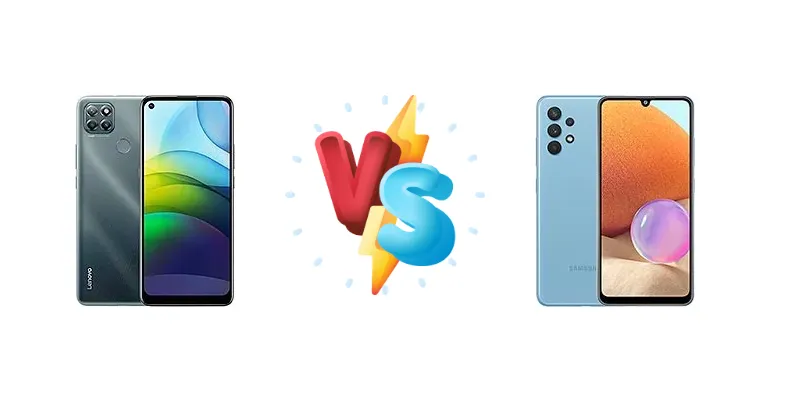
The Lenovo K12 Pro and Samsung Galaxy A32 represent compelling options in the crowded budget smartphone market. While both aim to deliver essential features at an accessible price point, they take different approaches to achieving this. The K12 Pro prioritizes charging speed and a newer Qualcomm chipset, while the A32 focuses on display brightness and Samsung’s established brand recognition. This comparison will dissect their key differences to determine which device offers the best value.
🏆 Quick Verdict
For the average user prioritizing consistent performance and faster charging, the Lenovo K12 Pro emerges as the better choice. Its Snapdragon 662 chipset, while not a powerhouse, offers a more refined experience than the MediaTek Helio G80 in the A32, and the 20W charging significantly reduces downtime. However, the A32’s brighter display is a notable advantage for outdoor visibility.
| Network |
|---|
| 2G bands | GSM 850 / 900 / 1800 / 1900 | GSM 850 / 900 / 1800 / 1900 |
| 3G bands | HSDPA 850 / 900 / 1700(AWS) / 1900 / 2100 | HSDPA 850 / 900 / 1900 / 2100 |
| 4G bands | 1, 3, 4, 5, 7, 8, 18, 19, 20, 26, 28, 38, 39, 40, 41 | 1, 2, 3, 5, 7, 8, 20, 28, 38, 40, 41 |
| Speed | HSPA, LTE | HSPA, LTE |
| Technology | GSM / HSPA / LTE | GSM / HSPA / LTE |
| Launch |
|---|
| Announced | 2020, December 09. Released 2020, December 12 | 2021, February 25 |
| Status | Discontinued | Available. Released 2021, February 25 |
| Body |
|---|
| Build | - | Glass front (Gorilla Glass 5), plastic frame, plastic back |
| Dimensions | 172.1 x 76.8 x 9.7 mm (6.78 x 3.02 x 0.38 in) | 158.9 x 73.6 x 8.4 mm (6.26 x 2.90 x 0.33 in) |
| SIM | · Nano-SIM· Nano-SIM + Nano-SIM | · Nano-SIM· Nano-SIM + Nano-SIM |
| Weight | 221 g (7.80 oz) | 184 g (6.49 oz) |
| | Water-repellent coating | - |
| Display |
|---|
| Protection | - | Corning Gorilla Glass 5 |
| Resolution | 720 x 1640 pixels (~263 ppi density) | 1080 x 2400 pixels, 20:9 ratio (~411 ppi density) |
| Size | 6.8 inches, 109.8 cm2 (~83.1% screen-to-body ratio) | 6.4 inches, 98.9 cm2 (~84.6% screen-to-body ratio) |
| Type | IPS LCD | Super AMOLED, 90Hz, 800 nits (HBM) |
| Platform |
|---|
| CPU | Octa-core (4x2.0 GHz Kryo 260 Gold & 4x1.8 GHz Kryo 260 Silver) | Octa-core (2x2.0 GHz Cortex-A75 & 6x1.8 GHz Cortex-A55) |
| Chipset | Qualcomm SM6115 Snapdragon 662 (11 nm) | Mediatek MT6769V/CU Helio G80 (12 nm) |
| GPU | Adreno 610 | Mali-G52 MC2 |
| OS | Android 10 | Android 11, upgradable to Android 13, One UI 5 |
| Memory |
|---|
| Card slot | microSDXC (uses shared SIM slot) | microSDXC (dedicated slot) |
| Internal | 64GB 4GB RAM, 128GB 4GB RAM | 64GB 4GB RAM, 64GB 6GB RAM, 128GB 4GB RAM, 128GB 6GB RAM, 128GB 8GB RAM |
| Main Camera |
|---|
| Features | LED flash, HDR, panorama | LED flash, panorama, HDR |
| Quad | - | 64 MP, f/1.8, 26mm (wide), PDAF
8 MP, f/2.2, 123˚, (ultrawide), 1/4.0", 1.12µm
5 MP (macro)
Auxiliary lens |
| Single | - | 20 MP, f/2.2, (wide) |
| Triple | 64 MP, f/1.8, 26mm (wide), 1/1.97", 0.7µm, PDAF
2 MP (macro)
Auxiliary lens | - |
| Video | 1080p@30/60fps | 1080p@30fps |
| Selfie camera |
|---|
| Features | HDR | - |
| Single | 16 MP, f/2.2, 1.0µm | 20 MP, f/2.2, (wide) |
| Video | 1080p@30fps | 1080p@30fps |
| Sound |
|---|
| 3.5mm jack | Yes | Yes |
| 35mm jack | Yes | Yes |
| Loudspeaker | Yes | Yes |
| Comms |
|---|
| Bluetooth | 5.0, A2DP, LE | 5.0, A2DP, LE |
| NFC | Yes | Yes (market/region dependent) |
| Positioning | GPS, GLONASS, GALILEO | GPS, GLONASS, BDS, GALILEO |
| Radio | FM radio | FM radio, RDS, recording |
| USB | USB Type-C 2.0, OTG | USB Type-C 2.0, OTG |
| WLAN | Wi-Fi 802.11 a/b/g/n/ac, dual-band, Wi-Fi Direct | Wi-Fi 802.11 a/b/g/n/ac, dual-band, Wi-Fi Direct |
| Features |
|---|
| Sensors | Fingerprint (rear-mounted), accelerometer, proximity | Fingerprint (under display, optical), accelerometer, gyro, compass |
| | - | Virtual proximity sensing |
| Battery |
|---|
| Charging | 20W wired
2.5W reverse wired | 15W wired |
| Type | Li-Po 6000 mAh | Li-Ion 5000 mAh |
| Misc |
|---|
| Colors | Electric Violet, Metallic Sage | Awesome Black, Awesome White, Awesome Blue, Awesome Violet |
| Models | XT2091-8, XT2091-7 | SM-A325F, SM-A325F/DS, SM-A325M, SM-A325N |
| Price | About 130 EUR | € 124.99 / £ 89.38 |
| SAR EU | - | 0.45 W/kg (head) 1.30 W/kg (body) |
| Tests |
|---|
| Battery life | - |
Endurance rating 119h
|
| Camera | - |
Photo / Video |
| Display | - |
Contrast ratio: Infinite (nominal) |
| Loudspeaker | - |
-30.3 LUFS (Below average)
|
| Performance | - |
AnTuTu: 286666 (v8)
GeekBench: 1277 (v5.1)
GFXBench: 8.1fps (ES 3.1 onscreen) |
Lenovo K12 Pro
- Faster 20W charging for quicker top-ups
- More efficient Snapdragon 662 chipset
- 2.5W reverse wired charging for accessories
- Display brightness likely lower than the A32
- Camera details are unknown, potentially limiting image quality
Samsung Galaxy A32
- Brighter 814 nit display for excellent outdoor visibility
- Samsung brand recognition and software experience
- Potentially better camera image processing
- Slower 15W charging
- Less efficient MediaTek Helio G80 chipset
- No reverse charging capability
Display Comparison
The Samsung Galaxy A32 boasts a significant advantage in display brightness, reaching a measured 814 nits. This makes it considerably more usable in direct sunlight compared to the Lenovo K12 Pro, which lacks published brightness data but is expected to be lower. While the A32’s contrast ratio is listed as ‘Infinite (nominal)’ – a common marketing term – the K12 Pro’s panel characteristics are unknown. Both phones likely utilize LCD technology given their price points, meaning color accuracy and viewing angles may be similar, but the A32’s brightness is a clear win for outdoor users.
Camera Comparison
Both devices feature ‘Photo / Video’ capabilities, but lack specific details regarding sensor size or image processing. Given the budget nature of both phones, image quality will likely be comparable in good lighting conditions. However, the absence of Optical Image Stabilization (OIS) on either device suggests low-light performance will be limited. The A32’s camera system is likely to lean towards Samsung’s signature vibrant color processing, while the K12 Pro’s image style is less predictable. Without detailed sensor specifications, a definitive camera winner is difficult to determine, but the A32’s brand reputation for camera software may give it a slight edge.
Performance
The Lenovo K12 Pro’s Qualcomm Snapdragon 662 (11nm) and the Samsung Galaxy A32’s MediaTek Helio G80 (12nm) represent a clash of architectures. The Snapdragon 662, built on an 11nm process, generally offers better power efficiency and sustained performance than the 12nm Helio G80. While both are octa-core CPUs, the Snapdragon utilizes a Kryo 260 core configuration (4x2.0 GHz Gold & 4x1.8 GHz Silver) optimized for a balance of power and efficiency, whereas the Helio G80 employs Cortex-A75 (2x2.0 GHz) and Cortex-A55 (6x1.8 GHz) cores. This translates to smoother multitasking and potentially better gaming performance on the K12 Pro, despite the A32’s focus on gaming with its Helio G80.
Battery Life
Interestingly, both the Lenovo K12 Pro and Samsung Galaxy A32 share an endurance rating of 119 hours, suggesting similar real-world battery life despite potentially different battery capacities (not specified in the provided data). However, the K12 Pro’s 20W wired charging significantly outperforms the A32’s 15W charging. This means the K12 Pro can replenish its battery much faster, reducing downtime. The K12 Pro also offers 2.5W reverse wired charging, a feature absent on the A32, allowing it to top up accessories like earbuds.
Buying Guide
Buy the Lenovo K12 Pro if you need a phone that can reliably handle daily tasks and benefit from quicker charging times, making it ideal for users who are constantly on the go. Buy the Samsung Galaxy A32 if you prioritize a brighter screen for outdoor use and value the Samsung ecosystem and brand reputation, even if it means sacrificing some processing power and charging speed.
Frequently Asked Questions
❓ Does the MediaTek Helio G80 in the Galaxy A32 tend to overheat during prolonged gaming sessions?
The Helio G80 is known to throttle under sustained load, meaning performance can decrease over time during extended gaming. While it's capable of running many games, users may experience frame drops or reduced graphics settings to mitigate overheating. The Snapdragon 662 in the K12 Pro is generally more efficient and less prone to throttling.
❓ Is the 2MP macro camera on either phone actually useful for taking detailed close-up photos?
Generally, 2MP macro cameras on budget phones offer limited detail and image quality. The small sensor size and lack of autofocus result in soft, often blurry images. They are more of a marketing feature than a genuinely useful camera tool. Don't base your purchase decision on the presence of a 2MP macro lens.
❓ How long does it realistically take to fully charge the Lenovo K12 Pro from 0% to 100% with the included 20W charger?
With 20W charging, the Lenovo K12 Pro should fully charge from 0% to 100% in approximately 1 hour and 45 minutes to 2 hours, depending on background app activity and battery health. This is significantly faster than the Samsung Galaxy A32's 15W charging, which will likely take over 2.5 hours.