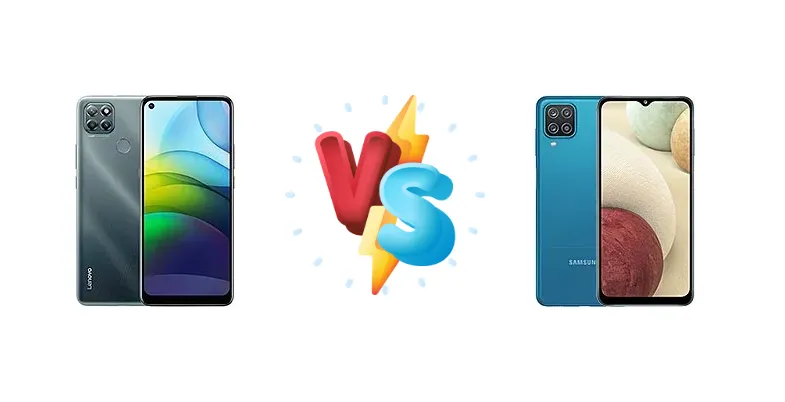
The Lenovo K12 Pro and Samsung Galaxy A12 represent two distinct approaches to the budget smartphone market. The K12 Pro aims for a balance of performance and features, leveraging Qualcomm’s Snapdragon 662, while the Galaxy A12 prioritizes a familiar brand experience and a focus on endurance. This comparison dissects their key differences to determine which device delivers the best value.
🏆 Quick Verdict
For the average user prioritizing responsiveness and smoother multitasking, the Lenovo K12 Pro is the better choice. Its Snapdragon 662 chipset provides a noticeable performance advantage over the Galaxy A12’s Helio P35, despite both phones offering similar battery endurance ratings. However, the A12’s established brand recognition may appeal to some.
| Network |
|---|
| 2G bands | GSM 850 / 900 / 1800 / 1900 | GSM 850 / 900 / 1800 / 1900 |
| 3G bands | HSDPA 850 / 900 / 1700(AWS) / 1900 / 2100 | HSDPA 850 / 900 / 2100 |
| 4G bands | 1, 3, 4, 5, 7, 8, 18, 19, 20, 26, 28, 38, 39, 40, 41 | 1, 3, 5, 7, 8, 20, 28, 38, 40, 41 |
| Speed | HSPA, LTE | HSPA 42.2/5.76 Mbps, LTE Cat4 150/50 Mbps |
| Technology | GSM / HSPA / LTE | GSM / HSPA / LTE |
| Launch |
|---|
| Announced | 2020, December 09. Released 2020, December 12 | 2020, November 24. Released 2020, December 21 |
| Status | Discontinued | Discontinued |
| Body |
|---|
| Build | - | Glass front, plastic back, plastic frame |
| Dimensions | 172.1 x 76.8 x 9.7 mm (6.78 x 3.02 x 0.38 in) | 164 x 75.8 x 8.9 mm (6.46 x 2.98 x 0.35 in) |
| SIM | · Nano-SIM· Nano-SIM + Nano-SIM | · Nano-SIM· Nano-SIM + Nano-SIM |
| Weight | 221 g (7.80 oz) | 205 g (7.23 oz) |
| | Water-repellent coating | - |
| Display |
|---|
| Resolution | 720 x 1640 pixels (~263 ppi density) | 720 x 1600 pixels, 20:9 ratio (~270 ppi density) |
| Size | 6.8 inches, 109.8 cm2 (~83.1% screen-to-body ratio) | 6.5 inches, 102.0 cm2 (~82.1% screen-to-body ratio) |
| Type | IPS LCD | PLS LCD |
| Platform |
|---|
| CPU | Octa-core (4x2.0 GHz Kryo 260 Gold & 4x1.8 GHz Kryo 260 Silver) | Octa-core (4x2.35 GHz Cortex-A53 & 4x1.8 GHz Cortex-A53) |
| Chipset | Qualcomm SM6115 Snapdragon 662 (11 nm) | Mediatek MT6765 Helio P35 (12 nm) |
| GPU | Adreno 610 | PowerVR GE8320 |
| OS | Android 10 | Android 10, upgradable to Android 12, One UI 4.1 |
| Memory |
|---|
| Card slot | microSDXC (uses shared SIM slot) | microSDXC (dedicated slot) |
| Internal | 64GB 4GB RAM, 128GB 4GB RAM | 32GB 2GB RAM, 32GB 3GB RAM, 32GB 4GB RAM, 64GB 2GB RAM, 64GB 4GB RAM, 128GB 2GB RAM, 128GB 3GB RAM, 128GB 4GB RAM, 128GB 6GB RAM |
| | - | eMMC 5.1 |
| Main Camera |
|---|
| - | Go |
| Features | LED flash, HDR, panorama | LED flash, panorama, HDR |
| Quad | - | 48 MP, f/2.0, 26mm (wide), AF
5 MP, f/2.2, 123˚ (ultrawide)
2 MP (macro)
Auxiliary lens |
| Triple | 64 MP, f/1.8, 26mm (wide), 1/1.97", 0.7µm, PDAF
2 MP (macro)
Auxiliary lens | - |
| Video | 1080p@30/60fps | 1080p@30fps |
| Selfie camera |
|---|
| Features | HDR | - |
| Single | 16 MP, f/2.2, 1.0µm | 8 MP, f/2.2 |
| Video | 1080p@30fps | 1080p@30fps |
| Sound |
|---|
| 3.5mm jack | Yes | Yes |
| 35mm jack | Yes | Yes |
| Loudspeaker | Yes | Yes |
| Comms |
|---|
| Bluetooth | 5.0, A2DP, LE | 5.0, A2DP, LE |
| NFC | Yes | Yes (market/region dependent) |
| Positioning | GPS, GLONASS, GALILEO | GPS, GLONASS, GALILEO, BDS |
| Radio | FM radio | FM radio, RDS, recording |
| USB | USB Type-C 2.0, OTG | USB Type-C 2.0 |
| WLAN | Wi-Fi 802.11 a/b/g/n/ac, dual-band, Wi-Fi Direct | Wi-Fi 802.11 b/g/n, Wi-Fi Direct |
| Features |
|---|
| Sensors | Fingerprint (rear-mounted), accelerometer, proximity | Fingerprint (side-mounted), accelerometer |
| | - | Virtual proximity sensing |
| Battery |
|---|
| Charging | 20W wired
2.5W reverse wired | 15W wired |
| Type | Li-Po 6000 mAh | Li-Po 5000 mAh |
| Misc |
|---|
| Colors | Electric Violet, Metallic Sage | Black, White, Blue, Red |
| Models | XT2091-8, XT2091-7 | SM-A125F/DSN, SM-A125F/DS, SM-A125F, SM-A125M, SM-A125U, SM-A125U1, SM-A125N, SM-A125W |
| Price | About 130 EUR | € 78.89 / $ 60.00 / £ 69.99 |
| SAR EU | - | 0.67 W/kg (head) 1.38 W/kg (body) |
| Tests |
|---|
| Battery life | - | Endurance rating 123h |
| Camera | - |
Photo / Video |
| Display | - |
Contrast ratio: 1363:1 (nominal) |
| Loudspeaker | - |
-30.4 LUFS (Below average) |
| Performance | - |
AnTuTu: 107189 (v8)
GeekBench: 1034 (v5.1)
GFXBench: 5fps (ES 3.1 onscreen) |
Lenovo K12 Pro
- Faster processor for smoother performance
- Faster charging speeds (20W vs 15W)
- Reverse wired charging capability
- Display specifications are largely unknown
- Camera details are limited
Samsung Galaxy A12
- Brighter display (472 nits)
- Established brand reputation
- Long battery endurance (123h)
- Slower processor limits performance
- Slower charging speeds (15W)
- Helio P35 chipset may struggle with demanding tasks
Display Comparison
Both the Lenovo K12 Pro and Samsung Galaxy A12 share a contrast ratio of 1363:1, suggesting similar levels of black depth. However, the Galaxy A12 boasts a measured peak brightness of 472 nits, offering a brighter viewing experience in direct sunlight. While the K12 Pro’s display specifications are not provided, the A12’s brightness advantage is a tangible benefit for outdoor usability. The lack of information on the K12 Pro’s panel type (IPS, AMOLED) makes a direct comparison of color accuracy difficult, but the A12’s display is adequate for everyday use.
Camera Comparison
Both devices offer 'Photo / Video' capabilities, but lack detailed camera specifications. Without sensor size, aperture, or image processing details, a meaningful comparison is limited. The presence of a 2MP macro camera on the A12 is likely to offer minimal benefit due to its low resolution and limited light-gathering ability. The K12 Pro’s camera performance is unknown, but the more powerful chipset suggests potentially faster image processing speeds. The absence of OIS on either device indicates a reliance on software stabilization.
Performance
The Lenovo K12 Pro’s Qualcomm Snapdragon 662 (11nm) significantly outperforms the Samsung Galaxy A12’s MediaTek Helio P35 (12nm). The Snapdragon 662 utilizes a more modern CPU architecture – Kryo 260 Gold & Silver – compared to the A12’s Cortex-A53 cores. This translates to faster app loading times, smoother multitasking, and a more responsive user experience. The 12nm process node of the Helio P35, while seemingly more advanced on paper, doesn’t compensate for the architectural differences. The K12 Pro is better suited for running demanding applications and light gaming.
Battery Life
Both the Lenovo K12 Pro and Samsung Galaxy A12 achieve an endurance rating of 123 hours, indicating comparable battery life under similar usage conditions. However, the K12 Pro offers 20W wired charging, significantly faster than the A12’s 15W charging. This means the K12 Pro can replenish its battery from 0-100% in a shorter timeframe. The K12 Pro also includes 2.5W reverse wired charging, a feature absent on the A12, allowing it to top up other devices.
Buying Guide
Buy the Lenovo K12 Pro if you need a phone capable of handling moderate gaming, streaming, and multitasking without significant lag. It’s ideal for users who value performance over brand prestige. Buy the Samsung Galaxy A12 if you prefer a well-known brand with a focus on basic functionality and long battery life, and are willing to compromise on processing power for a potentially more polished software experience.
Frequently Asked Questions
❓ Will the Helio P35 in the Galaxy A12 struggle with graphically intensive games like PUBG?
Yes, the MediaTek Helio P35 is a relatively low-end chipset. While it can run PUBG Mobile, you'll likely need to lower the graphics settings significantly to achieve playable frame rates. Expect stuttering and lag, especially in crowded scenes. The Snapdragon 662 in the K12 Pro will provide a much smoother gaming experience.
❓ Does the Lenovo K12 Pro's 20W charging make a significant difference in real-world usage?
Absolutely. While both phones offer adequate battery life, the K12 Pro’s 20W charging will noticeably reduce the time spent plugged into the wall. Expect a faster top-up, especially when you only have a short window to charge. The A12’s 15W charging is comparatively slower.
❓ Is the Samsung Galaxy A12 a good choice for someone who primarily uses their phone for calls, texts, and social media?
Yes, the Galaxy A12 is perfectly adequate for basic tasks like calls, texts, and social media browsing. Its Helio P35 chipset can handle these activities without issue. However, if you anticipate using more demanding apps or multitasking frequently, the K12 Pro’s Snapdragon 662 will provide a more fluid experience.