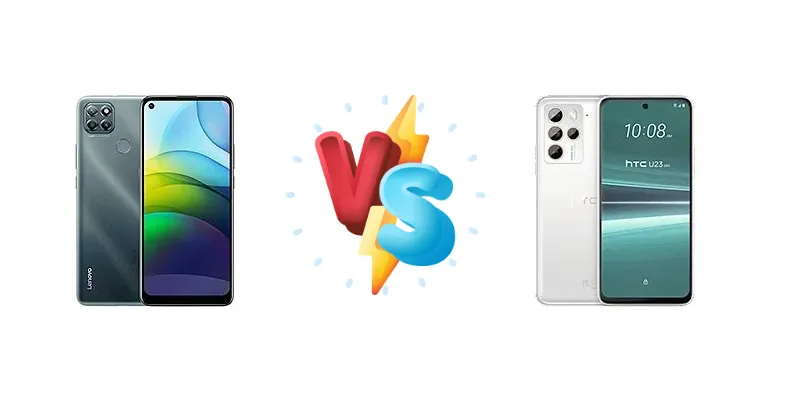
The Lenovo K12 Pro and HTC U23 Pro represent different approaches to the mid-range smartphone market. The K12 Pro, a more established budget option, focuses on delivering essential features at a competitive price. The U23 Pro, while newer, aims to offer a more refined experience with a more powerful chipset and modern features like wireless charging. This comparison dissects their key differences to determine which phone best suits your needs.
🏆 Quick Verdict
For most users, the HTC U23 Pro is the superior choice. Its Snapdragon 7 Gen 1 chipset provides a substantial performance advantage over the K12 Pro’s Snapdragon 662, translating to smoother multitasking and gaming. While the K12 Pro offers a lower entry price, the U23 Pro’s added features and performance justify the price difference.
| Network |
|---|
| 2G bands | GSM 850 / 900 / 1800 / 1900 | GSM 850 / 900 / 1800 / 1900 |
| 3G bands | HSDPA 850 / 900 / 1700(AWS) / 1900 / 2100 | HSDPA 850 / 900 / 1700(AWS) / 1900 / 2100 |
| 4G bands | 1, 3, 4, 5, 7, 8, 18, 19, 20, 26, 28, 38, 39, 40, 41 | 1, 3, 5, 7, 8, 12, 17, 20, 28, 38, 39, 40, 41 |
| 5G bands | - | 1, 3, 7, 20, 28, 41, 78 SA/NSA |
| Speed | HSPA, LTE | HSPA, LTE, 5G |
| Technology | GSM / HSPA / LTE | GSM / HSPA / LTE / 5G |
| Launch |
|---|
| Announced | 2020, December 09. Released 2020, December 12 | 2023, May 18 |
| Status | Discontinued | Available. Released 2023, May 18 |
| Body |
|---|
| Build | - | Glass front (Gorilla Glass Victus), plastic frame, plastic back |
| Dimensions | 172.1 x 76.8 x 9.7 mm (6.78 x 3.02 x 0.38 in) | 166.6 x 77.1 x 8.9 mm (6.56 x 3.04 x 0.35 in) |
| SIM | · Nano-SIM· Nano-SIM + Nano-SIM | Nano-SIM + Nano-SIM |
| Weight | 221 g (7.80 oz) | 205 g (7.23 oz) |
| | Water-repellent coating | IP67 dust/water resistant (up to 1m for 30 min) |
| Display |
|---|
| Protection | - | Corning Gorilla Glass Victus |
| Resolution | 720 x 1640 pixels (~263 ppi density) | 1080 x 2400 pixels, 20:9 ratio (~393 ppi density) |
| Size | 6.8 inches, 109.8 cm2 (~83.1% screen-to-body ratio) | 6.7 inches, 108.4 cm2 (~84.4% screen-to-body ratio) |
| Type | IPS LCD | OLED, 120Hz |
| Platform |
|---|
| CPU | Octa-core (4x2.0 GHz Kryo 260 Gold & 4x1.8 GHz Kryo 260 Silver) | Octa-core (1x2.4 GHz Cortex-A710 & 3x2.36 GHz Cortex-A710 & 4x1.8 GHz Cortex-A510) |
| Chipset | Qualcomm SM6115 Snapdragon 662 (11 nm) | Qualcomm SM7450-AB Snapdragon 7 Gen 1 (4 nm) |
| GPU | Adreno 610 | Adreno 644 |
| OS | Android 10 | Android 13 |
| Memory |
|---|
| Card slot | microSDXC (uses shared SIM slot) | microSDXC |
| Internal | 64GB 4GB RAM, 128GB 4GB RAM | 256GB 8GB RAM, 256GB 12GB RAM |
| Main Camera |
|---|
| Features | LED flash, HDR, panorama | Dual-LED flash, HDR, panorama |
| Quad | - | 108 MP, f/1.7, (wide), 1/1.67", 0.64μm, PDAF, OIS
8 MP, f/2.4, 120˚ (ultrawide), 1/4.0", 1.12µm
5 MP (macro)
Auxiliary lens |
| Triple | 64 MP, f/1.8, 26mm (wide), 1/1.97", 0.7µm, PDAF
2 MP (macro)
Auxiliary lens | - |
| Video | 1080p@30/60fps | 4K@30fps, 1080p@30fps, gyro-EIS |
| Selfie camera |
|---|
| Features | HDR | HDR |
| Single | 16 MP, f/2.2, 1.0µm | 32 MP, f/2.5, (wide), 1/3.2", 0.7µm |
| Video | 1080p@30fps | 1080p@30fps |
| Sound |
|---|
| 3.5mm jack | Yes | Yes |
| 35mm jack | Yes | Yes |
| Loudspeaker | Yes | Yes |
| Comms |
|---|
| Bluetooth | 5.0, A2DP, LE | 5.2, A2DP, LE |
| NFC | Yes | Yes |
| Positioning | GPS, GLONASS, GALILEO | GPS, GLONASS, GALILEO, BDS |
| Radio | FM radio | No |
| USB | USB Type-C 2.0, OTG | USB Type-C 3.0 |
| WLAN | Wi-Fi 802.11 a/b/g/n/ac, dual-band, Wi-Fi Direct | Wi-Fi 802.11 a/b/g/n/ac/6, dual-band |
| Features |
|---|
| Sensors | Fingerprint (rear-mounted), accelerometer, proximity | Fingerprint (side-mounted), accelerometer, gyro, proximity, compass |
| Battery |
|---|
| Charging | 20W wired
2.5W reverse wired | 30W wired
15W wireless
5W reverse wireless
Reverse wired |
| Type | Li-Po 6000 mAh | Li-Ion 4600 mAh |
| Misc |
|---|
| Colors | Electric Violet, Metallic Sage | Snow White, Coffee Black |
| Models | XT2091-8, XT2091-7 | 2QC9200, 2QC9100, 2QCB100 |
| Price | About 130 EUR | About 220 EUR |
Lenovo K12 Pro
- Lower price point
- Reverse wired charging available
- Simple and straightforward user experience
- Outdated Snapdragon 662 chipset
- Slower charging speeds
- Likely lower display brightness
HTC U23 Pro
- Significantly faster Snapdragon 7 Gen 1 chipset
- Faster 30W wired and 15W wireless charging
- Brighter display for better outdoor visibility
- Reverse wireless charging
- Higher price compared to the K12 Pro
- Limited camera details available
- May not be as readily available in all markets
Display Comparison
The HTC U23 Pro boasts a significantly brighter display, reaching a measured 727 nits, compared to the Lenovo K12 Pro’s unspecified brightness. This higher peak brightness will provide superior visibility outdoors under direct sunlight. While panel technology details are missing for the K12 Pro, the U23 Pro’s brightness advantage is a clear win. The absence of refresh rate information for both devices suggests standard 60Hz panels, limiting smoothness compared to higher refresh rate alternatives.
Camera Comparison
Detailed camera specs beyond 'Photo / Video' are unavailable for the HTC U23 Pro, making a direct sensor comparison difficult. However, the U23 Pro’s positioning suggests a more modern image processing pipeline. The Lenovo K12 Pro’s camera capabilities are likely adequate for casual photography, but it’s unlikely to compete with the image quality potential of a more recent chipset like the Snapdragon 7 Gen 1. Without further information, it’s safe to assume the U23 Pro offers a more versatile and capable camera system.
Performance
The core difference lies in the chipsets: the Lenovo K12 Pro utilizes the Qualcomm Snapdragon 662 (11nm), while the HTC U23 Pro features the Snapdragon 7 Gen 1 (4nm). The 4nm process node of the 7 Gen 1 offers significantly improved power efficiency and thermal performance compared to the 11nm 662. The U23 Pro’s CPU configuration – a 1x2.4 GHz Cortex-A710 prime core alongside 3x2.36 GHz Cortex-A710 cores and 4x1.8 GHz Cortex-A510 efficiency cores – is a substantial upgrade over the K12 Pro’s Octa-core (4x2.0 GHz Kryo 260 Gold & 4x1.8 GHz Kryo 260 Silver). This translates to faster app loading times, smoother multitasking, and a more responsive user experience on the U23 Pro.
Battery Life
The HTC U23 Pro’s 30W wired charging is considerably faster than the Lenovo K12 Pro’s 20W charging. The U23 Pro also adds 15W wireless charging and 5W reverse wireless charging, features absent on the K12 Pro. While the K12 Pro offers 2.5W reverse wired charging, it’s significantly slower. The U23 Pro’s endurance rating of 83 hours suggests excellent battery life, likely benefiting from the more efficient 4nm chipset. While battery capacity isn’t specified for either device, the U23 Pro’s faster charging and efficiency give it a clear advantage.
Buying Guide
Buy the Lenovo K12 Pro if you prioritize absolute affordability and basic smartphone functionality. It’s ideal for users who primarily need a phone for calls, texts, and light social media use. Buy the HTC U23 Pro if you value performance, a brighter display, and modern conveniences like wireless charging. This phone is better suited for users who enjoy mobile gaming, streaming video, and taking photos.
Frequently Asked Questions
❓ Does the Snapdragon 7 Gen 1 in the HTC U23 Pro handle demanding games like Genshin Impact or Call of Duty Mobile?
Yes, the Snapdragon 7 Gen 1 is capable of running demanding games like Genshin Impact and Call of Duty Mobile at medium to high settings. While it won't match the performance of flagship chipsets, it provides a significantly smoother gaming experience compared to the Snapdragon 662 in the Lenovo K12 Pro, with less frame rate drops and improved thermal management.
❓ How much faster is the 30W charging on the HTC U23 Pro compared to the 20W charging on the Lenovo K12 Pro?
While exact 0-100% charge times are unavailable, the 30W charging on the U23 Pro will noticeably reduce charging time. Expect a roughly 30-45 minute difference in a full charge, making it more convenient for users who need to quickly top up their battery. The addition of 15W wireless charging on the U23 Pro is a further convenience the K12 Pro lacks.
❓ Is the lack of detailed camera specifications for the HTC U23 Pro a cause for concern?
While the absence of detailed specs is unfortunate, HTC typically focuses on software optimization and image processing. The Snapdragon 7 Gen 1’s ISP is a significant upgrade over the 662, suggesting improved image quality, dynamic range, and low-light performance. Expect a more refined camera experience, even without knowing the exact sensor details.