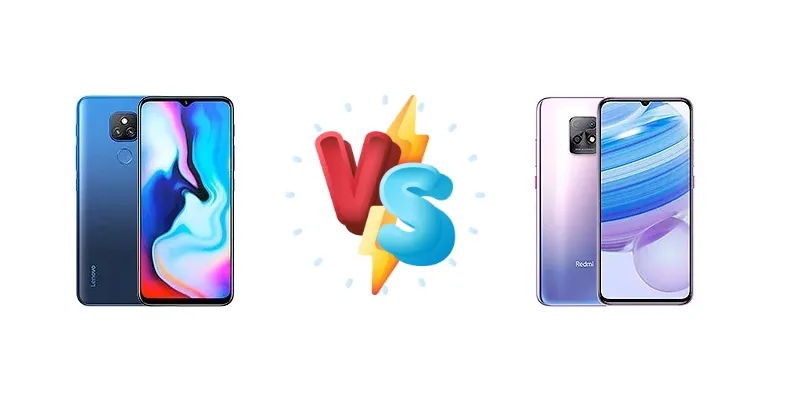
Both the Lenovo K12 (China) and Xiaomi Redmi 10X 5G target the increasingly competitive budget 5G market. However, they take drastically different approaches to achieving affordability. The K12 prioritizes a lower entry price with a Qualcomm Snapdragon 460, while the Redmi 10X 5G opts for a more powerful Mediatek Dimensity 820, resulting in a clear performance disparity.
🏆 Quick Verdict
For the average user prioritizing performance and future-proofing, the Xiaomi Redmi 10X 5G is the clear winner. Its Dimensity 820 chipset delivers significantly faster processing speeds and better gaming capabilities. While the Lenovo K12 offers a lower price point, the performance trade-offs are substantial.
| Network |
|---|
| 2G bands | GSM 850 / 900 / 1800 / 1900 | GSM 850 / 900 / 1800 / 1900 |
| 3G bands | HSDPA 850 / 900 / 1900 / 2100 | HSDPA 850 / 900 / 1700(AWS) / 1900 / 2100 |
| 4G bands | 1, 3, 5, 7, 8, 20, 28, 38, 39, 40, 41 | 1, 2, 3, 4, 5, 7, 8, 34, 38, 39, 40, 41 |
| 5G bands | - | 1, 3, 41, 78, 79 SA/NSA |
| Speed | HSPA, LTE | HSPA, LTE, 5G |
| Technology | GSM / HSPA / LTE | GSM / CDMA / HSPA / LTE / 5G |
| | - | CDMA 800 & TD-SCDMA |
| Launch |
|---|
| Announced | 2020, December 09. Released 2020, December 12 | 2020, May 26 |
| Status | Discontinued | Available. Released 2020, June 01 |
| Body |
|---|
| Build | - | Glass front (Gorilla Glass 5), glass back (Gorilla Glass 5) |
| Dimensions | 165.2 x 75.7 x 9.2 mm (6.50 x 2.98 x 0.36 in) | 164.2 x 75.8 x 9 mm (6.46 x 2.98 x 0.35 in) |
| SIM | Nano-SIM + Nano-SIM | Nano-SIM + Nano-SIM |
| Weight | 200 g (7.05 oz) | 205 g (7.23 oz) |
| | - | Water-repellent coating |
| Display |
|---|
| Protection | - | Corning Gorilla Glass 5 |
| Resolution | 720 x 1600 pixels, 20:9 ratio (~270 ppi density) | 1080 x 2400 pixels, 20:9 ratio (~401 ppi density) |
| Size | 6.5 inches, 102.0 cm2 (~81.6% screen-to-body ratio) | 6.57 inches, 104.2 cm2 (~83.7% screen-to-body ratio) |
| Type | IPS LCD | AMOLED, HDR10+, 600 nits (typ) |
| Platform |
|---|
| CPU | Octa-core (4x1.8 GHz Kryo 240 & 4x1.6 GHz Kryo 240) | Octa-core (4x2.6 GHz Cortex-A76 & 4x2.0 GHz Cortex-A55) |
| Chipset | Qualcomm SM4250 Snapdragon 460 (11 nm) | Mediatek Dimensity 820 (7 nm) |
| GPU | Adreno 610 | Mali-G57 MC5 |
| OS | Android 10 | Android 10, MIUI 11 |
| Memory |
|---|
| Card slot | microSDXC (uses shared SIM slot) | microSDXC (uses shared SIM slot) |
| Internal | 64GB 4GB RAM | 64GB 6GB RAM, 128GB 6GB RAM, 128GB 8GB RAM, 256GB 8GB RAM |
| | eMMC 5.1 | UFS 2.1 |
| Main Camera |
|---|
| Dual | 48 MP, f/1.7, 26mm (wide), 1/2.0", 0.8µm, PDAF
Auxiliary lens | - |
| Features | LED flash, HDR, panorama | LED flash, HDR, panorama |
| Triple | - | 48 MP, f/1.8, 26mm (wide), 1/2.0", 0.8µm, PDAF
8 MP, f/2.2, 119˚ (ultrawide), 1/4.0", 1.12µm
Auxiliary lens |
| Video | 1080p@30/60fps | 4K@30fps, 1080p@30/60fps, 720p@960fps |
| Selfie camera |
|---|
| Features | HDR | HDR, panorama |
| Single | 8 MP, f/2.2, 26mm (wide), 1/4.0", 1.12µm | 16 MP, f/2.3, (wide), 1/3.06", 1.0µm |
| Video | 1080p@30fps | 1080p@30fps |
| Sound |
|---|
| 3.5mm jack | Yes | Yes |
| 35mm jack | Yes | Yes |
| Loudspeaker | Yes | Yes |
| | - | 24-bit/192kHz audio |
| Comms |
|---|
| Bluetooth | 5.0, A2DP, LE | 5.1, A2DP, LE |
| Infrared port | - | Yes |
| NFC | No | No |
| Positioning | GPS, GLONASS, GALILEO | GPS, GLONASS, GALILEO, BDS |
| Radio | FM radio | FM radio; built-in antenna |
| USB | microUSB 2.0, OTG | USB Type-C 2.0 |
| WLAN | Wi-Fi 802.11 b/g/n | Wi-Fi 802.11 a/b/g/n/ac, dual-band, Wi-Fi Direct |
| Features |
|---|
| Sensors | Fingerprint (rear-mounted), accelerometer, proximity | Fingerprint (under display, optical), accelerometer, gyro, proximity, compass |
| Battery |
|---|
| Charging | 10W wired
2.5W reverse wired | 22.5W wired |
| Type | Li-Po 5000 mAh | Li-Po 4520 mAh |
| Misc |
|---|
| Colors | Navy Blue, Gray | Blue, Gold, Pink/Blue |
| Price | About 100 EUR | About 200 EUR |
Lenovo K12 (China)
- Lower price point makes it accessible to budget-conscious buyers.
- Reverse wired charging offers limited power bank functionality.
- Functional for basic smartphone tasks.
- Significantly weaker performance compared to the Redmi 10X 5G.
- Slow 10W charging.
- Likely limited gaming capabilities.
Xiaomi Redmi 10X 5G
- Much faster performance thanks to the Dimensity 820 chipset.
- Significantly faster 22.5W charging.
- Better suited for gaming and demanding applications.
- Higher price compared to the Lenovo K12.
- May not be available in all markets.
- Potentially larger physical size.
Display Comparison
Display specifications are not provided in the context data. However, given the price points, both devices likely feature LCD panels with 60Hz refresh rates. The Redmi 10X 5G, being the higher-tier device, may have a slightly higher peak brightness and potentially better color accuracy. Bezels are expected to be relatively thick on both models, typical for this segment.
Camera Comparison
Camera details are limited. Without sensor size or aperture information, a direct comparison is difficult. However, the Redmi 10X 5G, positioned as a more premium device, likely features a more capable main camera sensor. The inclusion of Optical Image Stabilization (OIS) on the Redmi 10X 5G would be a significant advantage, improving image quality in low-light conditions and reducing blur. The prevalence of 2MP macro lenses on both devices suggests they are primarily for marketing purposes and offer limited real-world benefit.
Performance
The core difference lies in the chipsets. The Xiaomi Redmi 10X 5G’s Mediatek Dimensity 820, built on a 7nm process, boasts a significantly more powerful CPU configuration – four Cortex-A76 cores clocked at 2.6 GHz alongside four Cortex-A55 cores at 2.0 GHz. This contrasts sharply with the Lenovo K12’s Qualcomm Snapdragon 460 (11nm), featuring four Kryo 240 cores at 1.8 GHz and another four at 1.6 GHz. The Dimensity 820’s superior architecture and higher clock speeds translate to a demonstrably faster and more responsive experience, particularly in demanding applications and games. The 7nm process also contributes to better thermal efficiency, reducing the likelihood of throttling under sustained load.
Battery Life
Battery capacity is not specified, but the charging speeds reveal a key difference. The Redmi 10X 5G’s 22.5W wired charging is substantially faster than the Lenovo K12’s 10W charging. This means the Redmi 10X 5G can replenish its battery much more quickly, minimizing downtime. While a larger battery capacity on the K12 could partially offset the slower charging, the convenience of rapid charging offered by the Redmi 10X 5G is a significant advantage for users who frequently use their phones throughout the day. The K12 also offers 2.5W reverse wired charging, a niche feature not found on the Redmi 10X 5G.
Buying Guide
Buy the Lenovo K12 (China) if you need a functional 5G device for basic tasks like calling, texting, and light social media use, and your budget is extremely limited. Buy the Xiaomi Redmi 10X 5G if you prefer a smoother user experience, enjoy mobile gaming, and value faster charging speeds – even if it means spending a bit more upfront.
Frequently Asked Questions
❓ Will the Snapdragon 460 in the Lenovo K12 struggle with graphically intensive games like PUBG Mobile?
Yes, the Qualcomm Snapdragon 460 is an entry-level chipset. While it can run PUBG Mobile, expect to play at lower graphics settings and potentially experience frame rate drops, especially during intense action. The Dimensity 820 in the Redmi 10X 5G offers a much smoother gaming experience.
❓ How long will it take to fully charge the Redmi 10X 5G from 0% to 100% with the 22.5W charger?
While a precise time requires testing, with 22.5W charging, the Redmi 10X 5G should fully charge in approximately 60-90 minutes, depending on battery capacity. This is significantly faster than the Lenovo K12’s 10W charging, which could take over 3 hours.
❓ Is the 5G connectivity on both phones compatible with all 5G networks globally?
5G band compatibility varies by region. Both phones support 5G, but it's crucial to check if the specific 5G bands supported by each device are compatible with your carrier's network in your location. The Lenovo K12, being a China-specific model, may have limited band support outside of China.