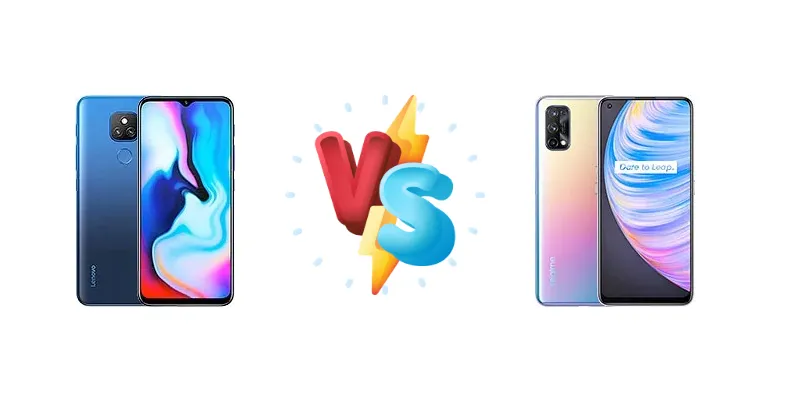
The Realme Q2 Pro and Lenovo K12 represent distinct approaches to the budget and mid-range smartphone market. The Q2 Pro aims for a compelling performance-to-price ratio with its Dimensity 800U chipset and blazing-fast 65W charging, while the K12 focuses on delivering essential functionality at an even lower price point, utilizing the Snapdragon 460. This comparison dissects their key differences to help you determine which device best suits your needs.
🏆 Quick Verdict
For most users, the Realme Q2 Pro is the superior choice. Its Mediatek Dimensity 800U chipset offers a substantial performance advantage over the Lenovo K12’s Snapdragon 460, and the 65W charging is a game-changer. While the K12 is more affordable, the Q2 Pro’s benefits justify the price difference for anyone prioritizing speed and convenience.
| Network |
|---|
| 2G bands | GSM 850 / 900 / 1800 / 1900 | GSM 850 / 900 / 1800 / 1900 |
| 3G bands | HSDPA 850 / 900 / 1900 / 2100 | HSDPA 850 / 900 / 1700(AWS) / 1900 / 2100 |
| 4G bands | 1, 3, 5, 7, 8, 20, 28, 38, 39, 40, 41 | 1, 2, 3, 4, 5, 7, 8, 34, 38, 39, 40, 41 |
| 5G bands | - | 1, 41, 77, 78, 79 SA/NSA |
| Speed | HSPA, LTE | HSPA, LTE, 5G 2.3 Gbps DL |
| Technology | GSM / HSPA / LTE | GSM / CDMA / HSPA / EVDO / LTE / 5G |
| | - | CDMA2000 1xEV-DO |
| Launch |
|---|
| Announced | 2020, December 09. Released 2020, December 12 | 2020, October 13. Released 2020, October 19 |
| Status | Discontinued | Discontinued |
| Body |
|---|
| Dimensions | 165.2 x 75.7 x 9.2 mm (6.50 x 2.98 x 0.36 in) | 160.9 x 74.4 x 8.1 mm (6.33 x 2.93 x 0.32 in) |
| SIM | Nano-SIM + Nano-SIM | Nano-SIM + Nano-SIM |
| Weight | 200 g (7.05 oz) | 175 g (6.17 oz) |
| Display |
|---|
| Protection | - | Corning Gorilla Glass |
| Resolution | 720 x 1600 pixels, 20:9 ratio (~270 ppi density) | 1080 x 2400 pixels, 20:9 ratio (~411 ppi density) |
| Size | 6.5 inches, 102.0 cm2 (~81.6% screen-to-body ratio) | 6.4 inches, 98.9 cm2 (~82.6% screen-to-body ratio) |
| Type | IPS LCD | Super AMOLED, 600 nits (peak) |
| Platform |
|---|
| CPU | Octa-core (4x1.8 GHz Kryo 240 & 4x1.6 GHz Kryo 240) | Octa-core (2x2.4 GHz Cortex-A76 & 6x2.0 GHz Cortex-A55) |
| Chipset | Qualcomm SM4250 Snapdragon 460 (11 nm) | Mediatek Dimensity 800U (7 nm) |
| GPU | Adreno 610 | Mali-G57 MC3 |
| OS | Android 10 | Android 10, Realme UI |
| Memory |
|---|
| Card slot | microSDXC (uses shared SIM slot) | No |
| Internal | 64GB 4GB RAM | 128GB 8GB RAM, 256GB 8GB RAM |
| | eMMC 5.1 | UFS 2.1 |
| Main Camera |
|---|
| Dual | 48 MP, f/1.7, 26mm (wide), 1/2.0", 0.8µm, PDAF
Auxiliary lens | - |
| Features | LED flash, HDR, panorama | LED flash, HDR, panorama |
| Quad | - | 48 MP, f/1.8, 25mm (wide), 1/2.0", 0.8µm, PDAF
8 MP, f/2.3, 119˚, 16mm (ultrawide), 1/4.0", 1.12µm
2 MP (macro)
Auxiliary lens |
| Video | 1080p@30/60fps | 4K@30fps, 1080p@30/60/120fps, gyro-EIS |
| Selfie camera |
|---|
| Features | HDR | HDR, panorama |
| Single | 8 MP, f/2.2, 26mm (wide), 1/4.0", 1.12µm | 16 MP, f/2.5, 26mm (wide), 1/3.1", 1.0µm |
| Video | 1080p@30fps | 1080p@30/120fps |
| Sound |
|---|
| 3.5mm jack | Yes | No |
| 35mm jack | Yes | No |
| Loudspeaker | Yes | Yes |
| | - | 24-bit/192kHz audio |
| Comms |
|---|
| Bluetooth | 5.0, A2DP, LE | 5.1, A2DP, LE |
| NFC | No | - |
| Positioning | GPS, GLONASS, GALILEO | GPS, GLONASS, GALILEO, QZSS, BDS |
| Radio | FM radio | No |
| USB | microUSB 2.0, OTG | USB Type-C 2.0 |
| WLAN | Wi-Fi 802.11 b/g/n | Wi-Fi 802.11 a/b/g/n/ac, dual-band, Wi-Fi Direct |
| Features |
|---|
| Sensors | Fingerprint (rear-mounted), accelerometer, proximity | Fingerprint (under display, optical), accelerometer, gyro, proximity, compass |
| Battery |
|---|
| Charging | 10W wired
2.5W reverse wired | 65W wired |
| Type | Li-Po 5000 mAh | 4300 mAh |
| Misc |
|---|
| Colors | Navy Blue, Gray | Leather Gray, Rainbow, Sea Blue, Fantasy White |
| Models | - | RMX2173 |
| Price | About 100 EUR | About 310 EUR |
Lenovo K12 (China)
- More affordable price point
- Decent battery life for basic usage
- Reliable for essential smartphone functions
- Significantly slower performance
- Extremely slow charging speed
- Limited gaming capabilities
Realme Q2 Pro
- Much faster performance with Dimensity 800U
- Blazing-fast 65W charging
- Better suited for gaming and multitasking
- Higher price compared to the Lenovo K12
- Potentially shorter battery life due to higher performance
- May not be available in all markets
Display Comparison
Neither device’s display specifications are provided, so a direct comparison is limited. However, given the Q2 Pro’s positioning, it likely features a higher refresh rate panel (90Hz or 120Hz) compared to the K12’s standard 60Hz. The Q2 Pro’s target market suggests a more vibrant and responsive visual experience. Bezels are likely comparable, given both phones aim for affordability, but the Q2 Pro may benefit from slightly thinner bezels due to its more premium aspirations.
Camera Comparison
Without detailed camera specifications, a precise comparison is difficult. However, the Q2 Pro, positioned as a more feature-rich device, likely incorporates a more capable main sensor and potentially optical image stabilization (OIS). The K12 likely relies on a simpler camera setup. The image processing capabilities of the Dimensity 800U’s ISP (Image Signal Processor) are also likely more advanced, resulting in better image quality in various lighting conditions. The presence of a 2MP macro camera on either device is unlikely to significantly impact the overall camera experience.
Performance
The performance gap between these two devices is significant. The Realme Q2 Pro’s Mediatek Dimensity 800U (7nm) boasts a more modern architecture – specifically, two Cortex-A76 cores clocked at 2.4GHz alongside six Cortex-A55 cores – compared to the Lenovo K12’s Qualcomm Snapdragon 460 (11nm). The Dimensity 800U’s superior process node and core configuration translate to substantially faster CPU and GPU performance, making it far better suited for gaming and demanding applications. The Snapdragon 460, while adequate for basic tasks, will struggle with graphically intensive games and multitasking. The 7nm process of the Dimensity 800U also implies better thermal efficiency, reducing the likelihood of performance throttling during extended use.
Battery Life
While battery capacity isn’t specified, the charging capabilities are a defining difference. The Realme Q2 Pro’s 65W wired charging is a massive advantage, allowing for a full charge in under 40 minutes. The Lenovo K12’s 10W charging is comparatively slow, requiring several hours to reach 100%. Even if the K12 has a slightly larger battery capacity, the Q2 Pro’s rapid charging mitigates any potential disadvantage, offering significantly more convenience. The Q2 Pro also offers 2.5W reverse wired charging, a feature absent on the K12.
Buying Guide
Buy the Lenovo K12 (China) if you need a basic, reliable smartphone for essential tasks like calling, texting, and light social media use, and your budget is extremely limited. You’re willing to sacrifice performance and charging speed for maximum affordability. Buy the Realme Q2 Pro if you prioritize a smoother user experience, faster app loading times, and significantly quicker charging, and you enjoy mobile gaming or media consumption. You want a phone that can keep up with a more demanding lifestyle.
Frequently Asked Questions
❓ Will the Realme Q2 Pro’s Dimensity 800U handle demanding games like PUBG Mobile at high settings?
Yes, the Dimensity 800U is well-equipped to handle PUBG Mobile at high settings with smooth frame rates. Its Mali-G57 MC4 GPU provides sufficient graphical power, and the 7nm process helps prevent overheating during extended gaming sessions. Expect a significantly better gaming experience compared to the Snapdragon 460-powered Lenovo K12.
❓ How long does it *actually* take to charge the Realme Q2 Pro from 0% to 100% with the 65W charger?
The Realme Q2 Pro can charge from 0% to 100% in approximately 35-40 minutes using the included 65W charger. This is a substantial improvement over the Lenovo K12’s 10W charging, which would take several hours for a full charge. This rapid charging is a key advantage for users who need to quickly top up their battery.
❓ Is the Snapdragon 460 in the Lenovo K12 sufficient for everyday tasks like browsing and social media?
Yes, the Snapdragon 460 is adequate for basic tasks like web browsing, social media, and making calls. However, you may experience noticeable slowdowns when multitasking or running more demanding applications. It's best suited for users with minimal smartphone requirements.