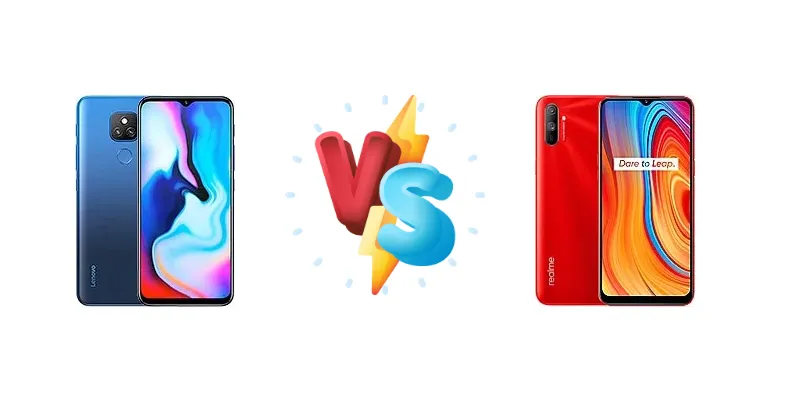
The Lenovo K12 (China) and Realme C3 represent compelling options in the ultra-budget smartphone segment. While both aim to deliver essential functionality at a low price point, they take different approaches to achieving this. The K12 leverages Qualcomm's Snapdragon 460, while the C3 opts for MediaTek's Helio G70. This comparison dissects these choices, revealing which device offers the best balance of performance, features, and value.
🏆 Quick Verdict
For the average user prioritizing consistent performance and a potentially smoother software experience, the Realme C3 emerges as the better choice. Its Helio G70 chipset, built on a 12nm process, offers a performance edge over the Snapdragon 460, despite both phones sharing a 10W charging rate. However, the K12's reverse wired charging is a unique benefit.
| Network |
|---|
| 2G bands | GSM 850 / 900 / 1800 / 1900 | GSM 850 / 900 / 1800 / 1900 |
| 3G bands | HSDPA 850 / 900 / 1900 / 2100 | HSDPA 850 / 900 / 2100 |
| 4G bands | 1, 3, 5, 7, 8, 20, 28, 38, 39, 40, 41 | 1, 3, 5, 8, 38, 40, 41 |
| Speed | HSPA, LTE | HSPA 42.2/11.5 Mbps, LTE (2CA) Cat6 300/75 Mbps |
| Technology | GSM / HSPA / LTE | GSM / HSPA / LTE |
| Launch |
|---|
| Announced | 2020, December 09. Released 2020, December 12 | 2020, February 05. Released 2020, February 14 |
| Status | Discontinued | Discontinued |
| Body |
|---|
| Build | - | Glass front (Gorilla Glass 3), plastic back, plastic frame |
| Dimensions | 165.2 x 75.7 x 9.2 mm (6.50 x 2.98 x 0.36 in) | 164.4 x 75 x 9 mm (6.47 x 2.95 x 0.35 in) |
| SIM | Nano-SIM + Nano-SIM | Nano-SIM + Nano-SIM |
| Weight | 200 g (7.05 oz) | 195 g (6.88 oz) |
| | - | Weather-sealed ports & loudspeaker |
| Display |
|---|
| Protection | - | Corning Gorilla Glass 3 |
| Resolution | 720 x 1600 pixels, 20:9 ratio (~270 ppi density) | 720 x 1600 pixels, 20:9 ratio (~270 ppi density) |
| Size | 6.5 inches, 102.0 cm2 (~81.6% screen-to-body ratio) | 6.5 inches, 102.0 cm2 (~82.7% screen-to-body ratio) |
| Type | IPS LCD | IPS LCD, 480 nits (typ) |
| Platform |
|---|
| CPU | Octa-core (4x1.8 GHz Kryo 240 & 4x1.6 GHz Kryo 240) | Octa-core (2x2.0 GHz Cortex-A75 & 6x1.7 GHz Cortex-A55) |
| Chipset | Qualcomm SM4250 Snapdragon 460 (11 nm) | Mediatek MT6769V/CB Helio G70 (12 nm) |
| GPU | Adreno 610 | Mali-G52 2EEMC2 |
| OS | Android 10 | Android 10, Realme UI |
| Memory |
|---|
| Card slot | microSDXC (uses shared SIM slot) | microSDXC (dedicated slot) |
| Internal | 64GB 4GB RAM | 32GB 2GB RAM, 32GB 3GB RAM, 64GB 3GB RAM, 64GB 4GB RAM |
| | eMMC 5.1 | eMMC 5.1 |
| Main Camera |
|---|
| Dual | 48 MP, f/1.7, 26mm (wide), 1/2.0", 0.8µm, PDAF
Auxiliary lens | 12 MP, f/1.8, 28mm (wide), 1/2.8", 1.25µm, PDAF
Auxiliary lens |
| Features | LED flash, HDR, panorama | LED flash, HDR, panorama |
| Video | 1080p@30/60fps | 1080p@30fps |
| Selfie camera |
|---|
| Features | HDR | HDR, panorama |
| Single | 8 MP, f/2.2, 26mm (wide), 1/4.0", 1.12µm | 5 MP, f/2.4, 27mm (wide), 1/5.0", 1.12µm |
| Video | 1080p@30fps | 1080p@30fps |
| Sound |
|---|
| 3.5mm jack | Yes | Yes |
| 35mm jack | Yes | Yes |
| Loudspeaker | Yes | Yes |
| Comms |
|---|
| Bluetooth | 5.0, A2DP, LE | 5.0, A2DP, LE, aptX |
| NFC | No | No |
| Positioning | GPS, GLONASS, GALILEO | GPS, GLONASS, BDS |
| Radio | FM radio | FM radio |
| USB | microUSB 2.0, OTG | microUSB 2.0, OTG |
| WLAN | Wi-Fi 802.11 b/g/n | Wi-Fi 802.11 b/g/n |
| Features |
|---|
| Sensors | Fingerprint (rear-mounted), accelerometer, proximity | Accelerometer, proximity, compass |
| Battery |
|---|
| Charging | 10W wired
2.5W reverse wired | 10W wired |
| Type | Li-Po 5000 mAh | 5000 mAh |
| Misc |
|---|
| Colors | Navy Blue, Gray | Frozen Blue, Blazing Red, Volcano Grey shade |
| Models | - | RMX2027, RMX2020, RMX2021 |
| Price | About 100 EUR | About 90 EUR |
| Tests |
|---|
| Performance | - |
AnTuTu: 192223 (v8)
GeekBench: 1262 (v5.1)
GFXBench: 15fps (ES 3.1 onscreen) |
Lenovo K12 (China)
- Reverse wired charging for accessories
- Potentially better battery life due to Snapdragon 460 efficiency
- Qualcomm chipset may offer better software support long-term
- Snapdragon 460 offers less raw performance than Helio G70
- Likely less optimized for gaming
- Limited information available on display quality
Realme C3
- Helio G70 provides a performance advantage for apps and gaming
- Cortex-A75 cores offer snappier responsiveness
- 12nm process offers a good balance of performance and efficiency
- No reverse wired charging
- MediaTek chipsets sometimes receive less frequent software updates
- 10W charging is relatively slow
Display Comparison
Neither device boasts a standout display. Both are likely to feature LCD panels, typical for this price bracket. Without specific display specs, it's difficult to definitively compare brightness or color accuracy. However, the Realme C3's focus on gaming suggests a potentially higher refresh rate, though unconfirmed. The K12's display is likely optimized for power efficiency given the Snapdragon 460's focus on efficiency.
Camera Comparison
Without detailed camera specifications beyond the presence of cameras, a direct comparison is limited. It's safe to assume both phones feature basic camera setups geared towards casual photography. The Realme C3, given its gaming focus, *might* have slightly more aggressive image processing for social media sharing. However, the absence of OIS or large sensors on either device suggests image quality will be heavily reliant on software optimization and lighting conditions. The inclusion of a 2MP macro lens on either device is likely a marketing feature with limited practical benefit.
Performance
The core difference lies in the chipsets. The Realme C3’s MediaTek Helio G70 (12nm) features a dual-cluster configuration with 2x2.0 GHz Cortex-A75 cores and 6x1.7 GHz Cortex-A55 cores. This architecture provides a noticeable boost in single-core and multi-core performance compared to the Lenovo K12’s Qualcomm Snapdragon 460 (11nm) which uses 4x1.8 GHz Kryo 240 and 4x1.6 GHz Kryo 240 cores. The 12nm process of the Helio G70, while slightly less efficient than the 11nm Snapdragon, is offset by the more powerful Cortex-A75 cores, resulting in a more responsive user experience, particularly in app loading and multitasking. The Snapdragon 460 prioritizes power efficiency, potentially leading to slightly longer battery life during less demanding tasks.
Battery Life
Both the Lenovo K12 and Realme C3 are equipped with 10W wired charging, indicating similar charging speeds. Without knowing the battery capacity of the K12, it's difficult to assess real-world battery life. However, the Snapdragon 460’s efficiency could translate to slightly longer usage on a single charge, assuming comparable battery sizes. The K12’s 2.5W reverse wired charging is a unique feature, allowing it to act as a power bank for accessories, a benefit the C3 lacks.
Buying Guide
Buy the Lenovo K12 (China) if you need a phone with the added convenience of reverse wired charging, allowing you to top up accessories. Buy the Realme C3 if you prioritize slightly better overall performance for everyday tasks and light gaming, benefiting from the Helio G70's Cortex-A75 cores and more efficient 12nm manufacturing process.
Frequently Asked Questions
❓ Will the Realme C3's Helio G70 struggle with demanding games like PUBG Mobile?
While the Helio G70 isn't a flagship gaming chip, it's capable of running PUBG Mobile at medium settings with reasonable frame rates. Expect some frame drops during intense action, but it's a playable experience. The Snapdragon 460 in the K12 will likely require even lower settings.
❓ Is the 10W charging on both phones significantly slow compared to newer smartphones?
Yes, 10W charging is considerably slower than the 18W, 33W, or even 65W charging found on many modern smartphones. Expect a full charge to take around 2-3 hours. However, for overnight charging or topping up during downtime, it's sufficient.
❓ Does the Lenovo K12's reverse wired charging work with all USB devices?
The 2.5W reverse wired charging is primarily intended for small accessories like wireless earbuds or smartwatches. It won't charge larger devices like tablets or other smartphones at a useful rate. Compatibility may also vary depending on the accessory's charging requirements.