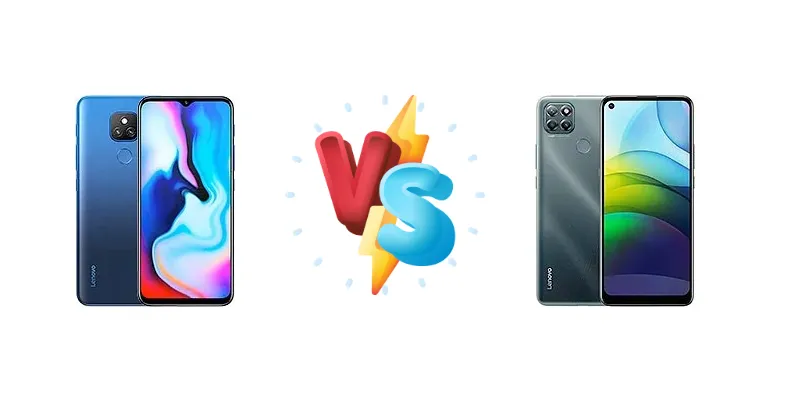
The Lenovo K12 and K12 Pro represent Lenovo's approach to the competitive budget smartphone market. While visually similar, the core differences lie beneath the surface, specifically in their chipsets and charging capabilities. This comparison dissects those differences to help you determine which K12 variant best suits your needs.
🏆 Quick Verdict
For most users, the Lenovo K12 Pro is the superior choice. Its Snapdragon 662 chipset offers a noticeable performance boost over the K12’s Snapdragon 460, and the faster 20W charging significantly reduces downtime. The K12 remains a viable option for extremely budget-conscious users.
| Network |
|---|
| 2G bands | GSM 850 / 900 / 1800 / 1900 | GSM 850 / 900 / 1800 / 1900 |
| 3G bands | HSDPA 850 / 900 / 1900 / 2100 | HSDPA 850 / 900 / 1700(AWS) / 1900 / 2100 |
| 4G bands | 1, 3, 5, 7, 8, 20, 28, 38, 39, 40, 41 | 1, 3, 4, 5, 7, 8, 18, 19, 20, 26, 28, 38, 39, 40, 41 |
| Speed | HSPA, LTE | HSPA, LTE |
| Technology | GSM / HSPA / LTE | GSM / HSPA / LTE |
| Launch |
|---|
| Announced | 2020, December 09. Released 2020, December 12 | 2020, December 09. Released 2020, December 12 |
| Status | Discontinued | Discontinued |
| Body |
|---|
| Dimensions | 165.2 x 75.7 x 9.2 mm (6.50 x 2.98 x 0.36 in) | 172.1 x 76.8 x 9.7 mm (6.78 x 3.02 x 0.38 in) |
| SIM | Nano-SIM + Nano-SIM | · Nano-SIM· Nano-SIM + Nano-SIM |
| Weight | 200 g (7.05 oz) | 221 g (7.80 oz) |
| | - | Water-repellent coating |
| Display |
|---|
| Resolution | 720 x 1600 pixels, 20:9 ratio (~270 ppi density) | 720 x 1640 pixels (~263 ppi density) |
| Size | 6.5 inches, 102.0 cm2 (~81.6% screen-to-body ratio) | 6.8 inches, 109.8 cm2 (~83.1% screen-to-body ratio) |
| Type | IPS LCD | IPS LCD |
| Platform |
|---|
| CPU | Octa-core (4x1.8 GHz Kryo 240 & 4x1.6 GHz Kryo 240) | Octa-core (4x2.0 GHz Kryo 260 Gold & 4x1.8 GHz Kryo 260 Silver) |
| Chipset | Qualcomm SM4250 Snapdragon 460 (11 nm) | Qualcomm SM6115 Snapdragon 662 (11 nm) |
| GPU | Adreno 610 | Adreno 610 |
| OS | Android 10 | Android 10 |
| Memory |
|---|
| Card slot | microSDXC (uses shared SIM slot) | microSDXC (uses shared SIM slot) |
| Internal | 64GB 4GB RAM | 64GB 4GB RAM, 128GB 4GB RAM |
| | eMMC 5.1 | - |
| Main Camera |
|---|
| Dual | 48 MP, f/1.7, 26mm (wide), 1/2.0", 0.8µm, PDAF
Auxiliary lens | - |
| Features | LED flash, HDR, panorama | LED flash, HDR, panorama |
| Triple | - | 64 MP, f/1.8, 26mm (wide), 1/1.97", 0.7µm, PDAF
2 MP (macro)
Auxiliary lens |
| Video | 1080p@30/60fps | 1080p@30/60fps |
| Selfie camera |
|---|
| Features | HDR | HDR |
| Single | 8 MP, f/2.2, 26mm (wide), 1/4.0", 1.12µm | 16 MP, f/2.2, 1.0µm |
| Video | 1080p@30fps | 1080p@30fps |
| Sound |
|---|
| 3.5mm jack | Yes | Yes |
| 35mm jack | Yes | Yes |
| Loudspeaker | Yes | Yes |
| Comms |
|---|
| Bluetooth | 5.0, A2DP, LE | 5.0, A2DP, LE |
| NFC | No | Yes |
| Positioning | GPS, GLONASS, GALILEO | GPS, GLONASS, GALILEO |
| Radio | FM radio | FM radio |
| USB | microUSB 2.0, OTG | USB Type-C 2.0, OTG |
| WLAN | Wi-Fi 802.11 b/g/n | Wi-Fi 802.11 a/b/g/n/ac, dual-band, Wi-Fi Direct |
| Features |
|---|
| Sensors | Fingerprint (rear-mounted), accelerometer, proximity | Fingerprint (rear-mounted), accelerometer, proximity |
| Battery |
|---|
| Charging | 10W wired
2.5W reverse wired | 20W wired
2.5W reverse wired |
| Type | Li-Po 5000 mAh | Li-Po 6000 mAh |
| Misc |
|---|
| Colors | Navy Blue, Gray | Electric Violet, Metallic Sage |
| Models | - | XT2091-8, XT2091-7 |
| Price | About 100 EUR | About 130 EUR |
Lenovo K12 (China)
- Most affordable option
- Sufficient for basic tasks
- Reverse wired charging
- Slow Snapdragon 460 processor
- Slow 10W charging
- Limited multitasking capabilities
Lenovo K12 Pro
- Faster Snapdragon 662 processor
- 20W fast charging
- Improved multitasking performance
- Higher price point
- Still not a high-end performer
- Limited camera details
Display Comparison
Both devices likely feature similar LCD panels, given their market positioning. However, detailed display specs (resolution, brightness, color gamut) are unavailable. The focus here is on internal performance, not display fidelity. Expect standard viewing experiences for the price point.
Camera Comparison
Without detailed camera specifications, a direct comparison is limited. Both phones likely feature a multi-camera setup, but the image quality will heavily depend on sensor size and image processing. Given the price bracket, expect competent but not exceptional camera performance. The absence of information regarding OIS or large sensors suggests a focus on affordability over photographic excellence.
Performance
The core differentiator is the chipset. The Lenovo K12 utilizes the Qualcomm SM4250 Snapdragon 460, an 11nm processor with an octa-core configuration split between 1.8 GHz and 1.6 GHz Kryo 240 cores. The K12 Pro steps up to the Qualcomm SM6115 Snapdragon 662, also 11nm, but with faster 2.0 GHz Kryo 260 Gold cores and 1.8 GHz Kryo 260 Silver cores. This translates to a tangible performance advantage for the Pro model in app loading times, multitasking, and gaming. The 662’s architecture is more efficient, leading to better sustained performance under load. While neither phone is a gaming powerhouse, the K12 Pro will handle moderately demanding titles with greater ease.
Battery Life
Both devices offer 2.5W reverse wired charging, a niche feature for emergency top-ups of accessories. The key difference lies in wired charging speed: the K12 supports a slow 10W, while the K12 Pro boasts 20W. This doubling of charging wattage significantly reduces charging times. While battery capacity is not specified, the faster charging of the K12 Pro mitigates any potential disadvantage from a slightly smaller battery, offering a more convenient user experience.
Buying Guide
Buy the Lenovo K12 (China) if you prioritize absolute affordability and your smartphone usage is limited to basic tasks like calls, texts, and light social media. Buy the Lenovo K12 Pro if you value smoother multitasking, occasional gaming, and faster charging, even if it means spending a bit more. The Pro model offers a more future-proof experience.
Frequently Asked Questions
❓ Will the Snapdragon 662 in the K12 Pro handle popular games like PUBG Mobile?
The Snapdragon 662 is capable of running PUBG Mobile, but likely at medium graphics settings and frame rates to maintain a smooth experience. Don't expect flagship-level performance, but it's a significant improvement over the K12's Snapdragon 460.
❓ How long will it take to fully charge the Lenovo K12 Pro from 0%?
With 20W charging, the K12 Pro should fully charge in approximately 1.5 to 2 hours, depending on usage during charging. This is considerably faster than the K12's 10W charging, which could take upwards of 3-4 hours.
❓ Is the difference in performance between the Snapdragon 460 and 662 noticeable for everyday tasks?
Yes, the difference is noticeable. While both chips can handle basic tasks, the Snapdragon 662 offers smoother app switching, faster loading times, and a more responsive overall experience, especially when running multiple apps simultaneously.