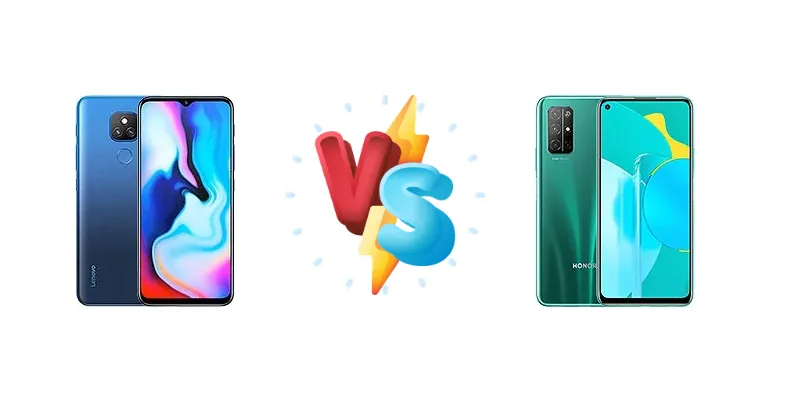
The Lenovo K12 (China) and Honor 30S represent distinct approaches to the mid-range smartphone market. The K12 prioritizes affordability, while the Honor 30S aims for a balance of performance and features, leveraging 5G connectivity. This comparison dissects their key differences to help you determine which device best aligns with your priorities.
🏆 Quick Verdict
For the average user prioritizing performance and future-proofing, the Honor 30S is the clear winner. Its Kirin 820 5G chipset delivers significantly faster processing and smoother multitasking compared to the Lenovo K12’s Snapdragon 460. However, the K12 remains a viable option for budget-conscious users with basic smartphone needs.
| Network |
|---|
| 2G bands | GSM 850 / 900 / 1800 / 1900 | GSM 850 / 900 / 1800 / 1900 |
| 3G bands | HSDPA 850 / 900 / 1900 / 2100 | HSDPA 800 / 850 / 900 / 1700(AWS) / 1900 / 2100 |
| 4G bands | 1, 3, 5, 7, 8, 20, 28, 38, 39, 40, 41 | 1, 2, 3, 4, 5, 6, 8, 18, 19, 26, 34, 38, 39, 40, 41 |
| 5G bands | - | 1, 3, 41, 78, 79 SA/NSA |
| Speed | HSPA, LTE | HSPA, LTE, 5G |
| Technology | GSM / HSPA / LTE | GSM / CDMA / HSPA / LTE / 5G |
| | - | CDMA 800 & TD-SCDMA |
| Launch |
|---|
| Announced | 2020, December 09. Released 2020, December 12 | 2020, March 30. Released 2020, April 07 |
| Status | Discontinued | Discontinued |
| Body |
|---|
| Build | - | Glass front (Aluminosilicate glass), glass back, aluminum frame |
| Dimensions | 165.2 x 75.7 x 9.2 mm (6.50 x 2.98 x 0.36 in) | 162.3 x 75 x 8.6 mm (6.39 x 2.95 x 0.34 in) |
| SIM | Nano-SIM + Nano-SIM | Nano-SIM + Nano-SIM |
| Weight | 200 g (7.05 oz) | 190 g (6.70 oz) |
| Display |
|---|
| Protection | - | Aluminosilicate glass |
| Resolution | 720 x 1600 pixels, 20:9 ratio (~270 ppi density) | 1080 x 2400 pixels, 20:9 ratio (~405 ppi density) |
| Size | 6.5 inches, 102.0 cm2 (~81.6% screen-to-body ratio) | 6.5 inches, 102.0 cm2 (~83.8% screen-to-body ratio) |
| Type | IPS LCD | IPS LCD, HDR10 |
| Platform |
|---|
| CPU | Octa-core (4x1.8 GHz Kryo 240 & 4x1.6 GHz Kryo 240) | Octa-core (1x2.36 GHz Cortex-A76 & 3x2.22 GHz Cortex-A76 & 4x1.84 GHz Cortex-A55) |
| Chipset | Qualcomm SM4250 Snapdragon 460 (11 nm) | Kirin 820 5G (7 nm) |
| GPU | Adreno 610 | Mali-G57 6 |
| OS | Android 10 | Android 10, Magic UI 3, no Google Play Services |
| Memory |
|---|
| Card slot | microSDXC (uses shared SIM slot) | Nano Memory (uses shared SIM slot) |
| Internal | 64GB 4GB RAM | 128GB 6GB RAM, 128GB 8GB RAM, 256GB 8GB RAM |
| | eMMC 5.1 | UFS 2.1 |
| Main Camera |
|---|
| Dual | 48 MP, f/1.7, 26mm (wide), 1/2.0", 0.8µm, PDAF
Auxiliary lens | - |
| Features | LED flash, HDR, panorama | LED flash, HDR, panorama |
| Quad | - | 64 MP, f/1.8, 26mm (wide), 1/1.73", 0.8µm, PDAF
8 MP, f/2.4, 80mm (telephoto), AF, 3x optical zoom
8 MP, f/2.4, 17mm (ultrawide)
Auxiliary lens |
| Video | 1080p@30/60fps | 4K@30fps, 1080p@30fps, 720p@960fps, gyro-EIS |
| Selfie camera |
|---|
| Features | HDR | HDR |
| Single | 8 MP, f/2.2, 26mm (wide), 1/4.0", 1.12µm | 16 MP, f/2.0, (wide) |
| Video | 1080p@30fps | 1080p@30fps |
| Sound |
|---|
| 3.5mm jack | Yes | Yes |
| 35mm jack | Yes | Yes |
| Loudspeaker | Yes | Yes |
| | - | 32-bit/192kHz audio |
| Comms |
|---|
| Bluetooth | 5.0, A2DP, LE | 5.1, A2DP, LE |
| NFC | No | No |
| Positioning | GPS, GLONASS, GALILEO | GPS, GLONASS, BDS |
| Radio | FM radio | No |
| USB | microUSB 2.0, OTG | USB Type-C 2.0, OTG |
| WLAN | Wi-Fi 802.11 b/g/n | Wi-Fi 802.11 a/b/g/n/ac, dual-band, Wi-Fi Direct |
| Features |
|---|
| Sensors | Fingerprint (rear-mounted), accelerometer, proximity | Fingerprint (side-mounted), accelerometer, gyro, proximity, compass |
| Battery |
|---|
| Charging | 10W wired
2.5W reverse wired | 40W wired, 70% in 30 min |
| Type | Li-Po 5000 mAh | Li-Po 4000 mAh |
| Misc |
|---|
| Colors | Navy Blue, Gray | Black, Blue, Green, Gradient, Butterfly Feather Red |
| Models | - | CDY-AN90, CDY-AN95, CDY-TN90 |
| Price | About 100 EUR | About 310 EUR |
Lenovo K12 (China)
- Extremely affordable price point
- Functional for basic smartphone tasks
- 2.5W reverse wired charging
- Significantly slower performance
- Slow 10W charging
- Likely lower-quality display and camera
Honor 30S
- Powerful Kirin 820 5G chipset
- 40W fast charging (70% in 30 min)
- Superior performance for gaming and multitasking
- Higher price compared to Lenovo K12
- No reverse wireless charging
- Potential for software bloat (Honor's history)
Display Comparison
While display specifications are missing for the Lenovo K12, its market positioning suggests a standard LCD panel. The Honor 30S, however, benefits from a more advanced display technology, though specifics like panel type (IPS vs OLED) are not provided. The core difference lies in processing power; the Kirin 820’s image signal processor (ISP) will likely deliver more vibrant colors and sharper images, even if both phones have similar resolutions. Bezels are likely larger on the K12 due to cost constraints.
Camera Comparison
Without detailed camera specs for either device, analysis relies on brand positioning. Honor typically emphasizes camera capabilities, and the Kirin 820’s ISP is designed for advanced image processing. While the K12 likely features a basic camera setup sufficient for casual snapshots, the Honor 30S is expected to deliver superior image quality, particularly in low-light conditions. The Honor 30S’s ISP will likely offer features like AI scene detection and improved dynamic range. The absence of OIS information for both phones suggests neither prioritizes advanced stabilization.
Performance
The performance gap is substantial. The Honor 30S’s Kirin 820 5G, built on a 7nm process, significantly outperforms the Lenovo K12’s Snapdragon 460 (11nm). The Kirin 820 features a more powerful CPU configuration – a single Cortex-A76 core at 2.36 GHz, alongside three additional A76 cores, versus the K12’s four Kryo 240 cores at 1.8 GHz and four at 1.6 GHz. This translates to faster app loading times, smoother multitasking, and a more responsive user experience on the Honor 30S. The 7nm process also contributes to better thermal efficiency, reducing throttling during sustained workloads. The Honor 30S is the clear choice for gamers and power users.
Battery Life
The Honor 30S’s 40W wired charging is a game-changer, capable of reaching 70% charge in just 30 minutes. The Lenovo K12’s 10W charging is comparatively slow, requiring significantly longer to fully charge. While battery capacity isn’t specified for either device, the Honor 30S’s faster charging mitigates the impact of a potentially smaller battery. The K12 also offers 2.5W reverse wired charging, a niche feature for topping up accessories, absent on the Honor 30S.
Buying Guide
Buy the Lenovo K12 (China) if you need a functional, extremely affordable smartphone for essential tasks like calling, texting, and light social media use. You’ll appreciate its simplicity and low price point. Buy the Honor 30S if you prefer a more responsive experience, faster 5G connectivity, and the ability to handle demanding applications and games without significant lag. It’s the better choice for users who value performance and longevity.
Frequently Asked Questions
❓ Is the Kirin 820 in the Honor 30S powerful enough for demanding games like PUBG or Genshin Impact?
Yes, the Kirin 820 is a capable chipset for gaming. While it won't match flagship-level performance, it can comfortably run PUBG and Genshin Impact at medium to high settings with stable frame rates. The 7nm process also helps manage heat, reducing throttling during extended gaming sessions.
❓ Does the Lenovo K12 support 5G connectivity, and is the Snapdragon 460 sufficient for modern apps?
The Lenovo K12 does *not* support 5G; it relies on 4G LTE. The Snapdragon 460 is a budget-oriented chipset and may struggle with demanding applications or heavy multitasking. It's best suited for basic tasks like calling, texting, and light social media browsing.
❓ How long does it realistically take to fully charge the Lenovo K12 with its 10W charger?
With a 10W charger, fully charging the Lenovo K12 will likely take between 3 to 4 hours, depending on the battery capacity. This is significantly slower than the Honor 30S's 40W fast charging.
❓ Is the Honor 30S still a good buy in [current year], considering newer phones are available?
Yes, the Honor 30S remains a compelling option, particularly if you can find it at a discounted price. Its Kirin 820 chipset still offers respectable performance, and the 40W fast charging is a valuable feature. However, consider your long-term needs and whether newer phones with improved features and software support are worth the extra investment.