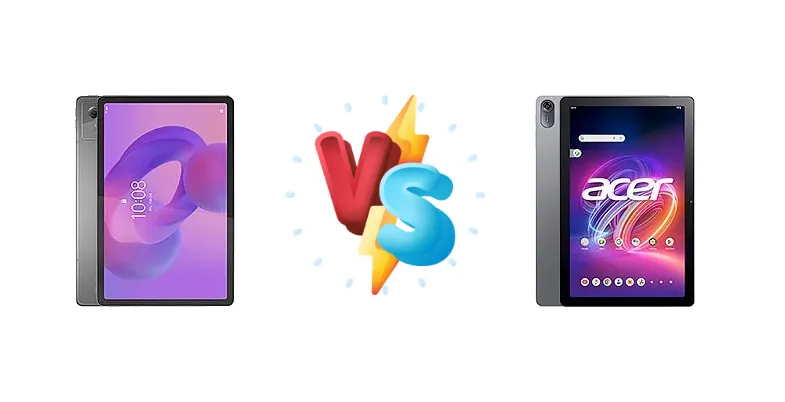
The tablet market is increasingly competitive, with manufacturers focusing on delivering a balance of performance and affordability. The Lenovo Idea Tab and the Acer Iconia Tab P10 (2025) both aim to provide a solid experience, but they take different approaches. This comparison will dissect their core components – processors, battery capacity, and charging capabilities – to determine which tablet best suits your needs.
🏆 Quick Verdict
For users prioritizing longevity, the Lenovo Idea Tab is the clear winner. Its exceptional 94:01h battery endurance, coupled with 1000 charge cycles, significantly outpaces the Acer Iconia Tab P10 (2025). While the Acer offers a slightly newer chipset, the Lenovo’s battery performance makes it the more practical choice for extended use.
| Network |
|---|
| 2G bands | GSM 850 / 900 / 1800 / 1900 - cellular model only | N/A |
| 3G bands | HSDPA 850 / 900 / 1700(AWS) / 1900 / 2100 / 1800 - cellular model only | N/A |
| 4G bands | 1, 2, 3, 4, 5, 7, 8, 12, 13, 18, 19, 20, 25, 26, 28, 38, 40, 41, 66 - cellular model only | N/A |
| 5G bands | 1, 2, 3, 5, 7, 8, 20, 26, 28, 38, 40, 41, 66, 71, 77, 78 SA/NSA/Sub6 - cellular model only | - |
| EDGE | - | No |
| GPRS | - | No |
| Speed | HSPA, LTE, 5G - cellular model only | - |
| Technology | GSM / HSPA / LTE / 5G | No cellular connectivity |
| Launch |
|---|
| Announced | 2025, September 07 | 2025, Q4 |
| Status | Available. Released 2025, October | Available. Released 2025, Q4 |
| Body |
|---|
| Build | Glass front, aluminum frame, aluminum back | Glass front, aluminum alloy frame |
| Dimensions | 254.6 x 166.2 x 7 mm (10.02 x 6.54 x 0.28 in) | 8.1 mm thickness |
| SIM | Nano-SIM - cellular model only | No |
| Weight | 480 g (1.06 lb) | 495 g (1.09 lb) |
| Display |
|---|
| Protection | Mohs level 5 | - |
| Resolution | 2560 x 1600 pixels, 16:10 ratio (~274 ppi density) | 1200 x 2000 pixels, 5:3 ratio (~224 ppi density) |
| Size | 11.0 inches, 350.9 cm2 (~82.9% screen-to-body ratio) | 10.4 inches, 307.9 cm2 |
| Type | IPS LCD, 90Hz, 500 nits | IPS LCD, 90Hz |
| Platform |
|---|
| CPU | Octa-core (2x2.4 GHz Cortex-A76 & 6x2.0 GHz Cortex-A55) | Octa-core (2x2.2 GHz Cortex-A76 & 6x2.0 GHz Cortex-A55) |
| Chipset | Mediatek Dimensity 6300 (6 nm) | Mediatek Helio G99 (6 nm) |
| GPU | Mali-G57 MC2 | Mali-G57 MC2 |
| OS | Android 15, up to 2 major Android upgrades | Android 14 |
| Memory |
|---|
| Card slot | microSDXC | microSDXC (dedicated slot) |
| Internal | 128GB 4GB RAM, 256GB 4GB RAM, 256GB 8GB RAM | 128GB 6GB RAM, 256GB 6GB RAM |
| Main Camera |
|---|
| Single | 8 MP, (wide), AF | 13 MP |
| Video | Yes | 1080p@30fps |
| Selfie camera |
|---|
| Single | 5 MP | 5 MP |
| Video | Yes | Yes |
| Sound |
|---|
| 35mm jack | Yes | Yes |
| Loudspeaker | Yes, with stereo speakers, Dolby Atmos (4 speakers) | Yes, with stereo speakers |
| Comms |
|---|
| Bluetooth | 5.2, A2DP, LE | 5.0, A2DP, LE |
| NFC | No | No |
| Positioning | GPS, GALILEO, GLONASS | GPS |
| Radio | No | No |
| USB | USB Type-C 2.0, accessory connector pins | USB Type-C 2.0 |
| WLAN | Wi-Fi 802.11 a/b/g/n/ac, Wi-Fi Direct | Wi-Fi 802.11 a/b/g/n/ac, dual-band |
| Features |
|---|
| Sensors | Accelerometer, proximity (accessories only) | Gyro |
| Battery |
|---|
| Charging | 20W wired | 10W wired |
| Type | Li-Ion 7040 mAh | Li-Ion 8000 mAh |
| Misc |
|---|
| Colors | Luna grey, Polar blue | Iron Gray |
| Models | TB336FU, TB336ZU | P10-21Q-870Q, NT.LHBAA.001 |
| Price | $ 119.99 | About 220 EUR |
| EU LABEL |
|---|
| Battery | 94:01h endurance, 1000 cycles | - |
| Energy | Class E | - |
| Free fall | Class E (9 falls) | - |
| Repairability | Class A | - |
Lenovo Idea Tab
- Exceptional battery life (94:01h endurance)
- Faster 20W wired charging
- High battery cycle count (1000 cycles)
- Slightly lower CPU clock speed on primary cores
- Missing display specifications
Acer Iconia Tab P10 (2025)
- Slightly newer chipset (Helio G99)
- Potentially lower price point (market dependent)
- 6nm process for efficiency
- Significantly slower 10W charging
- No battery endurance data available
- Likely shorter battery lifespan
Display Comparison
Display specifications are absent from the provided data, making a direct comparison impossible. However, given the target market of both devices, we can assume both utilize IPS LCD panels. The absence of details like resolution, refresh rate, and brightness suggests neither tablet is positioned as a premium display experience. Users should research these aspects independently based on their visual preferences.
Camera Comparison
Camera details are unavailable, but given the tablet category and price point, expectations should be tempered. It’s reasonable to assume both devices feature basic camera setups suitable for video calls and casual snapshots. Without sensor size or aperture information, a meaningful comparison is impossible. Users should not expect flagship-level image quality from either device.
Performance
Both tablets employ Mediatek chipsets built on a 6nm process, indicating similar efficiency levels. However, the Lenovo Idea Tab features the Dimensity 6300, while the Acer Iconia Tab P10 (2025) uses the Helio G99. While the Helio G99’s Cortex-A76 cores clock slightly higher at 2.2 GHz versus the Dimensity 6300’s 2.4 GHz, the difference is likely minimal in real-world usage. Both CPUs share the same Cortex-A55 efficiency cores clocked at 2.0 GHz. The Dimensity 6300’s architecture may offer better overall system-level optimization, potentially leading to smoother multitasking. The lack of RAM specifications prevents a full performance assessment, but the chipset choice suggests both are geared towards mid-range performance.
Battery Life
The Lenovo Idea Tab’s battery performance is its standout feature, boasting an impressive 94:01h endurance and a robust 1000 charge cycles. This suggests a significantly longer lifespan and reduced battery degradation over time. In contrast, the Acer Iconia Tab P10 (2025) lacks specific endurance data, but its 10W wired charging is considerably slower than the Lenovo’s 20W charging. This means the Acer will take longer to fully recharge, impacting usability for users who need quick top-ups. The Lenovo’s faster charging and superior endurance make it the clear winner in this category.
Buying Guide
Buy the Lenovo Idea Tab if you need a tablet that can reliably last through long flights, workdays, or entertainment sessions without frequent charging. It’s ideal for students, travelers, and anyone who values uninterrupted usage. Buy the Acer Iconia Tab P10 (2025) if you prioritize a marginally newer chipset and are willing to compromise on battery life, potentially keeping a charger nearby for extended use. It may appeal to users who primarily use their tablet for short bursts of activity.
Frequently Asked Questions
❓ How will the slower charging speed of the Acer Iconia Tab P10 (2025) impact daily use?
The Acer’s 10W charging is significantly slower than the Lenovo’s 20W. This means it will take considerably longer to fully recharge the battery, potentially requiring overnight charging even for moderate use. Users who frequently need to top up their tablet throughout the day will find the Lenovo’s faster charging much more convenient.
❓ Does the Mediatek Helio G99 chipset in the Acer Iconia Tab P10 (2025) offer a noticeable performance boost over the Dimensity 6300 in the Lenovo Idea Tab for gaming?
While the Helio G99 has slightly higher clocked CPU cores, the difference in real-world gaming performance is likely to be minimal. Both chipsets are designed for mid-range tablets and will handle casual gaming adequately. The Lenovo’s potentially better system-level optimization with the Dimensity 6300 could offset the slight clock speed advantage of the Helio G99.
❓ What does the 1000 charge cycle rating of the Lenovo Idea Tab mean for long-term ownership?
A 1000 charge cycle rating indicates that the Lenovo Idea Tab’s battery is designed to retain a significant portion of its original capacity after being fully charged and discharged 1000 times. This suggests a longer battery lifespan and reduced degradation over time compared to tablets with lower cycle counts, offering better value in the long run.