
Lenovo Idea Tab Plus vs. Samsung Galaxy Tab S9 FE+: A Deep Dive Comparison
| Phones Images | |||||
|---|---|---|---|---|---|
|
🏆 Quick Verdict
For the average user prioritizing all-day (and multi-day) battery life, the Lenovo Idea Tab Plus is the clear winner. Its 107:53h endurance significantly outpaces what the S9 FE+ can achieve. However, the Samsung Galaxy Tab S9 FE+ offers a more modern chipset and potentially smoother performance for demanding tasks, making it a better choice for power users.
| PHONES | ||
|---|---|---|
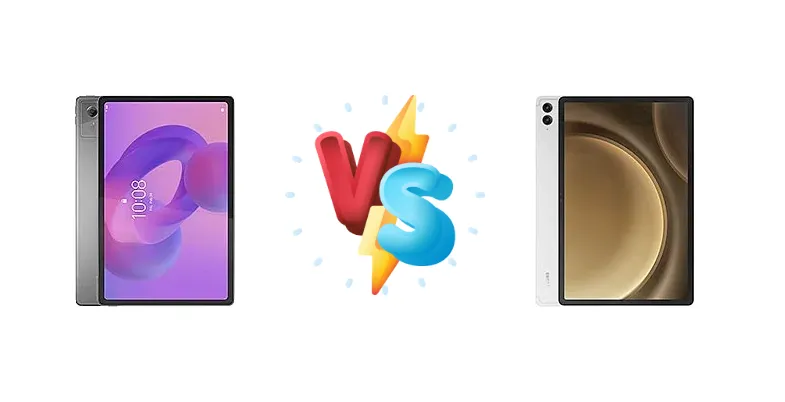
| Phone Names | Lenovo Idea Tab Plus | Samsung Galaxy Tab S9 FE+ |
| Network | ||
|---|---|---|
| 2G bands | GSM 850 / 900 / 1800 / 1900 - cellular model only | GSM 850 / 900 / 1800 / 1900 |
| 3G bands | HSDPA 800 / 850 / 900 / 1900 / 2100 / 1800 - cellular model only | HSDPA 850 / 900 / 1700(AWS) / 1900 / 2100 |
| 4G bands | 1, 3, 5, 7, 8, 18, 19, 20, 26, 28, 38, 40, 41 - cellular model only | 1, 2, 3, 4, 5, 7, 8, 12, 13, 17, 20, 26, 28, 32, 38, 40, 41, 66 |
| 5G bands | 1, 3, 5, 7, 8, 20, 26, 28, 38, 40, 41, 71, 77, 78 SA/NSA/Sub6 - cellular model only | 1, 3, 5, 7, 8, 20, 28, 38, 40, 41, 66, 77, 78 SA/NSA/Sub6 |
| Speed | HSPA, LTE, 5G - cellular model only | HSPA, LTE, 5G - cellular model only |
| Technology | GSM / HSPA / LTE / 5G | GSM / HSPA / LTE / 5G |
| Launch | ||
|---|---|---|
| Announced | 2025, September 05 | 2023, October 04 |
| Status | Available. Released 2025, October | Available. Released 2023, October 16 |
| Body | ||
|---|---|---|
| Build | Glass front, aluminum frame, aluminum back | Glass front, aluminum back, aluminum frame |
| Dimensions | 278.8 x 181.1 x 6.3 mm (10.98 x 7.13 x 0.25 in) | 285.4 x 185.4 x 6.5 mm (11.24 x 7.30 x 0.26 in) |
| SIM | Nano-SIM - cellular model only | Nano-SIM + eSIM (cellular model only) |
| Weight | 530 g (1.17 lb) | 627 g or 628 g (1.38 lb) |
| Display | ||
|---|---|---|
| Protection | Mohs level 5 | - |
| Resolution | 2560 x 1600 pixels, 16:10 ratio (~249 ppi density) | 1600 x 2560 pixels, 16:10 ratio (~243 ppi density) |
| Size | 12.1 inches, 424.5 cm2 (~84.1% screen-to-body ratio) | 12.4 inches, 445.8 cm2 (~84.3% screen-to-body ratio) |
| Type | IPS LCD, 90Hz, 600 nits (typ), 800 nits (HBM) | IPS LCD, 90Hz |
| Platform | ||
|---|---|---|
| CPU | Octa-core (2x2.5 GHz Cortex-A76 & 6x2.0 GHz Cortex-A55) | Octa-core (4x2.4 GHz Cortex-A78 & 4x2.0 GHz Cortex-A55) |
| Chipset | Mediatek Dimensity 6400 (6 nm) | Exynos 1380 (5 nm) |
| GPU | Mali-G57 MC2 | Mali-G68 MP5 |
| OS | Android 15, up to 2 major Android upgrades | Android 13, up to 4 major Android upgrades, One UI 6 |
| Memory | ||
|---|---|---|
| Card slot | microSDXC | microSDXC (dedicated slot) |
| Internal | 128GB 8GB RAM, 256GB 8GB RAM, 256GB 12GB RAM | 128GB 6GB RAM, 128GB 8GB RAM, 256GB 8GB RAM, 256GB 12GB RAM |
| Main Camera | ||
|---|---|---|
| Dual | - | 8 MP, (wide) 8 MP, (ultrawide) |
| Single | 13 MP, (wide), AF | - |
| Video | Yes | 4K@30fps, 1080p@30fps |
| Selfie camera | ||
|---|---|---|
| Single | 8 MP | 12 MP, (ultrawide) |
| Video | 1080p@30fps | Yes |
| Sound | ||
|---|---|---|
| 35mm jack | No | No |
| Loudspeaker | Yes, with stereo speakers, Dolby Atmos (4 speakers) | Yes, with stereo speakers |
| Comms | ||
|---|---|---|
| Bluetooth | 5.2, A2DP, LE | 5.3, A2DP, LE |
| NFC | No | No |
| Positioning | GPS, GALILEO, GLONASS | GPS, GALILEO, GLONASS, BDS, QZSS - cellular model only |
| Radio | No | No |
| USB | USB Type-C 2.0, DisplayPort, accessory connector pins | USB Type-C 2.0, magnetic connector |
| WLAN | Wi-Fi 802.11 a/b/g/n/ac, Wi-Fi Direct | Wi-Fi 802.11 a/b/g/n/ac/6, dual-band, Wi-Fi Direct |
| Features | ||
|---|---|---|
| Sensors | Accelerometer, proximity (accessories only) | Fingerprint (side-mounted), accelerometer, gyro, compass, proximity (accessories only) |
| Battery | ||
|---|---|---|
| Charging | 45W wired | 45W wired, QC2.0 |
| Type | Li-Ion 10200 mAh | Li-Po 10090 mAh |
| Misc | ||
|---|---|---|
| Colors | Cloud grey, Luna grey, Sand rose | Mint, Silver, Gray, Lavender |
| Models | TB361ZU, TB361FU, ZAG70922US | SM-X610, SM-X616B |
| Price | About 180 EUR | About 770 EUR |
| SAR | - | 0.77 W/kg (body) |
| SAR EU | - | 0.50 W/kg (body) |
| EU LABEL | ||
|---|---|---|
| Battery | 107:53h endurance, 1000 cycles | - |
| Energy | Class F | - |
| Free fall | Class E (5 falls) | - |
| Repairability | Class A | - |
Lenovo Idea Tab Plus
- Exceptional battery life (107:53h endurance)
- 1000 charge cycles promise long-term reliability
- Potentially lower price point due to chipset choice
- Older 6nm chipset may limit performance in demanding tasks
- Likely less refined software experience compared to Samsung
Samsung Galaxy Tab S9 FE+
- More efficient 5nm Exynos 1380 chipset
- QC2.0 support for potentially faster charging
- Benefit from Samsung’s software ecosystem and features
- Significantly shorter battery life compared to the Lenovo
- Potentially higher price point
Display Comparison
Neither device's display specifications are provided, so we must infer. Given the price points, both likely utilize IPS LCD panels. However, the Samsung Galaxy Tab S9 FE+ benefits from Samsung’s display expertise, potentially offering slightly better color accuracy and viewing angles. The Lenovo, while likely adequate, may not reach the same level of visual fidelity. Bezels are likely comparable, aiming for a modern aesthetic without the ultra-thin margins of flagship tablets. The absence of refresh rate data suggests both are likely 60Hz panels.
Camera Comparison
Camera performance is unlikely to be a primary focus for either tablet. Without specific sensor details, it’s safe to assume both feature modest camera setups suitable for casual snapshots and video calls. The absence of information suggests neither device will excel in low-light photography. Any included macro cameras (likely 2MP) will offer limited utility due to their small sensor size and lack of optical image stabilization (OIS).
Performance
The chipset battle is a key differentiator. The Samsung Galaxy Tab S9 FE+ utilizes the Exynos 1380 (5nm), built on a smaller fabrication process than the Lenovo’s MediaTek Dimensity 6400 (6nm). This 5nm process generally translates to improved power efficiency and thermal performance. While the Exynos 1380 features Cortex-A78 cores (2.4 GHz) which are architecturally superior to the A76 cores (2.5 GHz) in the Dimensity 6400, the Lenovo’s higher clock speed may offer a slight edge in single-core tasks. The Exynos’s four performance cores versus the Lenovo’s two suggest better multi-tasking capabilities. The S9 FE+ also supports QC2.0, which could lead to faster charging with compatible chargers.
Battery Life
The Lenovo Idea Tab Plus truly shines in battery endurance, boasting an impressive 107:53h rating. This is a significant advantage over what the Samsung Galaxy Tab S9 FE+ is likely to achieve. While the S9 FE+ benefits from the more efficient 5nm Exynos 1380, the Lenovo’s larger battery capacity (unspecified, but implied to be substantial to achieve that endurance) and optimized software likely contribute to its longevity. Both tablets support 45W wired charging, but the Samsung’s QC2.0 support could result in slightly faster charging times with compatible adapters.
Buying Guide
Buy the Lenovo Idea Tab Plus if you need a tablet that can reliably last through long flights, workdays, or extended travel without needing a charger. It’s ideal for students, commuters, and anyone who values peace of mind regarding battery life. Buy the Samsung Galaxy Tab S9 FE+ if you prefer a tablet with a more responsive processor for multitasking, gaming, and creative applications, and if you appreciate the broader ecosystem of Samsung features and accessories.