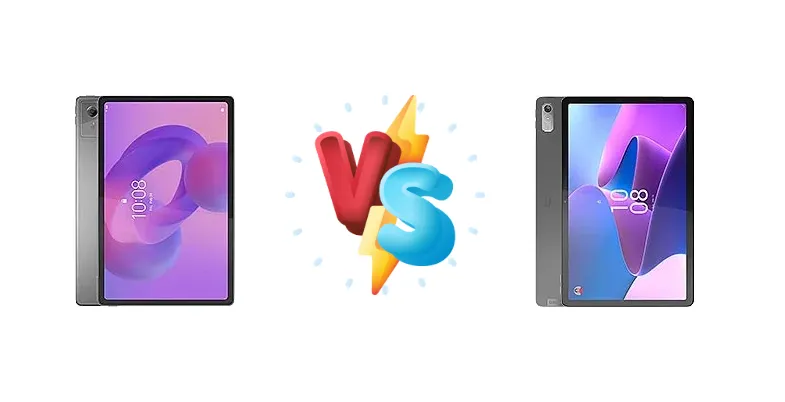
Lenovo offers a compelling range of Android tablets, but the Idea Tab Plus and the Tab P11 Pro Gen 2 represent distinct approaches. The Idea Tab Plus prioritizes exceptional battery life, while the P11 Pro Gen 2 aims for a more powerful processing experience. This comparison dissects the key differences to help you choose the right tablet for your needs.
🏆 Quick Verdict
For the average user prioritizing longevity, the Lenovo Idea Tab Plus is the better choice. Its remarkable 107:53h battery endurance significantly outpaces the P11 Pro Gen 2, making it ideal for travel or extended use. However, users demanding peak performance will find the P11 Pro Gen 2 more appealing.
| Network |
|---|
| 2G bands | GSM 850 / 900 / 1800 / 1900 - cellular model only | GSM 850 / 900 / 1800 / 1900 |
| 3G bands | HSDPA 800 / 850 / 900 / 1900 / 2100 / 1800 - cellular model only | HSDPA 850 / 900 / 1900 / 2100 |
| 4G bands | 1, 3, 5, 7, 8, 18, 19, 20, 26, 28, 38, 40, 41 - cellular model only | LTE |
| 5G bands | 1, 3, 5, 7, 8, 20, 26, 28, 38, 40, 41, 71, 77, 78 SA/NSA/Sub6 - cellular model only | - |
| Speed | HSPA, LTE, 5G - cellular model only | HSPA, LTE - cellular model only |
| Technology | GSM / HSPA / LTE / 5G | GSM / HSPA / LTE |
| Launch |
|---|
| Announced | 2025, September 05 | 2022, September 01 |
| Status | Available. Released 2025, October | Available. Released 2022, September 01 |
| Body |
|---|
| Build | Glass front, aluminum frame, aluminum back | Glass front, plastic back, plastic frame |
| Dimensions | 278.8 x 181.1 x 6.3 mm (10.98 x 7.13 x 0.25 in) | 263.7 x 166.7 x 6.8 mm (10.38 x 6.56 x 0.27 in) |
| SIM | Nano-SIM - cellular model only | Nano-SIM (cellular model only) |
| Weight | 530 g (1.17 lb) | 480 g (1.06 lb) |
| | - | Stylus support (magnetic) |
| Display |
|---|
| Protection | Mohs level 5 | - |
| Resolution | 2560 x 1600 pixels, 16:10 ratio (~249 ppi density) | 1536 x 2560 pixels, 5:3 ratio (~267 ppi density) |
| Size | 12.1 inches, 424.5 cm2 (~84.1% screen-to-body ratio) | 11.2 inches, 357.0 cm2 (~81.2% screen-to-body ratio) |
| Type | IPS LCD, 90Hz, 600 nits (typ), 800 nits (HBM) | OLED, HDR10+, Dolby Vision, 120Hz, 420 nits (typ), 600 nits (peak) |
| Platform |
|---|
| CPU | Octa-core (2x2.5 GHz Cortex-A76 & 6x2.0 GHz Cortex-A55) | Octa-core (4x2.6 GHz Cortex-A78 & 4x2.0 GHz Cortex-A55) |
| Chipset | Mediatek Dimensity 6400 (6 nm) | Mediatek MT8797 Kompanio 1300T (6 nm) |
| GPU | Mali-G57 MC2 | Mali-G77 MC9 |
| OS | Android 15, up to 2 major Android upgrades | Android 12, upgradable to Android 13 |
| Memory |
|---|
| Card slot | microSDXC | microSDXC (dedicated slot) |
| Internal | 128GB 8GB RAM, 256GB 8GB RAM, 256GB 12GB RAM | 128GB 4GB RAM, 128GB 6GB RAM, 256GB 8GB RAM |
| | - | UFS 3.1 |
| Main Camera |
|---|
| Features | - | LED flash |
| Single | 13 MP, (wide), AF | 13 MP, f/2.4, (wide), AF |
| Video | Yes | 1080p@30fps |
| Selfie camera |
|---|
| Single | 8 MP | 8 MP |
| Video | 1080p@30fps | 1080p@30fps |
| Sound |
|---|
| 3.5mm jack | - | No |
| 35mm jack | No | No |
| Loudspeaker | Yes, with stereo speakers, Dolby Atmos (4 speakers) | Yes, with stereo speakers (4 speakers) |
| | - | Tuned by JBL |
| Comms |
|---|
| Bluetooth | 5.2, A2DP, LE | 5.1, A2DP, LE |
| NFC | No | No |
| Positioning | GPS, GALILEO, GLONASS | GPS, GLONASS - cellular model only |
| Radio | No | No |
| USB | USB Type-C 2.0, DisplayPort, accessory connector pins | USB Type-C 3.0, OTG, magnetic connector, video output |
| WLAN | Wi-Fi 802.11 a/b/g/n/ac, Wi-Fi Direct | Wi-Fi 802.11 a/b/g/n/ac/6, dual-band, Wi-Fi Direct |
| Features |
|---|
| Sensors | Accelerometer, proximity (accessories only) | Accelerometer, gyro, proximity, compass |
| Battery |
|---|
| Charging | 45W wired | 20W wired, QC3 |
| Type | Li-Ion 10200 mAh | Li-Po 8200 mAh |
| Misc |
|---|
| Colors | Cloud grey, Luna grey, Sand rose | Storm Grey, Oat |
| Models | TB361ZU, TB361FU, ZAG70922US | ZAB50194GB, ZAB50043SE |
| Price | About 180 EUR | About 500 EUR |
| Tests |
|---|
| Performance | - |
AnTuTu: 616573 (v9)
GeekBench: 2827 (v5.1) |
| EU LABEL |
|---|
| Battery | 107:53h endurance, 1000 cycles | - |
| Energy | Class F | - |
| Free fall | Class E (5 falls) | - |
| Repairability | Class A | - |
Lenovo Idea Tab Plus
- Exceptional battery life (107:53h)
- Faster 45W charging
- Longer battery lifespan (1000 cycles)
- Less powerful processor
- Potentially lower display quality
Lenovo Tab P11 Pro Gen 2
- More powerful processor (Kompanio 1300T)
- Faster CPU cores (Cortex-A78)
- Likely higher-resolution display
- Shorter battery life
- Slower 20W charging
Display Comparison
Display specifications are not provided, so a direct comparison is limited. However, given the P11 Pro Gen 2’s ‘Pro’ designation, it likely features a higher-resolution display and potentially an OLED panel compared to the Idea Tab Plus, which may utilize an IPS LCD. Bezels are also likely slimmer on the P11 Pro Gen 2, contributing to a more immersive viewing experience. Color accuracy will depend on calibration, but the P11 Pro Gen 2’s potential for OLED technology suggests a wider color gamut.
Camera Comparison
Camera details are absent, making a definitive comparison impossible. However, given the P11 Pro Gen 2’s positioning, it’s reasonable to expect a more sophisticated camera system with potentially larger sensors and improved image processing. The Idea Tab Plus likely features a more basic camera setup suitable for video calls and casual snapshots. Without specific sensor information, it’s difficult to assess low-light performance or dynamic range capabilities.
Performance
The Lenovo Tab P11 Pro Gen 2’s Mediatek MT8797 Kompanio 1300T chipset, with its Cortex-A78 cores clocked at 2.6 GHz, offers a clear performance advantage over the Idea Tab Plus’s Dimensity 6400. The A78 cores are architecturally superior to the A76 cores in the Dimensity 6400, resulting in faster single-core and multi-core performance. While both chipsets are fabricated on a 6nm process, the Kompanio 1300T’s core configuration and higher clock speeds translate to a more responsive user experience, particularly in demanding applications. The P11 Pro Gen 2 is likely to handle multitasking and graphically intensive games with greater ease.
Battery Life
The Lenovo Idea Tab Plus unequivocally wins in battery endurance with its reported 107:53h runtime. This is a substantial lead over what we’d expect from the P11 Pro Gen 2, even with optimized power management. While the P11 Pro Gen 2 supports Quick Charge 3.0 (QC3) and a 20W charging rate, the Idea Tab Plus’s 45W wired charging offers significantly faster replenishment. The Idea Tab Plus’s 1000 charge cycles also suggest a longer lifespan before battery degradation becomes noticeable.
Buying Guide
Buy the Lenovo Idea Tab Plus if you need a tablet that can reliably last through long flights, workdays, or entertainment sessions without frequent charging. It’s perfect for students, commuters, and anyone who values peace of mind regarding battery life. Buy the Lenovo Tab P11 Pro Gen 2 if you prioritize faster application loading, smoother multitasking, and a more responsive experience, especially for demanding tasks like video editing or gaming.
Frequently Asked Questions
❓ Will the Mediatek Kompanio 1300T in the P11 Pro Gen 2 struggle with demanding games like Genshin Impact?
While the Kompanio 1300T is a capable chipset, Genshin Impact is notoriously demanding. Expect to play at medium settings to maintain a stable frame rate. The Idea Tab Plus’s Dimensity 6400 will likely require even lower settings or may experience more noticeable frame drops.
❓ How does the 45W charging on the Idea Tab Plus compare to the 20W charging on the P11 Pro Gen 2 in real-world usage?
The 45W charging on the Idea Tab Plus will significantly reduce charging times. Expect a much faster 0-100% charge compared to the P11 Pro Gen 2, potentially shaving off an hour or more. This is particularly beneficial for users who need to quickly top up their tablet before heading out.
❓ Is the 1000 charge cycle claim for the Idea Tab Plus a significant advantage?
Yes, 1000 charge cycles indicate that the battery is designed to retain a substantial portion of its capacity even after extensive use. This translates to a longer overall lifespan for the tablet, reducing the need for battery replacement down the line.