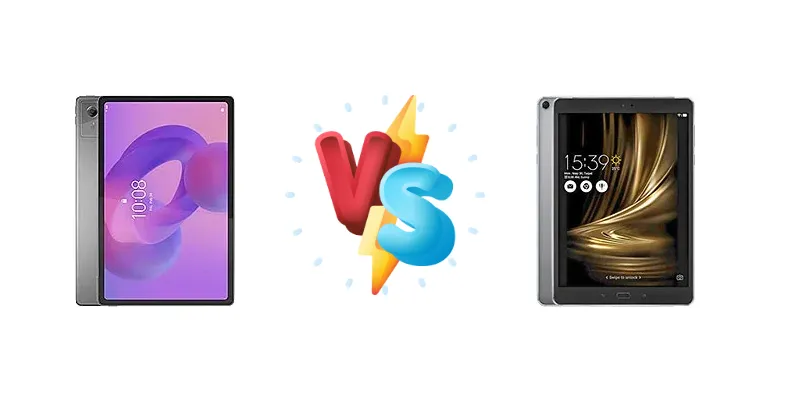
The tablet market offers a diverse range of options, but finding the right balance between performance, battery life, and price can be challenging. We pit the Lenovo Idea Tab Plus, powered by a modern Mediatek Dimensity 6400 chipset, against the Asus Zenpad 3S 10 Z500KL, featuring an older Qualcomm Snapdragon 650, to determine which tablet delivers the best overall experience.
🏆 Quick Verdict
For the average user prioritizing performance and longevity, the Lenovo Idea Tab Plus is the clear winner. Its significantly more powerful Mediatek Dimensity 6400 chipset and exceptional 107:53h battery endurance outweigh the Zenpad 3S 10’s lower price point. The Asus Zenpad 3S 10 remains a viable option for basic tasks, but struggles to compete in demanding scenarios.
| Network |
|---|
| 2G bands | GSM 850 / 900 / 1800 / 1900 - cellular model only | GSM 850 / 900 / 1800 / 1900 - SIM 1 & SIM 2 (dual-SIM model only) |
| 3G bands | HSDPA 800 / 850 / 900 / 1900 / 2100 / 1800 - cellular model only | HSDPA 850 / 900 / 2100 |
| 4G bands | 1, 3, 5, 7, 8, 18, 19, 20, 26, 28, 38, 40, 41 - cellular model only | 1, 3, 5, 7, 8, 9, 18, 19, 20, 26, 28, 38, 40 |
| 5G bands | 1, 3, 5, 7, 8, 20, 26, 28, 38, 40, 41, 71, 77, 78 SA/NSA/Sub6 - cellular model only | - |
| Speed | HSPA, LTE, 5G - cellular model only | HSPA, LTE |
| Technology | GSM / HSPA / LTE / 5G | GSM / HSPA / LTE |
| Launch |
|---|
| Announced | 2025, September 05 | 2017, January. Released 2017, January |
| Status | Available. Released 2025, October | Discontinued |
| Body |
|---|
| Build | Glass front, aluminum frame, aluminum back | - |
| Dimensions | 278.8 x 181.1 x 6.3 mm (10.98 x 7.13 x 0.25 in) | 242.3 x 164.2 x 6.8 mm (9.54 x 6.46 x 0.27 in) |
| SIM | Nano-SIM - cellular model only | Nano-SIM + Nano-SIM |
| Weight | 530 g (1.17 lb) | 490 g (1.08 lb) |
| Display |
|---|
| Protection | Mohs level 5 | Oleophobic coating |
| Resolution | 2560 x 1600 pixels, 16:10 ratio (~249 ppi density) | 1536 x 2048 pixels, 4:3 ratio (~264 ppi density) |
| Size | 12.1 inches, 424.5 cm2 (~84.1% screen-to-body ratio) | 9.7 inches, 291.4 cm2 (~73.2% screen-to-body ratio) |
| Type | IPS LCD, 90Hz, 600 nits (typ), 800 nits (HBM) | IPS LCD |
| Platform |
|---|
| CPU | Octa-core (2x2.5 GHz Cortex-A76 & 6x2.0 GHz Cortex-A55) | Hexa-core (4x1.4 GHz Cortex-A53 & 2x1.8 GHz Cortex-A72) |
| Chipset | Mediatek Dimensity 6400 (6 nm) | Qualcomm MSM8956 Snapdragon 650 |
| GPU | Mali-G57 MC2 | Adreno 510 |
| OS | Android 15, up to 2 major Android upgrades | Android 6.0 (Marshmallow) |
| Memory |
|---|
| Card slot | microSDXC | microSDXC (uses shared SIM slot) |
| Internal | 128GB 8GB RAM, 256GB 8GB RAM, 256GB 12GB RAM | 32GB 4GB RAM |
| | - | eMMC 4.5 |
| Main Camera |
|---|
| Features | - | HDR, panorama |
| Single | 13 MP, (wide), AF | 8 MP, AF |
| Video | Yes | 1080p@30fps |
| Selfie camera |
|---|
| Single | 8 MP | 5 MP |
| Video | 1080p@30fps | 1080p@30fps |
| Sound |
|---|
| 3.5mm jack | - | Yes |
| 35mm jack | No | Yes |
| Loudspeaker | Yes, with stereo speakers, Dolby Atmos (4 speakers) | Yes, with stereo speakers |
| | - | 24-bit/192kHz audio |
| Comms |
|---|
| Bluetooth | 5.2, A2DP, LE | 4.1, A2DP, LE, EDR, aptX |
| NFC | No | No |
| Positioning | GPS, GALILEO, GLONASS | GPS, GLONASS |
| Radio | No | No |
| USB | USB Type-C 2.0, DisplayPort, accessory connector pins | USB Type-C 2.0 |
| WLAN | Wi-Fi 802.11 a/b/g/n/ac, Wi-Fi Direct | Wi-Fi 802.11 a/b/g/n/ac, dual-band, Wi-Fi Direct |
| Features |
|---|
| Sensors | Accelerometer, proximity (accessories only) | Accelerometer, gyro, proximity, compass |
| Battery |
|---|
| Charging | 45W wired | 18W wired, QC3 |
| Talk time | - | Up to 16 h (multimedia) |
| Type | Li-Ion 10200 mAh | Li-Po 7800 mAh, non-removable (30 Wh) |
| Misc |
|---|
| Colors | Cloud grey, Luna grey, Sand rose | Silver, Grey |
| Models | TB361ZU, TB361FU, ZAG70922US | - |
| Price | About 180 EUR | About 350 EUR |
| EU LABEL |
|---|
| Battery | 107:53h endurance, 1000 cycles | - |
| Energy | Class F | - |
| Free fall | Class E (5 falls) | - |
| Repairability | Class A | - |
Lenovo Idea Tab Plus
- Significantly faster processor (Dimensity 6400)
- Exceptional battery life (107:53h endurance)
- Faster charging (45W)
- Potentially higher price
- Specific display specs unknown
Asus Zenpad 3S 10 Z500KL
- More affordable price point
- Compact and lightweight design (likely)
- Quick Charge 3.0 support
- Outdated processor (Snapdragon 650)
- Significantly shorter battery life
- Slower charging speed (18W)
Display Comparison
While display specifications are missing for both devices, the Zenpad 3S 10, being an older model, likely features an IPS LCD panel. The Idea Tab Plus, given its more recent release, may incorporate newer panel technology. The difference in processing power suggests the Idea Tab Plus could support higher resolution displays and smoother refresh rates, though this is speculative without concrete data. Bezels are likely larger on the Zenpad 3S 10 due to its age.
Camera Comparison
Camera specifications are not provided for either device. Given the market segment, it’s reasonable to assume both tablets feature modest camera setups primarily intended for video calls and casual snapshots. Without detailed information, a meaningful comparison is impossible. However, newer tablets generally benefit from improved image processing algorithms, potentially giving the Idea Tab Plus an edge.
Performance
The Lenovo Idea Tab Plus’s Mediatek Dimensity 6400 (6nm) represents a substantial leap in performance over the Asus Zenpad 3S 10’s Qualcomm Snapdragon 650. The Dimensity 6400’s octa-core configuration (2x2.5 GHz Cortex-A76 & 6x2.0 GHz Cortex-A55) offers significantly faster processing speeds and improved efficiency compared to the Snapdragon 650’s hexa-core setup (4x1.4 GHz Cortex-A53 & 2x1.8 GHz Cortex-A72). The 6nm process node further enhances efficiency, reducing heat and improving sustained performance. This translates to smoother multitasking, faster app loading times, and a more responsive user experience on the Idea Tab Plus. The Zenpad 3S 10 will struggle with demanding applications and heavier workloads.
Battery Life
The Lenovo Idea Tab Plus boasts an impressive 107:53h endurance, a testament to the efficiency of the Dimensity 6400 chipset and likely a larger battery capacity (though not specified). This is a massive advantage over the Zenpad 3S 10. Furthermore, the Idea Tab Plus supports 45W wired charging, enabling significantly faster charging times compared to the Zenpad 3S 10’s 18W charging with Quick Charge 3.0. The faster charging speed minimizes downtime and keeps the Idea Tab Plus ready for use.
Buying Guide
Buy the Lenovo Idea Tab Plus if you need a tablet capable of handling multitasking, demanding applications, and extended use without frequent charging. It’s ideal for students, professionals, and anyone who values performance. Buy the Asus Zenpad 3S 10 if you prioritize affordability and only require a tablet for light tasks like web browsing, video streaming, and basic productivity – and are willing to accept significantly slower performance and shorter battery life.
Frequently Asked Questions
❓ Is the Mediatek Dimensity 6400 in the Idea Tab Plus powerful enough for gaming?
Yes, the Mediatek Dimensity 6400 is a capable processor for mobile gaming. While it's not a flagship-level chipset, its Cortex-A76 cores and modern architecture provide sufficient power for most Android games at medium to high settings. The 6nm process also helps manage heat, preventing significant throttling during extended gaming sessions.
❓ How long will it take to fully charge the Lenovo Idea Tab Plus from 0%?
With 45W wired charging, the Lenovo Idea Tab Plus should fully charge from 0% in approximately 2-3 hours, depending on the battery capacity (which is not specified). This is considerably faster than the Asus Zenpad 3S 10’s 18W charging, which would likely take 4+ hours.
❓ Will the Asus Zenpad 3S 10 be sufficient for streaming videos and browsing the web?
Yes, the Asus Zenpad 3S 10 is adequate for basic tasks like streaming videos and browsing the web. However, expect some lag and slower loading times compared to the Idea Tab Plus, especially when multitasking or using demanding websites. It's best suited for users with light usage patterns.