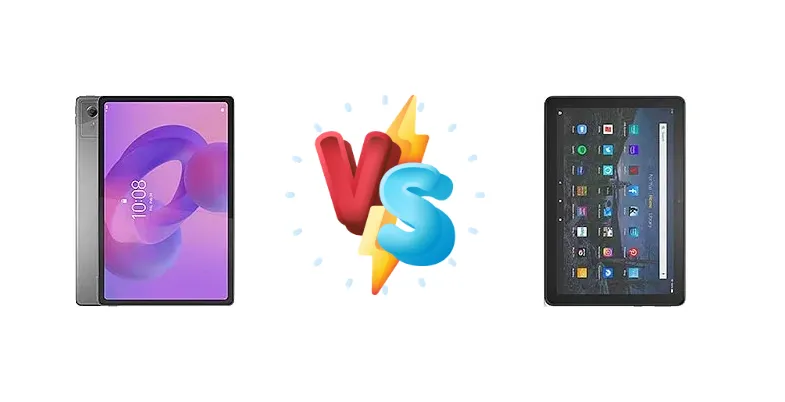
The tablet market offers a spectrum of choices, from budget-friendly media consumption devices to more capable productivity tools. The Lenovo Idea Tab Plus and the Amazon Fire HD 10 Plus (2021) represent opposite ends of this spectrum, with the Lenovo aiming for a balance of power and longevity, while the Amazon prioritizes affordability and ecosystem integration. This comparison dissects their core components to determine which tablet best suits your needs.
🏆 Quick Verdict
For users prioritizing performance and long-term battery health, the Lenovo Idea Tab Plus is the clear winner. Its Mediatek Dimensity 6400 chipset offers a significant performance leap over the Fire HD 10 Plus’s Helio P60T, coupled with impressive 107:53h endurance. While the Fire HD 10 Plus offers the convenience of wireless charging, it’s a trade-off for significantly reduced processing power.
| Network |
|---|
| 2G bands | GSM 850 / 900 / 1800 / 1900 - cellular model only | N/A |
| 3G bands | HSDPA 800 / 850 / 900 / 1900 / 2100 / 1800 - cellular model only | - |
| 4G bands | 1, 3, 5, 7, 8, 18, 19, 20, 26, 28, 38, 40, 41 - cellular model only | - |
| 5G bands | 1, 3, 5, 7, 8, 20, 26, 28, 38, 40, 41, 71, 77, 78 SA/NSA/Sub6 - cellular model only | - |
| EDGE | - | No |
| GPRS | - | No |
| Speed | HSPA, LTE, 5G - cellular model only | - |
| Technology | GSM / HSPA / LTE / 5G | No cellular connectivity |
| Launch |
|---|
| Announced | 2025, September 05 | 2021, April 27. Released 2021, May 26 |
| Status | Available. Released 2025, October | Discontinued |
| Body |
|---|
| Build | Glass front, aluminum frame, aluminum back | - |
| Dimensions | 278.8 x 181.1 x 6.3 mm (10.98 x 7.13 x 0.25 in) | 247 x 166 x 9.2 mm (9.72 x 6.54 x 0.36 in) |
| SIM | Nano-SIM - cellular model only | No |
| Weight | 530 g (1.17 lb) | 468 g (1.03 lb) |
| Display |
|---|
| Protection | Mohs level 5 | Aluminosilicate glass |
| Resolution | 2560 x 1600 pixels, 16:10 ratio (~249 ppi density) | 1920 x 1200 pixels, 16:10 ratio (~224 ppi density) |
| Size | 12.1 inches, 424.5 cm2 (~84.1% screen-to-body ratio) | 10.1 inches, 295.8 cm2 (~72.1% screen-to-body ratio) |
| Type | IPS LCD, 90Hz, 600 nits (typ), 800 nits (HBM) | IPS LCD |
| Platform |
|---|
| CPU | Octa-core (2x2.5 GHz Cortex-A76 & 6x2.0 GHz Cortex-A55) | Octa-core (4x2.0 GHz Cortex-A73 & 4x2.0 GHz Cortex-A53) |
| Chipset | Mediatek Dimensity 6400 (6 nm) | Mediatek MT8183 Helio P60T (12 nm) |
| GPU | Mali-G57 MC2 | Mali-G72 MP3 |
| OS | Android 15, up to 2 major Android upgrades | Android 9.0 (Pie), Fire OS 7 |
| Memory |
|---|
| Card slot | microSDXC | microSDXC (dedicated slot) |
| Internal | 128GB 8GB RAM, 256GB 8GB RAM, 256GB 12GB RAM | 32GB 4GB RAM, 64GB 4GB RAM |
| | - | eMMC 5.1 |
| Main Camera |
|---|
| Single | 13 MP, (wide), AF | 5 MP |
| Video | Yes | 720p |
| Selfie camera |
|---|
| Single | 8 MP | 2 MP |
| Video | 1080p@30fps | 720p |
| Sound |
|---|
| 3.5mm jack | - | Yes |
| 35mm jack | No | Yes |
| Loudspeaker | Yes, with stereo speakers, Dolby Atmos (4 speakers) | Yes, with stereo speakers |
| Comms |
|---|
| Bluetooth | 5.2, A2DP, LE | 5.0, A2DP, LE |
| NFC | No | No |
| Positioning | GPS, GALILEO, GLONASS | No |
| Radio | No | No |
| USB | USB Type-C 2.0, DisplayPort, accessory connector pins | USB Type-C 2.0, OTG |
| WLAN | Wi-Fi 802.11 a/b/g/n/ac, Wi-Fi Direct | Wi-Fi 802.11 a/b/g/n/ac, dual-band |
| Features |
|---|
| Sensors | Accelerometer, proximity (accessories only) | Accelerometer |
| | - | Text-to-Speech English-language content reader |
| Battery |
|---|
| Charging | 45W wired | Wireless |
| Type | Li-Ion 10200 mAh | Li-Ion |
| Misc |
|---|
| Colors | Cloud grey, Luna grey, Sand rose | Slate |
| Models | TB361ZU, TB361FU, ZAG70922US | T76N2P |
| Price | About 180 EUR | About 150 EUR |
| EU LABEL |
|---|
| Battery | 107:53h endurance, 1000 cycles | - |
| Energy | Class F | - |
| Free fall | Class E (5 falls) | - |
| Repairability | Class A | - |
Lenovo Idea Tab Plus
- Significantly faster processor for smoother performance.
- Longer battery life and faster charging.
- Potentially better image processing due to the more advanced chipset.
- Lacks wireless charging.
- May be more expensive than the Fire HD 10 Plus.
Amazon Fire HD 10 Plus (2021)
- More affordable price point.
- Convenience of wireless charging.
- Deep integration with the Amazon ecosystem.
- Significantly slower processor.
- Shorter battery life.
- Less responsive user experience.
Display Comparison
While both tablets likely feature IPS LCD panels (data not provided), the core difference lies in the processing power driving them. Display quality details like resolution and brightness are missing, but the chipset’s ability to efficiently render graphics will impact perceived smoothness. The Idea Tab Plus’s more modern chipset will likely handle video playback and UI transitions with greater fluidity.
Camera Comparison
Given the market segment, camera performance isn't a primary focus for either device. Without specific sensor details, it’s difficult to make a direct comparison. However, the Idea Tab Plus’s more powerful ISP (Image Signal Processor), integrated within the Dimensity 6400, will likely result in better image processing and potentially improved low-light performance, even with similar sensor hardware. We can assume both tablets will offer adequate cameras for video calls and casual snapshots.
Performance
The Lenovo Idea Tab Plus’s Mediatek Dimensity 6400 (6nm) represents a substantial architectural upgrade over the Amazon Fire HD 10 Plus’s Mediatek MT8183 Helio P60T (12nm). The Dimensity 6400 utilizes Cortex-A76 cores clocked at 2.5 GHz alongside Cortex-A55 cores at 2.0 GHz, offering significantly higher single-core and multi-core performance compared to the Fire HD 10 Plus’s Cortex-A73 (2.0 GHz) and A53 (2.0 GHz) configuration. The 6nm process node further enhances efficiency, reducing heat and improving sustained performance. This translates to faster app loading times, smoother multitasking, and a more responsive user experience on the Lenovo.
Battery Life
The Lenovo Idea Tab Plus boasts an impressive 107:53h endurance, suggesting a large battery capacity and efficient power management. Coupled with 45W wired charging, it offers a rapid recharge time. The Amazon Fire HD 10 Plus, while offering the convenience of wireless charging, lacks the fast-wired charging capabilities of the Lenovo. The older 12nm chipset is less efficient, likely resulting in shorter battery life despite potentially similar battery capacity. The 1000 charge cycles rating for the Lenovo also indicates a longer lifespan for the battery itself.
Buying Guide
Buy the Lenovo Idea Tab Plus if you need a tablet capable of handling demanding tasks like multitasking, light gaming, and content creation, and value long-term battery health. Its superior chipset and endurance make it ideal for students, professionals, or anyone who wants a versatile tablet experience. Buy the Amazon Fire HD 10 Plus (2021) if you primarily consume media, read ebooks, and are deeply invested in the Amazon ecosystem. Its lower price point and wireless charging are attractive features for casual users.
Frequently Asked Questions
❓ Does the Mediatek Dimensity 6400 in the Lenovo Idea Tab Plus get hot during extended use?
The Dimensity 6400’s 6nm process node is designed for improved thermal efficiency. While some heat generation is inevitable during demanding tasks, it’s significantly less prone to overheating compared to the 12nm Helio P60T in the Fire HD 10 Plus, allowing for more sustained performance without throttling.
❓ How does the Amazon Fire HD 10 Plus’s integration with the Amazon ecosystem affect the user experience?
The Fire HD 10 Plus is deeply integrated with Amazon services like Prime Video, Kindle, and Amazon Music. This provides seamless access to these services, but also means a heavier reliance on the Amazon ecosystem and potentially more pre-installed bloatware. Users heavily invested in Amazon’s services will find this integration beneficial, while others may prefer the more open Android experience of the Lenovo Idea Tab Plus.
❓ Is the wireless charging on the Fire HD 10 Plus a significant advantage?
Wireless charging offers convenience, but it’s generally slower than wired charging. The Fire HD 10 Plus lacks fast-wired charging, making the 45W charging of the Lenovo Idea Tab Plus a more practical solution for quickly replenishing the battery. The convenience of wireless charging is offset by the slower overall charging speed.