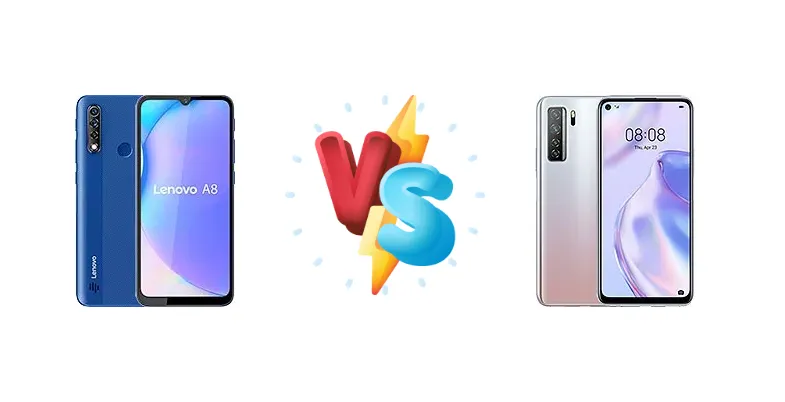
The Lenovo A8 2020 and Huawei P40 lite 5G represent different approaches to the mid-range smartphone market. The Lenovo focuses on affordability, while the Huawei attempts to bridge the gap to flagship features with 5G connectivity and faster charging. This comparison dissects their core components to determine which device delivers the best value for your money.
🏆 Quick Verdict
For the average user prioritizing future-proofing and speed, the Huawei P40 lite 5G is the clear winner. Its Kirin 820 chipset and 40W charging significantly outperform the Lenovo A8 2020’s Helio P22, justifying the price difference for those needing 5G or demanding performance.
| Network |
|---|
| 2G bands | GSM 850 / 900 / 1800 / 1900 | GSM 850 / 900 / 1800 / 1900 |
| 3G bands | HSDPA 850 / 900 / 2100 | HSDPA 800 / 850 / 900 / 1700(AWS) / 1900 / 2100 |
| 4G bands | 1, 3, 5, 8, 38, 40, 41 | 1, 2, 3, 4, 5, 6, 7, 8, 12, 17, 18, 19, 20, 26, 28, 34, 38, 39, 40, 41, 66 |
| 5G bands | - | 1, 3, 28, 38, 41, 77, 78, 79 SA/NSA |
| Speed | HSPA, LTE | HSPA, LTE, 5G |
| Technology | GSM / HSPA / LTE | GSM / HSPA / LTE / 5G |
| Launch |
|---|
| Announced | 2020, October 15. Released 2020, October 15 | 2020, May 15. Released 2020, May 28 |
| Status | Discontinued | Discontinued |
| Body |
|---|
| Build | Plastic back, plastic frame | - |
| Dimensions | 163.8 x 75.6 x 9.3 mm (6.45 x 2.98 x 0.37 in) | 162.3 x 75 x 8.6 mm (6.39 x 2.95 x 0.34 in) |
| SIM | Nano-SIM + Nano-SIM + Nano-SIM (max 2 at a time) | Nano-SIM + Nano-SIM |
| Weight | 205 g (7.23 oz) | 189 g (6.67 oz) |
| Display |
|---|
| Resolution | 720 x 1560 pixels, 19.5:9 ratio (~259 ppi density) | 1080 x 2400 pixels, 20:9 ratio (~405 ppi density) |
| Size | 6.53 inches, 107.9 cm2 (~87.2% screen-to-body ratio) | 6.5 inches, 102.0 cm2 (~83.8% screen-to-body ratio) |
| Type | IPS LCD | IPS LCD, HDR10 |
| Platform |
|---|
| CPU | Octa-core 2.0 GHz Cortex-A53 | Octa-core (1x2.36 GHz Cortex-A76 & 3x2.22 GHz Cortex-A76 & 4x1.84 GHz Cortex-A55) |
| Chipset | Mediatek MT6762 Helio P22 (12 nm) | Kirin 820 5G (7 nm) |
| GPU | PowerVR GE8320 | Mali-G57 (6-core) |
| OS | Android 10 | Android 10, EMUI 10.1, no Google Play Services |
| Memory |
|---|
| Card slot | microSDXC (dedicated slot) | Nano Memory (uses shared SIM slot) |
| Internal | 64GB 4GB RAM | 128GB 6GB RAM, 128GB 8GB RAM |
| | eMMC 5.1 | - |
| Main Camera |
|---|
| Features | LED flash, HDR, panorama | LED flash, Panorama, HDR |
| Quad | - | 64 MP, f/1.8, 26mm (wide), PDAF
8 MP, f/2.4, 17mm (ultrawide)
2 MP (macro)
Auxiliary lens |
| Triple | 13 MP, (wide), AF
2 MP (macro)
Auxiliary lens | - |
| Video | 1080p@30fps | 4K@30fps, 1080p@30fps |
| Selfie camera |
|---|
| Features | HDR | HDR |
| Single | 5 MP | 16 MP, f/2.0, (wide) |
| Video | 1080p@30fps | 1080p@30fps |
| Sound |
|---|
| 3.5mm jack | Yes | Yes |
| 35mm jack | Yes | Yes |
| Loudspeaker | Yes | Yes |
| Comms |
|---|
| Bluetooth | 5.0, A2DP, LE | 5.1, A2DP, LE |
| NFC | No | Yes |
| Positioning | GPS | GPS, GLONASS, GALILEO, BDS |
| Radio | FM radio | No |
| USB | microUSB 2.0, OTG | USB Type-C 2.0, OTG |
| WLAN | Wi-Fi 802.11 b/g/n, Wi-Fi Direct | Wi-Fi 802.11 a/b/g/n/ac, dual-band, Wi-Fi Direct |
| Features |
|---|
| Sensors | Fingerprint (rear-mounted), accelerometer, proximity | Fingerprint (side-mounted), accelerometer, gyro, proximity, compass |
| Battery |
|---|
| Charging | 10W wired | 40W wired, 70% in 30 min
5W reverse wired |
| Type | Li-Po 5000 mAh | Li-Po 4000 mAh |
| Misc |
|---|
| Colors | Black, Blue | Crush Green, Space Silver, Midnight Black |
| Models | L10041 | CDY-NX9A |
| Price | About 90 EUR | About 190 EUR |
Lenovo A8 2020
- Extremely affordable price point.
- Functional for basic smartphone tasks.
- Simple and straightforward user experience.
- Outdated Helio P22 chipset offers limited performance.
- Slow 10W charging.
- Likely lacks advanced features like NFC or 5G.
Huawei P40 lite 5G
- Powerful Kirin 820 5G chipset delivers smooth performance.
- Ultra-fast 40W charging significantly reduces downtime.
- 5G connectivity for future network compatibility.
- Higher price compared to the Lenovo A8 2020.
- May have bloatware or Huawei’s EMUI skin.
- No detailed camera specs available.
Display Comparison
Neither device’s display specifications are provided, so a direct comparison is limited. However, given the A8 2020’s positioning, it likely features a standard LCD panel. The P40 lite 5G, being a more premium offering, may incorporate a higher-quality panel with better color accuracy and viewing angles. The absence of refresh rate data suggests both likely operate at the standard 60Hz.
Camera Comparison
Without detailed camera specifications, a comprehensive comparison is difficult. However, the P40 lite 5G’s chipset includes a more powerful ISP (Image Signal Processor) capable of handling more complex image processing algorithms. This suggests superior image quality, particularly in low-light conditions. The A8 2020 will likely offer acceptable image quality for casual use, but will struggle to compete with the P40 lite 5G in challenging scenarios. The absence of OIS data suggests neither phone prioritizes advanced stabilization.
Performance
The performance disparity is stark. The Huawei P40 lite 5G’s Kirin 820 5G (7nm) is a substantial upgrade over the Lenovo A8 2020’s Mediatek MT6762 Helio P22 (12nm). The Kirin 820 utilizes a more modern CPU architecture – Cortex-A76 cores alongside A55 cores – compared to the A8’s all-Cortex-A53 setup. This translates to significantly faster application loading times, smoother multitasking, and a more responsive user experience. The 7nm process node also contributes to better thermal efficiency, reducing the likelihood of performance throttling under sustained load. The P40 lite 5G is the clear choice for gaming or demanding applications.
Battery Life
While battery capacity isn’t specified, the charging capabilities are a major differentiator. The Lenovo A8 2020’s 10W charging is slow by modern standards, requiring a significant amount of time to fully charge. Conversely, the Huawei P40 lite 5G’s 40W charging can replenish 70% of the battery in just 30 minutes, offering a substantial convenience advantage. The P40 lite 5G also includes 5W reverse wired charging, allowing it to top up other devices, a feature absent on the A8 2020.
Buying Guide
Buy the Lenovo A8 2020 if you need a basic, functional smartphone for everyday tasks like calling, texting, and light social media use, and are on a very tight budget. Buy the Huawei P40 lite 5G if you prioritize faster performance, 5G connectivity for future networks, and significantly quicker charging speeds, even if it means spending more upfront.
Frequently Asked Questions
❓ Is the Kirin 820 in the Huawei P40 lite 5G powerful enough for demanding games like PUBG or Call of Duty?
Yes, the Kirin 820 is a capable chipset that can handle most mobile games, including PUBG and Call of Duty, at medium to high settings. While it won't match the performance of flagship processors, it provides a smooth and enjoyable gaming experience, especially considering the phone's price point. The 7nm process also helps mitigate thermal throttling during extended gaming sessions.
❓ Does the Huawei P40 lite 5G support all 5G bands, and will it work with my carrier?
5G band support varies by region and carrier. You'll need to check the specific model number of the P40 lite 5G and compare its supported bands with those used by your mobile carrier to ensure compatibility. Huawei typically offers different variants of the phone with varying 5G band support.
❓ How long does it realistically take to fully charge the Huawei P40 lite 5G from 0% to 100% with the 40W charger?
While Huawei advertises 70% charge in 30 minutes, a full 0-100% charge with the 40W charger typically takes around 50-60 minutes. This is still significantly faster than the Lenovo A8 2020’s 10W charging, which could take several hours to reach full capacity.