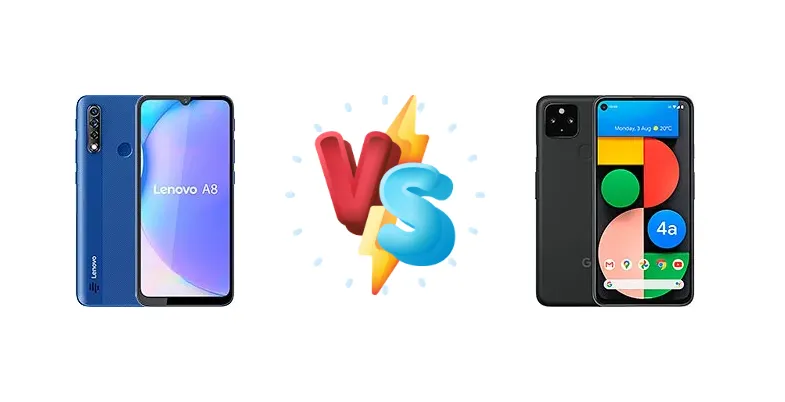
The Lenovo A8 2020 and Google Pixel 4a 5G represent different approaches to the budget 5G smartphone market. The A8 2020 aims for affordability, while the Pixel 4a 5G leverages Google’s software and a more powerful chipset to deliver a refined experience. This comparison dissects their key differences to help you determine which device best suits your needs.
🏆 Quick Verdict
For most users, the Google Pixel 4a 5G is the superior choice. Its Snapdragon 765G chipset provides significantly better performance and 5G connectivity, coupled with Google’s excellent camera software. While the Lenovo A8 2020 offers a lower price point, the performance trade-offs are substantial.
| Network |
|---|
| 2G bands | GSM 850 / 900 / 1800 / 1900 | GSM 850 / 900 / 1800 / 1900 |
| 3G bands | HSDPA 850 / 900 / 2100 | HSDPA 850 / 900 / 1700(AWS) / 1900 / 2100 |
| 4G bands | 1, 3, 5, 8, 38, 40, 41 | 1, 2, 3, 4, 5, 7, 8, 12, 13, 14, 17, 18, 19, 20, 25, 26, 28, 29, 30, 32, 38, 39, 40, 41, 42, 46, 48, 66, 71 |
| 5G bands | - | 1, 2, 3, 5, 7, 8, 12, 28, 41, 66, 71, 77, 78 Sub6, mmWave (market dependant) |
| Speed | HSPA, LTE | HSPA, LTE, 5G |
| Technology | GSM / HSPA / LTE | GSM / HSPA / LTE / 5G |
| Launch |
|---|
| Announced | 2020, October 15. Released 2020, October 15 | 2020, September 30 |
| Status | Discontinued | Available. Released 2020, November 05 |
| Body |
|---|
| Build | Plastic back, plastic frame | Glass front (Gorilla Glass 3), plastic back, plastic frame |
| Dimensions | 163.8 x 75.6 x 9.3 mm (6.45 x 2.98 x 0.37 in) | 153.9 x 74 x 8.2 mm (Sub-6) or 8.5 mm (Sub-6 and mmWave) |
| SIM | Nano-SIM + Nano-SIM + Nano-SIM (max 2 at a time) | Nano-SIM + eSIM |
| Weight | 205 g (7.23 oz) | 168 g (5G Sub-6); 171 g ( 5G Sub-6 and mmWave) (5.93 oz) |
| Display |
|---|
| Protection | - | Corning Gorilla Glass 3 |
| Resolution | 720 x 1560 pixels, 19.5:9 ratio (~259 ppi density) | 1080 x 2340 pixels, 19.5:9 ratio (~413 ppi density) |
| Size | 6.53 inches, 107.9 cm2 (~87.2% screen-to-body ratio) | 6.2 inches, 95.7 cm2 (~84.1% screen-to-body ratio) |
| Type | IPS LCD | OLED, HDR |
| | - | Always-on display |
| Platform |
|---|
| CPU | Octa-core 2.0 GHz Cortex-A53 | Octa-core (1x2.4 GHz Kryo 475 Prime & 1x2.2 GHz Kryo 475 Gold & 6x1.8 GHz Kryo 475 Silver) |
| Chipset | Mediatek MT6762 Helio P22 (12 nm) | Qualcomm SM7250 Snapdragon 765G 5G (7 nm) |
| GPU | PowerVR GE8320 | Adreno 620 |
| OS | Android 10 | Android 11, upgradable to Android 14 |
| Memory |
|---|
| Card slot | microSDXC (dedicated slot) | No |
| Internal | 64GB 4GB RAM | 128GB 6GB RAM |
| | eMMC 5.1 | UFS 2.1 |
| Main Camera |
|---|
| Dual | - | 12.2 MP, f/1.7, 27mm (wide), 1/2.55", 1.4µm, dual pixel PDAF, OIS
16 MP, f/2.2, 107˚ (ultrawide), 1.0µm |
| Features | LED flash, HDR, panorama | LED flash, Pixel Shift, Auto-HDR, panorama |
| Triple | 13 MP, (wide), AF
2 MP (macro)
Auxiliary lens | - |
| Video | 1080p@30fps | 4K@30/60fps, 1080p@30/60/120/240fps; gyro-EIS |
| Selfie camera |
|---|
| Features | HDR | HDR |
| Single | 5 MP | 8 MP, f/2.0, 24mm (wide), 1/4.0", 1.12µm |
| Video | 1080p@30fps | 1080p@30fps |
| Sound |
|---|
| 3.5mm jack | Yes | Yes |
| 35mm jack | Yes | Yes |
| Loudspeaker | Yes | Yes, with stereo speakers |
| Comms |
|---|
| Bluetooth | 5.0, A2DP, LE | 5.0, A2DP, LE, aptX HD |
| NFC | No | Yes |
| Positioning | GPS | GPS, GLONASS, GALILEO, QZSS, BDS |
| Radio | FM radio | No |
| USB | microUSB 2.0, OTG | USB Type-C 3.1 |
| WLAN | Wi-Fi 802.11 b/g/n, Wi-Fi Direct | Wi-Fi 802.11 a/b/g/n/ac, dual-band, Wi-Fi Direct |
| Features |
|---|
| Sensors | Fingerprint (rear-mounted), accelerometer, proximity | Fingerprint (rear-mounted), accelerometer, gyro, proximity, compass, barometer |
| Battery |
|---|
| Charging | 10W wired | 18W wired, PD2.0 |
| Type | Li-Po 5000 mAh | Li-Po 3885 mAh |
| Misc |
|---|
| Colors | Black, Blue | Just Black, Clearly White |
| Models | L10041 | GD1YQ, G025I, G025E, G025H, G6QU3 |
| Price | About 90 EUR | About 140 EUR |
Lenovo A8 2020
- Significantly lower price point
- Potentially longer battery life due to less powerful chipset
- Functional for basic smartphone tasks
- Substantially slower performance
- Inferior camera quality
- Slow charging speed (10W)
Google Pixel 4a 5G
- Much faster performance with Snapdragon 765G
- Superior camera quality and image processing
- Faster charging with 18W PD2.0
- Higher price tag
- LCD display (not OLED)
- Larger size may not suit all users
Display Comparison
Neither device boasts a cutting-edge display. The Lenovo A8 2020’s display specifications are not provided, but given its price point, it likely features a 720p LCD panel. The Pixel 4a 5G, while also using an LCD, benefits from a larger 6.7-inch screen and a higher resolution. The Snapdragon 765G’s ISP is also better equipped to handle display processing, potentially resulting in more accurate colors on the Pixel. The lack of high refresh rates on either device is standard for this price bracket.
Camera Comparison
While both phones likely feature multiple rear cameras, the Pixel 4a 5G holds a clear advantage due to Google’s computational photography prowess. The Pixel 4a 5G’s image processing algorithms, powered by the Snapdragon 765G’s ISP, excel in dynamic range and low-light performance. The A8 2020’s camera system, while functional, will likely struggle in challenging lighting conditions. Details regarding the A8 2020’s sensor size and aperture are unavailable, but it’s reasonable to assume they are less sophisticated than those found in the Pixel 4a 5G.
Performance
The performance gap between these two phones is significant. The Lenovo A8 2020’s Mediatek Helio P22, built on a 12nm process, features Cortex-A53 cores clocked at 2.0 GHz. This is a decidedly entry-level chipset. In contrast, the Google Pixel 4a 5G’s Snapdragon 765G (7nm) utilizes Kryo 475 cores in a tri-cluster configuration (1x2.4 GHz Prime, 1x2.2 GHz Gold, 6x1.8 GHz Silver). The 7nm process and more advanced core architecture of the Snapdragon 765G translate to substantially faster processing speeds and improved power efficiency. This difference is particularly noticeable in demanding tasks like gaming and multitasking. The Pixel 4a 5G will handle graphically intensive games with far greater ease.
Battery Life
Battery life will depend heavily on usage patterns. The Lenovo A8 2020’s battery capacity is not specified, but its less powerful chipset and likely lower-resolution display may result in comparable battery life to the Pixel 4a 5G’s 3885 mAh battery. However, the Pixel 4a 5G supports 18W wired charging with PD2.0, allowing for significantly faster charging times compared to the A8 2020’s 10W charging. This means less time tethered to a wall outlet for the Pixel.
Buying Guide
Buy the Lenovo A8 2020 if you prioritize absolute affordability and basic smartphone functionality, and 5G isn't a critical requirement. You'll be content with casual use and light tasks. Buy the Google Pixel 4a 5G if you value a smoother user experience, better camera quality, faster 5G speeds, and longer software support, even at a higher price.
Frequently Asked Questions
❓ Is the Snapdragon 765G in the Pixel 4a 5G powerful enough for demanding games like Genshin Impact?
Yes, the Snapdragon 765G is capable of running Genshin Impact, though you may need to lower the graphics settings to achieve a consistently smooth frame rate. The Helio P22 in the Lenovo A8 2020 would struggle significantly with such a title.
❓ How much faster is the 5G connectivity on the Pixel 4a 5G compared to 4G on the Lenovo A8 2020?
The Pixel 4a 5G’s 5G connectivity, utilizing the Snapdragon 765G’s integrated modem, offers significantly faster download and upload speeds compared to the A8 2020’s 4G. Real-world speeds will vary depending on network coverage, but 5G can be several times faster than 4G.
❓ Does the Lenovo A8 2020 support VoLTE and Wi-Fi calling?
Support for VoLTE and Wi-Fi calling on the Lenovo A8 2020 will depend on your carrier. Given its budget nature, compatibility isn't guaranteed, so it's crucial to check with your provider before purchasing.
❓ How long will the Pixel 4a 5G receive software updates?
The Google Pixel 4a 5G is guaranteed to receive at least 3 years of Android OS updates and 5 years of security updates from its launch date, ensuring long-term software support and security.