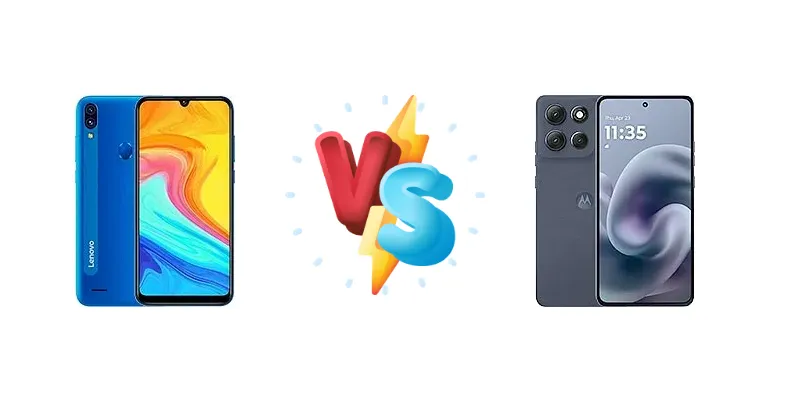
The Lenovo A7 and Motorola Moto G86 Power represent distinct approaches to the budget smartphone market. The A7 aims for extreme affordability, while the G86 Power prioritizes a balance of performance and endurance. This comparison dissects their key differences to determine which device delivers the best value for your money.
🏆 Quick Verdict
For the average user, the Motorola Moto G86 Power is the clear winner. Its significantly more powerful Mediatek Dimensity chipset, coupled with a respectable battery life and 30W charging, provides a far superior user experience compared to the Lenovo A7's aging Unisoc processor. While the A7 is cheaper, the performance gap is too large to ignore.
| Network |
|---|
| 2G bands | GSM 850 / 900 / 1800 / 1900 | GSM 850 / 900 / 1800 / 1900 |
| 3G bands | HSDPA 850 / 900 / 2100 | HSDPA 850 / 900 / 1900 / 2100 - International |
| 4G bands | 1, 3, 5, 8, 38, 40, 41 | 1, 2, 3, 5, 7, 8, 20, 26, 28, 32, 38, 40, 41, 42, 71 - EMEA & AP |
| 5G bands | - | 1, 3, 5, 7, 8, 20, 26, 28, 38, 40, 41, 71, 77, 78 SA/NSA/Sub6 - EMEA & AP |
| Speed | HSPA, LTE | HSPA, LTE, 5G |
| Technology | GSM / HSPA / LTE | GSM / HSPA / LTE / 5G |
| Launch |
|---|
| Announced | 2019, April 13. Released 2019, April 13 | 2025, May 29 |
| Status | Discontinued | Available. Released 2025, July 30 |
| Body |
|---|
| Build | Glass front, plastic back, plastic frame | Glass front (Gorilla Glass 7i), plastic frame, silicone polymer (eco leather) back |
| Dimensions | 155 x 75 x 12 mm (6.10 x 2.95 x 0.47 in) | 161.2 x 74.7 x 8.7 mm (6.35 x 2.94 x 0.34 in) |
| SIM | Nano-SIM + Nano-SIM | · Nano-SIM + eSIM· Nano-SIM + Nano-SIM |
| Weight | - | 195 or 198 g (6.98 oz) |
| Display |
|---|
| Protection | - | Corning Gorilla Glass 7i, Mohs level 4 |
| Resolution | 720 x 1560 pixels, 19.5:9 ratio (~282 ppi density) | 1220 x 2712 pixels, 20:9 ratio (~446 ppi density) |
| Size | 6.09 inches, 91.0 cm2 (~78.3% screen-to-body ratio) | 6.67 inches, 107.4 cm2 (~89.2% screen-to-body ratio) |
| Type | IPS LCD | P-OLED, 1B colors, 120Hz, HDR10+, 4500 nits peak |
| Platform |
|---|
| CPU | Octa-core (4x1.6 GHz Cortex-A55 & 4x1.2 GHz Cortex-A55) | Octa-core (4x2.5 GHz Cortex-A78 & 4x2.0 GHz Cortex-A55) - GlobalOcta-core (4x2.6 GHz Cortex-A78 & 4x2.0 GHz Cortex-A55) - India |
| Chipset | Unisoc SC9863A (28 nm) | Mediatek Dimensity 7300 (4 nm) - GlobalMediatek Dimensity 7400 (4 nm) - India |
| GPU | IMG8322 | Mali-G615 MC2 |
| OS | Android 9.0 (Pie) | Android 15, up to 2 major Android upgrades |
| Memory |
|---|
| Card slot | microSDXC (dedicated slot) | microSDXC (dedicated slot) |
| Internal | 64GB 4GB RAM | 128GB 8GB RAM, 256GB 8GB RAM, 256GB 12GB RAM, 512GB 8GB RAM, 512GB 12GB RAM |
| | eMMC 5.1 | - |
| Main Camera |
|---|
| Dual | 13 MP, (wide), 1/3.1", 1.12µm, PDAF
Auxiliary lens | 50 MP, f/1.9, 25mm (wide), 1/1.95", 0.8µm, dual pixel PDAF, OIS
8 MP, f/2.2, 12mm, 118˚ (ultrawide), 1.12µm, AF |
| Features | LED flash | LED flash, HDR, panorama |
| Video | 1080p@30fps | 4K@30/60fps, 1080p@30/60/120fps, gyro-EIS |
| Selfie camera |
|---|
| Features | - | HDR |
| Single | 5 MP | 32 MP, f/2.2, (wide), 0.7µm |
| Video | - | 4K@30fps, 1080p@30fps, gyro-EIS |
| Sound |
|---|
| 3.5mm jack | Yes | - |
| 35mm jack | Yes | No |
| Loudspeaker | Yes | Yes, with stereo speakers (with Dolby Atmos) |
| Comms |
|---|
| Bluetooth | Yes | 5.4, A2DP, LE |
| NFC | No | Yes |
| Positioning | GPS | GPS, GLONASS, GALILEO, BDS, QZSS |
| Radio | FM radio | No |
| USB | microUSB 2.0 | USB Type-C 2.0 |
| WLAN | Wi-Fi 802.11 b/g/n | Wi-Fi 802.11 a/b/g/n/ac/6, dual-band |
| Features |
|---|
| Sensors | Fingerprint (rear-mounted), accelerometer, proximity | Fingerprint (under display, optical), accelerometer, gyro, proximity, compass |
| Battery |
|---|
| Charging | - | 30W wired |
| Type | Li-Po 4000 mAh | 6720 mAh |
| Misc |
|---|
| Colors | Black, Blue | Pantone: Spellbound, Golden Cypress, Cosmic Sky, Chrysanthemum |
| Models | L19111 | XT2527-7 |
| Price | About 100 EUR | $ 472.00 / € 269.90 / ₹ 17,000 |
| EU LABEL |
|---|
| Battery | - | 67:39h endurance, 1000 cycles |
| Energy | - | Class A |
| Free fall | - | Class B (180 falls) |
| Repairability | - | Class B |
Lenovo A7
- Extremely affordable price point
- Functional for basic tasks
- Potentially lightweight design
- Very weak performance
- Likely poor camera quality
- Short battery life
Motorola Moto G86 Power
- Significantly faster performance
- Long battery life with high endurance
- 30W fast charging
- Higher price than the Lenovo A7
- May not have the absolute lowest price
- Software updates may be limited
Display Comparison
Display specifications are not provided for the Lenovo A7, making a direct comparison difficult. However, given its price point, it likely features a lower resolution and less color-accurate panel than the Moto G86 Power. The G86 Power's display benefits from the processing power of its Dimensity chipset, allowing for smoother animations and potentially higher refresh rates (though not specified). The lack of information on the A7's panel type (IPS vs. AMOLED) and brightness further widens the gap, suggesting a less vibrant and visible screen in outdoor conditions.
Camera Comparison
Camera details for the Lenovo A7 are unavailable. The Moto G86 Power's camera system is likely to be more capable, though specific sensor details are missing. The Dimensity 7300/7400 chipsets include an ISP capable of handling more complex image processing algorithms, potentially resulting in better dynamic range and low-light performance. Without knowing the A7's sensor resolution or aperture, it's safe to assume the G86 Power offers a more versatile and higher-quality camera experience. The presence of OIS (Optical Image Stabilization) on the G86 Power, if equipped, would further enhance image clarity and stability.
Performance
The performance disparity is the most significant difference between these two devices. The Lenovo A7's Unisoc SC9863A, built on a 28nm process, is an entry-level chipset with Cortex-A55 cores clocked at 1.6GHz and 1.2GHz. This is dramatically outmatched by the Motorola Moto G86 Power's Mediatek Dimensity 7300 (Global) or 7400 (India), fabricated on a modern 4nm process. The Dimensity chips feature a combination of Cortex-A78 and A55 cores, with the A78 cores reaching up to 2.6GHz in the Indian variant. This translates to significantly faster app loading times, smoother multitasking, and a much more enjoyable gaming experience on the Moto G86 Power. The 4nm process also contributes to better thermal efficiency, reducing throttling during sustained workloads.
Battery Life
The Motorola Moto G86 Power boasts a remarkable 67:39h endurance rating and a claimed 1000 charge cycles, indicating a long-lasting battery and excellent longevity. While the Lenovo A7's battery capacity is unknown, its less efficient Unisoc chipset will likely result in significantly shorter battery life. The G86 Power's 30W wired charging is also a substantial advantage, allowing for quicker top-ups compared to the A7, which likely supports slower charging speeds. The G86 Power's endurance rating suggests it can easily last a full day of moderate to heavy use, while the A7 may require more frequent charging.
Buying Guide
Buy the Lenovo A7 if you absolutely need the lowest possible price and your usage is limited to basic tasks like calls, texts, and light web browsing. It's a functional device for those on a very tight budget. Buy the Motorola Moto G86 Power if you prioritize a smoother, more responsive experience for everyday tasks, occasional gaming, and appreciate faster charging and longer-term software support. It's a worthwhile investment for anyone seeking a reliable and capable budget smartphone.
Frequently Asked Questions
❓ Does the Mediatek Dimensity 7300/7400 in the Moto G86 Power get hot during extended gaming sessions?
The 4nm process of the Dimensity 7300/7400 is designed for improved thermal efficiency. While some heat generation is inevitable during gaming, the G86 Power should manage temperatures well enough to avoid significant throttling, providing a consistently smooth gaming experience. The A7's 28nm Unisoc chip will likely throttle much more aggressively.
❓ How does the software support compare between the Lenovo A7 and Motorola Moto G86 Power?
Motorola generally provides at least one major Android update and a few years of security patches for its devices. Lenovo's software support for the A7 is likely to be more limited, potentially receiving only security updates for a shorter period. This means the G86 Power will remain secure and feature-rich for longer.
❓ Is the difference in performance between the Unisoc SC9863A and Dimensity 7300/7400 noticeable in everyday tasks?
Absolutely. The Dimensity 7300/7400 offers a vastly superior experience in everyday tasks like app loading, web browsing, and multitasking. The A7's Unisoc chip will feel sluggish and unresponsive in comparison, leading to frustration even with basic operations.