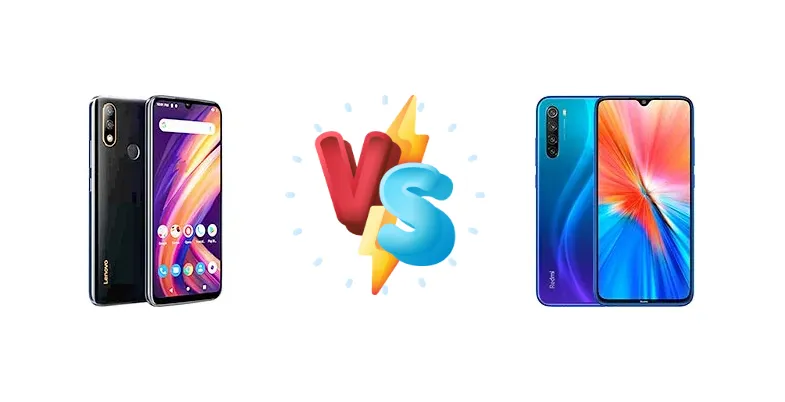
Both the Lenovo A6 Note and the Xiaomi Redmi Note 8 2021 occupy the fiercely competitive sub-$150 smartphone segment. While both aim to deliver essential smartphone functionality at an accessible price, they diverge significantly in their internal hardware, impacting performance and user experience. This comparison dissects these differences to determine which device offers the best value.
🏆 Quick Verdict
For the average user prioritizing responsiveness and occasional gaming, the Xiaomi Redmi Note 8 2021 is the superior choice. Its Helio G85 chipset provides a noticeable performance uplift over the Lenovo A6 Note’s Helio P22, and the 18W charging is a welcome addition, despite both phones sharing a 102-hour endurance rating.
| Network |
|---|
| 2G bands | GSM 850 / 900 / 1800 / 1900 | GSM 850 / 900 / 1800 / 1900 |
| 3G bands | HSDPA 850 / 900 / 1900 / 2100 | HSDPA 850 / 900 / 1700(AWS) / 1900 / 2100 |
| 4G bands | 1, 2, 3, 5, 7, 8, 20, 38, 40, 41 | 1, 2, 3, 4, 5, 7, 8, 20, 28, 38, 40 |
| Speed | HSPA, LTE | HSPA, LTE |
| Technology | GSM / HSPA / LTE | GSM / HSPA / LTE |
| Launch |
|---|
| Announced | 2019, September. Released 2019, September | 2021, May 25 |
| Status | Discontinued | Available. Released 2021, May 27 |
| Body |
|---|
| Build | - | Glass front (Gorilla Glass 5), glass back (Gorilla Glass 5), plastic frame |
| Dimensions | 154.7 x 72.9 x 9.2 mm (6.09 x 2.87 x 0.36 in) | 158.3 x 75.3 x 8.4 mm (6.23 x 2.96 x 0.33 in) |
| SIM | Nano-SIM + Nano-SIM | Nano-SIM + Nano-SIM |
| Weight | 172 g (6.07 oz) | 190 g (6.70 oz) |
| Display |
|---|
| Protection | - | Corning Gorilla Glass 5 |
| Resolution | 720 x 1560 pixels, 19.5:9 ratio (~282 ppi density) | 1080 x 2340 pixels, 19.5:9 ratio (~409 ppi density) |
| Size | 6.09 inches, 91.0 cm2 (~80.7% screen-to-body ratio) | 6.3 inches, 97.4 cm2 (~81.7% screen-to-body ratio) |
| Type | IPS LCD | IPS LCD, 500 nits (typ) |
| Platform |
|---|
| CPU | Octa-core 2.0 GHz Cortex-A53 | Octa-core (2x2.0 GHz Cortex-A75 & 6x1.8 GHz Cortex-A55) |
| Chipset | Mediatek MT6762 Helio P22 (12 nm) | Mediatek MT6769Z Helio G85 (12 nm) |
| GPU | PowerVR GE8320 | Mali-G52 MC2 |
| OS | Android 9.0 (Pie) | Android 11, MIUI 12.5 |
| Memory |
|---|
| Card slot | microSDXC (dedicated slot) | microSDXC (dedicated slot) |
| Internal | 16GB 2GB RAM, 32GB 3GB RAM | 64GB 3GB RAM, 64GB 4GB RAM, 128GB 4GB RAM |
| | eMMC 5.1 | eMMC 5.1 |
| Main Camera |
|---|
| Dual | 13 MP, f/2.0, 1/3.1", 1.12µm, AF
Auxiliary lens | - |
| Features | LED flash, panorama, HDR | LED flash, HDR, panorama |
| Quad | - | 48 MP, f/1.8, 26mm (wide), 1/2.0", 0.8µm, PDAF
8 MP, f/2.2, 120˚ (ultrawide), 1/4.0", 1.12µm
2 MP (macro)
Auxiliary lens |
| Single | - | 13 MP, f/2.0, (wide), 1/3.1", 1.12µm |
| Video | 1080p@30fps | 1080p@30/120fps; gyro-EIS |
| Selfie camera |
|---|
| Features | - | HDR, panorama |
| Single | 5 MP, 1/5.0", 1.12µm | 13 MP, f/2.0, (wide), 1/3.1", 1.12µm |
| Video | - | 1080p@30fps |
| Sound |
|---|
| 3.5mm jack | Yes | Yes |
| 35mm jack | Yes | Yes |
| Loudspeaker | Yes | Yes |
| Comms |
|---|
| Bluetooth | 5.0, A2DP, LE | 5.2, A2DP, LE |
| Infrared port | - | Yes |
| NFC | No | No |
| Positioning | GPS, GLONASS, GALILEO | GPS, GLONASS, GALILEO, BDS |
| Radio | FM radio | FM radio |
| USB | microUSB 2.0 | USB Type-C 2.0, OTG |
| WLAN | Wi-Fi 802.11 b/g/n | Wi-Fi 802.11 a/b/g/n/ac, dual-band, Wi-Fi Direct |
| Features |
|---|
| Sensors | Fingerprint (rear-mounted), accelerometer, proximity | Fingerprint (rear-mounted), accelerometer, gyro, proximity, compass |
| Battery |
|---|
| Charging | 10W wired | 18W wired |
| Type | Li-Po 4000 mAh, non-removable | Li-Po 4000 mAh |
| Misc |
|---|
| Colors | Black, Blue | Neptune Blue, Moonlight White, Space Black |
| Models | PAGK0027IN, PAGK0027, L19041 | M1908C3JGG |
| Price | About 100 EUR | About 160 EUR |
| SAR | - | 0.97 W/kg (head) 0.75 W/kg (body) |
| SAR EU | - | 0.57 W/kg (head) 0.94 W/kg (body) |
| Tests |
|---|
| Battery life | - |
Endurance rating 102h
|
| Camera | - |
Photo / Video |
| Display | - |
Contrast ratio: 1487:1 (nominal) |
| Loudspeaker | - |
-28.6 LUFS (Average)
|
| Performance | - |
AnTuTu: 180195 (v8), 165779 (v9)
GeekBench: 5259 (v4.4), 1314 (v5.1)
GFXBench: 8.7fps (ES 3.1 onscreen) |
Lenovo A6 Note
- Potentially lower price point
- Functional for basic tasks
- Acceptable battery endurance
- Outdated Helio P22 chipset
- Slow 10W charging
- Less responsive user experience
Xiaomi Redmi Note 8 2021
- More powerful Helio G85 chipset
- Faster 18W charging
- Brighter display for outdoor visibility
- Improved gaming performance
- Slightly higher price
- Similar battery endurance to A6 Note
Display Comparison
Both devices feature a contrast ratio of 1487:1, suggesting similar visual characteristics in terms of black levels. However, the Redmi Note 8 2021 boasts a measured peak brightness of 620 nits, significantly brighter than what we’d expect from the A6 Note, making it more usable outdoors under direct sunlight. While both likely utilize IPS LCD panels, the Redmi Note 8 2021’s higher brightness provides a clearer and more vibrant viewing experience.
Camera Comparison
Both phones are listed as having 'Photo / Video' capabilities, but detailed sensor information is absent. Given the price point, expectations should be tempered. The Redmi Note 8 2021 likely benefits from the more powerful ISP (Image Signal Processor) within the Helio G85, potentially leading to better image processing and low-light performance. It's reasonable to assume the Redmi Note 8 2021 offers a more versatile camera experience, even without specific sensor details.
Performance
The core difference lies in the chipsets. The Lenovo A6 Note utilizes the Mediatek MT6762 Helio P22, featuring an octa-core CPU clocked at 2.0 GHz, all Cortex-A53 cores. The Redmi Note 8 2021, however, is powered by the Mediatek MT6769Z Helio G85. This chipset employs a more modern CPU architecture with two Cortex-A75 cores at 2.0 GHz and six Cortex-A55 cores at 1.8 GHz. The A75 cores offer a substantial performance boost in single-core tasks and gaming. This translates to snappier app launches and smoother multitasking on the Redmi Note 8 2021. While both are built on a 12nm process, the G85’s architecture is more efficient.
Battery Life
Interestingly, both devices share an endurance rating of 102 hours, suggesting similar real-world battery life despite the Redmi Note 8 2021’s more powerful chipset. This indicates efficient power management on the Redmi’s side. However, the Redmi Note 8 2021 supports 18W wired charging, a significant advantage over the Lenovo A6 Note’s slower 10W charging. This means the Redmi Note 8 2021 can be topped up much faster, reducing downtime.
Buying Guide
Buy the Lenovo A6 Note if you need a basic, functional smartphone for essential tasks like calls, messaging, and light social media use, and are on an extremely tight budget. Buy the Xiaomi Redmi Note 8 2021 if you prefer a smoother, more responsive experience, enjoy occasional mobile gaming, and value faster charging speeds, even if it means spending slightly more.
Frequently Asked Questions
❓ Will the Redmi Note 8 2021 handle popular games like PUBG Mobile smoothly?
The Helio G85 chipset in the Redmi Note 8 2021 is specifically designed for gaming. While you may need to lower graphics settings for optimal performance, it should provide a playable experience in PUBG Mobile and similar titles, unlike the Lenovo A6 Note which will struggle with demanding games.
❓ Is the 18W charging on the Redmi Note 8 2021 a significant improvement over the A6 Note's 10W charging?
Yes, it is. 18W charging will significantly reduce the time it takes to fully charge the Redmi Note 8 2021, getting you back up and running much faster than the A6 Note. Expect a noticeable difference in charge times, especially when starting from a low battery level.
❓ How much of a difference will I notice in everyday tasks like browsing and social media between these two phones?
You'll likely notice a considerable difference. The Redmi Note 8 2021's Helio G85 chipset and more modern CPU architecture will result in snappier app launches, smoother scrolling, and a more responsive overall experience when browsing the web or using social media apps.