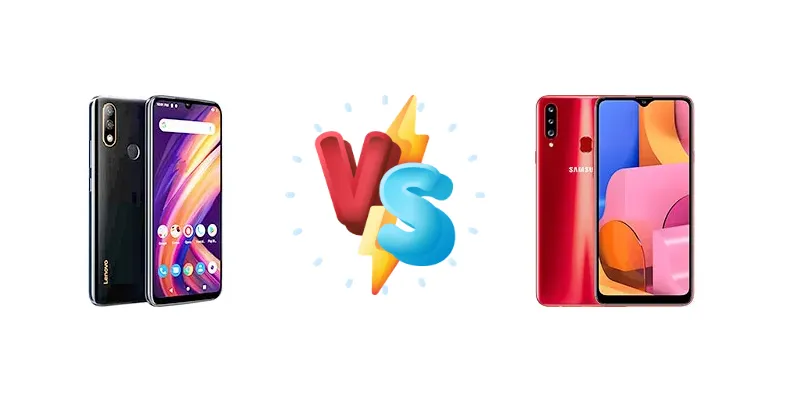
The Lenovo A6 Note and Samsung Galaxy A20s represent a critical segment of the smartphone market: affordable devices for everyday use. Both aim to deliver essential functionality without breaking the bank, but they take different approaches to achieving this. This comparison dissects their core components to reveal which phone offers the best value for your money.
🏆 Quick Verdict
For the average user prioritizing faster charging and a slightly more refined software experience, the Samsung Galaxy A20s is the better choice. While the Lenovo A6 Note offers a marginally faster CPU clock speed, the Snapdragon 450’s efficiency and 15W charging provide a smoother, more convenient daily experience.
| Network |
|---|
| 2G bands | GSM 850 / 900 / 1800 / 1900 | GSM 850 / 900 / 1800 / 1900 |
| 3G bands | HSDPA 850 / 900 / 1900 / 2100 | HSDPA 850 / 900 / 1900 / 2100 - SM-A207F/DS |
| 4G bands | 1, 2, 3, 5, 7, 8, 20, 38, 40, 41 | 1, 2, 3, 5, 7, 8, 20, 28, 34, 38, 39, 40, 41 - SM-A207F/DS |
| Speed | HSPA, LTE | HSPA, LTE |
| Technology | GSM / HSPA / LTE | GSM / HSPA / LTE |
| | - | 1, 2, 3, 4, 5, 7, 8, 12, 13, 17, 20, 28, 38, 40, 41, 66 - SM-A207M/DS |
| Launch |
|---|
| Announced | 2019, September. Released 2019, September | 2019, September 24. Released 2019, October 05 |
| Status | Discontinued | Discontinued |
| Body |
|---|
| Build | - | Glass front, plastic back, plastic frame |
| Dimensions | 154.7 x 72.9 x 9.2 mm (6.09 x 2.87 x 0.36 in) | 163.3 x 77.5 x 8 mm (6.43 x 3.05 x 0.31 in) |
| SIM | Nano-SIM + Nano-SIM | · Nano-SIM· Nano-SIM + Nano-SIM |
| Weight | 172 g (6.07 oz) | 183 g (6.46 oz) |
| Display |
|---|
| Resolution | 720 x 1560 pixels, 19.5:9 ratio (~282 ppi density) | 720 x 1560 pixels, 19.5:9 ratio (~264 ppi density) |
| Size | 6.09 inches, 91.0 cm2 (~80.7% screen-to-body ratio) | 6.5 inches, 103.7 cm2 (~81.9% screen-to-body ratio) |
| Type | IPS LCD | IPS LCD |
| Platform |
|---|
| CPU | Octa-core 2.0 GHz Cortex-A53 | Octa-core 1.8 GHz Cortex-A53 |
| Chipset | Mediatek MT6762 Helio P22 (12 nm) | Qualcomm SDM450 Snapdragon 450 (14 nm) |
| GPU | PowerVR GE8320 | Adreno 506 |
| OS | Android 9.0 (Pie) | Android 9.0 (Pie), upgradable to Android 11, One UI Core 3.1 |
| Memory |
|---|
| Card slot | microSDXC (dedicated slot) | microSDXC (dedicated slot) |
| Internal | 16GB 2GB RAM, 32GB 3GB RAM | 32GB 2GB RAM, 32GB 3GB RAM, 64GB 4GB RAM |
| | eMMC 5.1 | eMMC 5.1 |
| Main Camera |
|---|
| Dual | 13 MP, f/2.0, 1/3.1", 1.12µm, AF
Auxiliary lens | - |
| Features | LED flash, panorama, HDR | LED flash, panorama, HDR |
| Triple | - | 13 MP, f/1.8, 27mm (wide), PDAF
8 MP, f/2.2, 13mm (ultrawide), 1/4.0", 1.12µm
Auxiliary lens |
| Video | 1080p@30fps | 1080p@30fps |
| Selfie camera |
|---|
| Single | 5 MP, 1/5.0", 1.12µm | 8 MP, f/2.0 |
| Video | - | 1080p@30fps |
| Sound |
|---|
| 3.5mm jack | Yes | Yes |
| 35mm jack | Yes | Yes |
| Loudspeaker | Yes | Yes |
| Comms |
|---|
| Bluetooth | 5.0, A2DP, LE | 4.2, A2DP, LE |
| NFC | No | No |
| Positioning | GPS, GLONASS, GALILEO | GPS, GLONASS, GALILEO, BDS |
| Radio | FM radio | FM radio |
| USB | microUSB 2.0 | USB Type-C 2.0 |
| WLAN | Wi-Fi 802.11 b/g/n | Wi-Fi 802.11 b/g/n, Wi-Fi Direct |
| Features |
|---|
| Sensors | Fingerprint (rear-mounted), accelerometer, proximity | Fingerprint (rear-mounted), accelerometer, gyro, proximity, compass |
| Battery |
|---|
| Charging | 10W wired | 15W wired |
| Type | Li-Po 4000 mAh, non-removable | Li-Po 4000 mAh, non-removable |
| Misc |
|---|
| Colors | Black, Blue | Black, Blue, Red, Green |
| Models | PAGK0027IN, PAGK0027, L19041 | SM-A207F, SM-A207M, SM-A2070 |
| Price | About 100 EUR | About 250 EUR |
| SAR | - | 0.69 W/kg (head) 1.43 W/kg (body) |
| SAR EU | - | 0.35 W/kg (head) 0.83 W/kg (body) |
Lenovo A6 Note
- Slightly higher CPU clock speed (2.0 GHz)
- Potentially lower initial cost
- Mediatek’s power efficiency improvements in the P22
- Slower 10W charging
- Less efficient chipset (12nm vs 14nm)
- Potentially less refined software experience
Samsung Galaxy A20s
- Faster 15W charging
- More power-efficient chipset (14nm)
- Qualcomm’s ISP for potentially better image processing
- Slightly lower CPU clock speed (1.8 GHz)
- May be slightly more expensive
- Samsung’s software can be resource intensive
Display Comparison
Neither device boasts a standout display. Both likely utilize IPS LCD panels, common in this price bracket. The key difference lies under the hood. We lack specific display specs, but given the target market, expect 720p+ resolutions. The focus here isn't on visual fidelity, but on practicality and battery conservation.
Camera Comparison
Camera performance is likely similar on both devices, relying on software processing to enhance image quality. Without specific sensor details, it’s difficult to make a definitive statement. However, the A20s benefits from Qualcomm’s image signal processor (ISP), which is generally regarded as more capable than Mediatek’s equivalent in this class. Expect both to struggle in low-light conditions, and any 'macro' lenses included are likely to be of limited utility.
Performance
The Lenovo A6 Note’s Mediatek Helio P22 (MT6762) features an octa-core Cortex-A53 CPU clocked at 2.0 GHz, while the Samsung Galaxy A20s utilizes the Qualcomm Snapdragon 450 with an octa-core Cortex-A53 CPU clocked at 1.8 GHz. While the Lenovo has a higher clock speed, the Snapdragon 450 is built on a 14nm process compared to the Helio P22’s 12nm. This smaller node generally translates to better power efficiency, meaning the A20s is likely to exhibit less thermal throttling during prolonged use. The Snapdragon’s Adreno GPU also offers a slight edge in graphics performance, making it marginally better for casual gaming.
Battery Life
Both phones likely feature batteries in the 3000-4000 mAh range, typical for this segment. However, the Samsung Galaxy A20s has a significant advantage with its 15W wired charging, compared to the Lenovo A6 Note’s 10W charging. This translates to a noticeably faster 0-100% charge time, reducing downtime and improving overall usability. The Snapdragon 450’s efficiency also contributes to potentially longer battery life during typical usage.
Buying Guide
Buy the Lenovo A6 Note if you need a phone primarily for basic tasks like calling, texting, and light social media, and are willing to accept slower charging speeds. Buy the Samsung Galaxy A20s if you prefer a more balanced experience with slightly better performance in sustained tasks, faster charging, and the established Samsung ecosystem, even if it means a slightly lower CPU clock speed.
Frequently Asked Questions
❓ Will the Snapdragon 450 in the Galaxy A20s handle popular games like PUBG Mobile?
The Snapdragon 450 can run PUBG Mobile, but expect to play at lower graphics settings (balanced or low) to maintain a stable frame rate. It's not a gaming powerhouse, but it's sufficient for casual gaming sessions. The Helio P22 in the A6 Note will offer similar performance, but may experience more frame drops during intense gameplay due to thermal throttling.
❓ How much faster is the 15W charging on the Galaxy A20s compared to the 10W charging on the A6 Note?
While exact charge times depend on various factors, the 15W charging on the A20s will likely reduce the 0-100% charge time by approximately 30-60 minutes compared to the A6 Note. This is a significant difference for users who need to quickly top up their battery throughout the day.
❓ Does either phone support fast charging protocols beyond their advertised wattage?
Neither phone is likely to support advanced fast charging protocols like Quick Charge or Power Delivery. They are limited to the standard charging speeds supported by their respective chipsets and charging circuitry.
❓ Which phone is likely to receive more software updates?
Samsung generally provides more consistent and longer-term software support for its devices, even in the budget segment. The Lenovo A6 Note may receive fewer updates, and for a shorter duration.