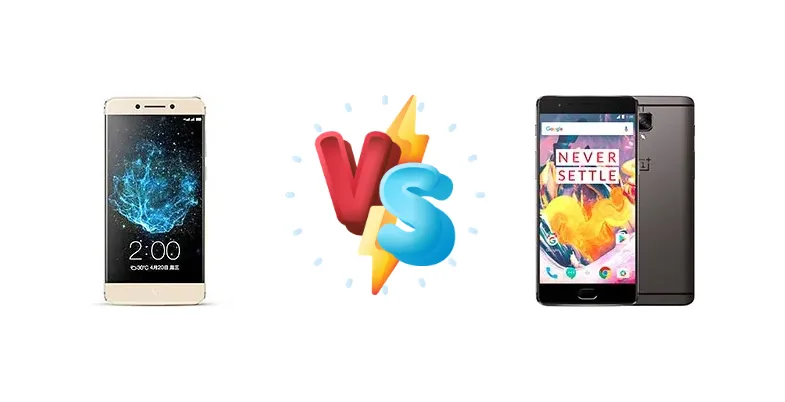
Released within months of each other in 2016, the LeEco Le Pro3 and OnePlus 3T represent a fascinating inflection point in the smartphone market. Both devices leveraged the powerful Snapdragon 821, but diverged in their approaches to design, software, and overall user experience. Today, as these phones find a second life in the budget market, understanding their differences is crucial for discerning buyers.
🏆 Quick Verdict
For the average user seeking a reliable and well-supported experience, the OnePlus 3T emerges as the stronger choice. While the LeEco Le Pro3 offers comparable performance thanks to the Snapdragon 821, OnePlus’s superior software support and established brand reputation provide long-term peace of mind.
| Network |
|---|
| 2G bands | GSM 850 / 900 / 1800 / 1900 - SIM 1 & SIM 2 | GSM 850 / 900 / 1800 / 1900 - SIM 1 & SIM 2 |
| 3G bands | HSDPA 850 / 900 / 1700(AWS) / 1900 / 2100 | HSDPA 850 / 900 / 1700(AWS) / 1900 / 2100 - North America |
| 4G bands | 1, 2, 3, 4, 5, 7, 8, 20, 38, 39, 40, 41 | 1, 2, 4, 5, 7, 8, 12, 17, 30 - North America |
| Speed | HSPA 42.2/5.76 Mbps, LTE (3CA) Cat12 600/150 Mbps | HSPA 42.2/5.76 Mbps, LTE (2CA) Cat6 300/50 Mbps |
| Technology | GSM / CDMA / HSPA / EVDO / LTE | GSM / HSPA / EVDO / LTE |
| | TD-SCDMA | 1, 3, 5, 7, 8, 20, 38, 40 - Global model |
| Launch |
|---|
| Announced | 2016, September. Released 2016, October | 2016, November. Released 2016, November |
| Status | Discontinued | Discontinued |
| Body |
|---|
| Build | - | Glass front (Gorilla Glass 4), aluminum back, aluminum frame |
| Dimensions | 151.4 x 73.9 x 7.5 mm (5.96 x 2.91 x 0.30 in) | 152.7 x 74.7 x 7.4 mm (6.01 x 2.94 x 0.29 in) |
| SIM | · Nano-SIM· Nano-SIM + Nano-SIM | Nano-SIM + Nano-SIM |
| Weight | 175 g (6.17 oz) | 158 g (5.57 oz) |
| Display |
|---|
| Protection | - | Corning Gorilla Glass 4 |
| Resolution | 1080 x 1920 pixels, 16:9 ratio (~403 ppi density) | 1080 x 1920 pixels, 16:9 ratio (~401 ppi density) |
| Size | 5.5 inches, 82.6 cm2 (~73.8% screen-to-body ratio) | 5.5 inches, 83.4 cm2 (~73.1% screen-to-body ratio) |
| Type | IPS LCD | Optic AMOLED |
| Platform |
|---|
| CPU | Quad-core (2x2.35 GHz Kryo & 2x2.0 GHz Kryo) | Quad-core (2x2.35 GHz Kryo & 2x1.6 GHz Kryo) |
| Chipset | Qualcomm MSM8996 Snapdragon 821 (14 nm) | Qualcomm MSM8996 Snapdragon 821 (14 nm) |
| GPU | Adreno 530 | Adreno 530 |
| OS | Android 6.0 (Marshmallow), eUI 5.8 | Android 6.0.1 (Marshmallow), upgradable to Android 9.0 (Pie) |
| Memory |
|---|
| Card slot | No | No |
| Internal | 32GB 4GB RAM, 64GB 4GB RAM, 64GB 6GB RAM, 128GB 6GB RAM | 64GB 6GB RAM, 128GB 6GB RAM |
| Main Camera |
|---|
| Features | Dual-LED dual-tone flash, panorama, HDR | LED flash, panorama, HDR |
| Single | 16 MP, f/2.0, 1/2.8", 1.12µm, PDAF | 16 MP, f/2.0, 1/2.8", 1.12µm, PDAF, OIS |
| Video | 4K@30fps, 1080p@30fps, 720p@120fps | 4K@30fps, 1080p@30/60fps, 720p@120fps, Auto HDR |
| Selfie camera |
|---|
| Single | 8 MP, f/2.2, 1/3.2", 1.4µm | 16 MP, f/2.0, (wide), 1/3.06", 1.0µm |
| Video | 1080p@30fps | 1080p@30fps |
| Sound |
|---|
| 3.5mm jack | No | Yes |
| 35mm jack | No | Yes |
| Loudspeaker | Yes, with stereo speakers | Yes |
| Comms |
|---|
| Bluetooth | 4.2, A2DP, LE | 4.2, A2DP, aptX HD, LE |
| Infrared port | Yes | - |
| NFC | Yes | Yes |
| Positioning | GPS, GLONASS, BDS | GPS, GLONASS, BDS |
| Radio | FM radio | No |
| USB | USB Type-C | USB Type-C 2.0 |
| WLAN | Wi-Fi 802.11 a/b/g/n/ac, dual-band, Wi-Fi Direct | Wi-Fi 802.11 a/b/g/n/ac, Wi-Fi Direct, DLNA |
| Features |
|---|
| Sensors | Fingerprint (rear-mounted), accelerometer, gyro, proximity, compass | Fingerprint (front-mounted), accelerometer, gyro, proximity, compass |
| Battery |
|---|
| Charging | 18W wired, QC3 | 20W wired |
| Type | Li-Ion 4070 mAh, non-removable | Li-Ion 3400 mAh, non-removable |
| Misc |
|---|
| Colors | Rose gold, gold, silver, gray | Gunmetal, Soft Gold, Midnight Black |
| Models | LEX720, LEX727 | A3010, A3003 |
| Price | About 330 EUR | About 440 EUR |
| SAR | - | 0.99 W/kg (head) 0.65 W/kg (body) |
| Tests |
|---|
| Audio quality | - |
Noise-94.3dB / Crosstalk -93.4dB |
| Battery life | - |
Endurance rating 83h
|
| Camera | - |
Photo / Video |
| Display | - |
Contrast ratio: Infinite (nominal), 4.232 (sunlight) |
| Loudspeaker | - |
Voice 61dB / Noise 69dB / Ring 78dB
|
| Performance | - |
AnTuTu: 171678 (v7)
GFXBench: 20fps (ES 3.1 onscreen) |
LeEco Le Pro3
- Potentially slightly higher CPU clock speeds
- Aggressive pricing in the current market
- Snapdragon 821 performance
- Limited software support and updates
- Less established brand reputation
- Potential for software bugs and instability
OnePlus 3T
- Reliable software support (historically)
- Faster 20W charging with Dash Charge
- Well-regarded camera performance
- Slightly lower CPU clock speeds
- May be more expensive than the LeEco Le Pro3
- Older device, limited future software updates
Display Comparison
Both the LeEco Le Pro3 and OnePlus 3T feature displays with an 'infinite' contrast ratio (nominal) and a 4.232 sunlight contrast ratio, suggesting similar panel quality in terms of black levels and outdoor visibility. However, the context data lacks specific details like screen size, resolution, or refresh rate. Given the era, both likely employed AMOLED panels. The OnePlus 3T’s brand reputation suggests a focus on color accuracy, while LeEco often prioritized vibrant, saturated colors. Without further data, it’s difficult to definitively declare a winner, but the OnePlus 3T likely offers a more calibrated viewing experience.
Camera Comparison
The provided data only indicates both phones have 'Photo / Video' capabilities, offering no specifics on sensor size, aperture, or image processing. Given OnePlus’s history, the 3T likely prioritized natural-looking images with good dynamic range. LeEco, on the other hand, may have leaned towards more heavily processed images with boosted colors. Without detailed specifications, a definitive camera comparison is impossible. The absence of information regarding OIS (Optical Image Stabilization) is a significant omission; its presence would be a major advantage for video recording and low-light photography.
Performance
Both devices are powered by the Qualcomm MSM8996 Snapdragon 821 (14 nm) chipset, but a key difference lies in the CPU configuration. The OnePlus 3T utilizes a 2x2.35 GHz Kryo core paired with 2x1.6 GHz Kryo cores, while the LeEco Le Pro3 features 2x2.35 GHz Kryo cores and 2x2.0 GHz Kryo cores. This suggests the LeEco Le Pro3 *could* offer slightly higher sustained CPU performance, though the real-world difference is likely minimal. Both devices benefit from the Snapdragon 821’s Adreno 510 GPU, providing excellent graphics performance for the time. Thermal management is a critical factor; the 14nm process, while efficient, could still lead to throttling under sustained load. OnePlus’s software optimizations likely provided a more consistent performance profile.
Battery Life
Both the LeEco Le Pro3 and OnePlus 3T achieve an endurance rating of 83h, indicating comparable battery life. However, charging speeds differ: the OnePlus 3T supports 20W wired charging, while the LeEco Le Pro3 is limited to 18W with QC3. This 2W difference, coupled with OnePlus’s Dash Charge implementation (known for its efficiency), likely translates to faster charging times for the 3T. While both phones offer similar battery endurance, the OnePlus 3T provides a more convenient charging experience.
Buying Guide
Buy the LeEco Le Pro3 if you prioritize raw performance on a tight budget and are comfortable with potential software limitations and a less polished user experience. It's a good option for tech enthusiasts willing to tinker. Buy the OnePlus 3T if you value a refined software experience, guaranteed updates (historically), and a more established ecosystem. It’s ideal for users who want a dependable daily driver without the hassle of custom ROMs or troubleshooting.
Frequently Asked Questions
❓ Is the LeEco Le Pro3 still receiving software updates?
Officially, no. LeEco has largely abandoned software support for its smartphones. Users may rely on custom ROMs from the Android developer community to maintain security and access newer Android versions, but this requires technical expertise and carries inherent risks.
❓ Does the OnePlus 3T support VoLTE and Wi-Fi calling on all carriers?
Support for VoLTE and Wi-Fi calling varies by carrier. While the OnePlus 3T generally supports these features, compatibility isn't guaranteed on all networks. Users should check with their carrier for specific compatibility information.
❓ What type of USB port do these phones use?
Both the LeEco Le Pro3 and OnePlus 3T utilize the USB Type-C port. However, the LeEco Le Pro3 lacks a 3.5mm headphone jack, requiring users to use a USB-C to 3.5mm adapter or Bluetooth headphones.
❓ Can I expect good gaming performance on either of these phones in 2024?
Yes, the Snapdragon 821 is still capable of handling many modern games at medium to high settings. However, demanding titles may require reduced graphics settings to maintain a smooth frame rate. Thermal throttling could also become a factor during extended gaming sessions.