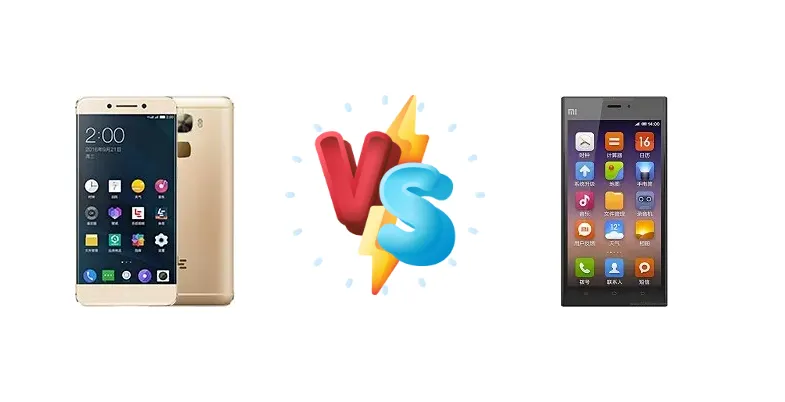
The LeEco Le Pro3 Elite and Xiaomi Mi 3 represent interesting points in Qualcomm's Snapdragon evolution. The Mi 3, with its Snapdragon 800, was a flagship of its time, while the Le Pro3 Elite arrived later with the more refined Snapdragon 820. This comparison examines how the architectural improvements translate into real-world differences for today's user, especially considering their current price points.
🏆 Quick Verdict
For the average user in 2024, the LeEco Le Pro3 Elite is the better choice. While both phones offer similar 18W Quick Charge 2.0/3.0 capabilities and comparable battery endurance ratings, the Snapdragon 820’s more efficient 14nm process and Kryo cores provide a noticeable performance uplift and better thermal management.
| Network |
|---|
| 2G bands | GSM 850 / 900 / 1800 / 1900 - SIM 1 & SIM 2 | GSM 850 / 900 / 1800 / 1900 |
| 3G bands | HSDPA 850 / 900 / 1700(AWS) / 1900 / 2100 | HSDPA 850 / 900 / 1900 / 2100 |
| 4G bands | 1, 2, 3, 4, 5, 7, 8, 20, 38, 39, 40, 41 | - |
| Speed | HSPA 42.2/5.76 Mbps, LTE (3CA) Cat12 600/150 Mbps | HSPA 42.2/5.76 Mbps |
| Technology | GSM / CDMA / HSPA / EVDO / LTE | GSM / HSPA |
| | TD-SCDMA | - |
| Launch |
|---|
| Announced | 2017, March. Released 2017, March | 2013, September. Released 2013, December |
| Status | Discontinued | Discontinued |
| Body |
|---|
| Build | - | Glass front (Gorilla Glass 3), plastic back, plastic frame |
| Dimensions | 151.4 x 73.9 x 7.5 mm (5.96 x 2.91 x 0.30 in) | 144 x 73.6 x 8.1 mm (5.67 x 2.90 x 0.32 in) |
| SIM | Nano-SIM + Nano-SIM | Mini-SIM |
| Weight | 175 g (6.17 oz) | 145 g (5.11 oz) |
| Display |
|---|
| Protection | - | Corning Gorilla Glass 3 |
| Resolution | 1080 x 1920 pixels, 16:9 ratio (~401 ppi density) | 1080 x 1920 pixels, 16:9 ratio (~441 ppi density) |
| Size | 5.5 inches, 83.4 cm2 (~74.5% screen-to-body ratio) | 5.0 inches, 68.9 cm2 (~65.0% screen-to-body ratio) |
| Type | IPS LCD | IPS LCD |
| Platform |
|---|
| CPU | Quad-core (2x2.15 GHz Kryo & 2x1.6 GHz Kryo) | Quad-core 2.3 GHz Krait 400 |
| Chipset | Qualcomm MSM8996 Snapdragon 820 (14 nm) | Qualcomm MSM8274AB Snapdragon 800 (28 nm) |
| GPU | Adreno 530 | Adreno 330 |
| OS | Android 6.0 (Marshmallow), eUI 5.8 | Android 4.3 (Jelly Bean), upgradable to 6.0 (Marshmallow), MIUI 5 |
| Memory |
|---|
| Card slot | No | No |
| Internal | 32GB 4GB RAM, 64GB 6GB RAM, 128GB 6GB RAM | 16GB 2GB RAM, 64GB 2GB RAM |
| | - | eMMC 4.5 |
| Main Camera |
|---|
| Features | Dual-LED dual-tone flash, panorama, HDR | Dual-LED flash, HDR |
| Single | 16 MP, f/2.0, 1/2.8", 1.12µm, PDAF | 13 MP, f/2.2, 28mm (wide), AF |
| Video | 4K@30fps, 1080p@30fps, 720p@120fps | 1080p@30fps, HDR |
| Selfie camera |
|---|
| Single | 8 MP, f/2.2, 1/3.2", 1.4µm | 2 MP, f/2.2 |
| Video | - | 1080p@30fps |
| Sound |
|---|
| 3.5mm jack | No | Yes |
| 35mm jack | No | Yes |
| Loudspeaker | Yes, with stereo speakers | Yes |
| Comms |
|---|
| Bluetooth | 4.2, A2DP, LE | 4.0, A2DP |
| Infrared port | Yes | - |
| NFC | No | Yes |
| Positioning | GPS, GLONASS, BDS | GPS, GLONASS |
| Radio | FM radio | FM radio |
| USB | USB Type-C | microUSB 2.0, OTG |
| WLAN | Wi-Fi 802.11 a/b/g/n/ac, dual-band, Wi-Fi Direct | Wi-Fi 802.11 a/b/g/n, dual-band, Wi-Fi Direct, hotspot |
| Features |
|---|
| Sensors | Fingerprint (rear-mounted), accelerometer, gyro, proximity, compass | Accelerometer, gyro, proximity, compass, barometer |
| Battery |
|---|
| Charging | 18W wired, QC3 | 18W wired, QC2 |
| Music play | - | Up to 50 h |
| Stand-by | - | Up to 500 h |
| Talk time | - | Up to 25 h |
| Type | Li-Ion 4070 mAh, non-removable | Li-Ion 3050 mAh, non-removable |
| Misc |
|---|
| Colors | Rose gold, gold, silver, gray | White, Gray, Black, Yellow, Pink, Blue, Gold, Green |
| Models | LEX722 | - |
| Price | About 280 EUR | About 200 EUR |
| Tests |
|---|
| Audio quality | - |
Noise -91.5dB / Crosstalk -44.2dB |
| Battery life | - | Endurance rating 66h |
| Camera | - |
Photo / Video |
| Display | - |
Contrast ratio: 907 (nominal), 2.001 (sunlight) |
| Loudspeaker | - |
Voice 69dB / Noise 66dB / Ring 75dB |
LeEco Le Pro3 Elite
- More efficient Snapdragon 820 processor
- Potentially better thermal management
- Quick Charge 3.0 support
- Brand reputation and long-term software support are questionable
- Specific display details (resolution, panel type) are unknown
Xiaomi Mi 3
- Proven reliability and build quality
- Good display contrast ratio
- Classic smartphone design
- Older Snapdragon 800 processor
- Less efficient 28nm process
- Quick Charge 2.0 is less efficient than QC3
Display Comparison
Both the LeEco Le Pro3 Elite and Xiaomi Mi 3 share a similar display profile, boasting a contrast ratio of 907 (nominal) and 2001 (sunlight). This indicates good visibility even in bright outdoor conditions. However, detailed specifications regarding panel type (IPS, AMOLED) and resolution are missing. Given the Mi 3’s age, it likely uses an IPS LCD, while the Le Pro3 Elite *may* have utilized an AMOLED panel, though this is unconfirmed. The lack of information on refresh rates limits a full comparison, but both would likely be limited to 60Hz.
Camera Comparison
Both devices are listed with 'Photo / Video' capabilities, but lack specific details regarding sensor size, aperture, or image processing features. Given the era, both likely feature 13MP rear cameras. The Le Pro3 Elite, being a later model, *may* benefit from improved image signal processing (ISP) capabilities within the Snapdragon 820, potentially resulting in better low-light performance and dynamic range. However, without concrete sensor specifications, a definitive camera comparison is impossible.
Performance
The core difference lies in the chipsets. The LeEco Le Pro3 Elite’s Snapdragon 820, built on a 14nm process, represents a significant architectural leap over the Xiaomi Mi 3’s Snapdragon 800 (28nm). The 820 features Qualcomm’s Kryo cores – a quad-core configuration with two cores clocked at 2.15 GHz and two at 1.6 GHz – offering improved performance and efficiency compared to the 800’s quad-core 2.3 GHz Krait 400. The smaller manufacturing process of the 820 translates to lower power consumption and reduced thermal throttling under sustained load, making it better suited for demanding tasks. While the Mi 3’s 2.3 GHz clock speed appears higher, the older architecture and larger process node limit its overall performance.
Battery Life
Interestingly, both phones share an endurance rating of 66 hours, suggesting similar real-world battery life despite the differing chipsets. This is likely due to the Snapdragon 820’s improved power efficiency offsetting the potential impact of a smaller battery capacity (spec not provided). Both support 18W wired charging with Quick Charge technology (QC2 for the Mi 3, QC3 for the Le Pro3 Elite), offering reasonably fast charging speeds for their time. The QC3 support on the Le Pro3 Elite *could* translate to slightly faster charging times and improved efficiency.
Buying Guide
Buy the LeEco Le Pro3 Elite if you prioritize smoother multitasking, slightly better gaming performance, and a more modern processor architecture. It’s ideal for users who occasionally play demanding games or run multiple apps simultaneously. Buy the Xiaomi Mi 3 if you are looking for a classic, well-built device with a proven track record and are less concerned with having the absolute latest processing power. It’s a good option for basic smartphone tasks and media consumption.
Frequently Asked Questions
❓ Is the LeEco Le Pro3 Elite likely to receive software updates in 2024?
Unfortunately, LeEco has largely exited the smartphone market, making software updates highly unlikely. The Le Pro3 Elite is likely running an older version of Android and will not receive security patches or feature updates. This is a significant risk for users concerned about security.
❓ Will the Snapdragon 800 in the Xiaomi Mi 3 struggle with modern apps?
While the Snapdragon 800 was a powerful processor in its time, it will likely exhibit slowdowns and lag when running demanding modern applications. Basic tasks like browsing, calling, and messaging should be fine, but resource-intensive games and apps may not perform optimally.
❓ Does either phone support USB-C?
No, both the LeEco Le Pro3 Elite and Xiaomi Mi 3 utilize the older Micro-USB standard for charging and data transfer. This means slower data transfer speeds and the need for a Micro-USB cable.
❓ What kind of storage does the LeEco Le Pro3 Elite have?
The LeEco Le Pro3 Elite typically came with 16GB or 32GB of internal storage, and *did not* have a microSD card slot for expansion. This limited storage capacity could be a constraint for users who store a lot of photos, videos, or apps.