
LeEco Le Max vs. Apple iPhone 11: A Tale of Two Chipsets and Value Propositions
| Phones Images | |||||
|---|---|---|---|---|---|
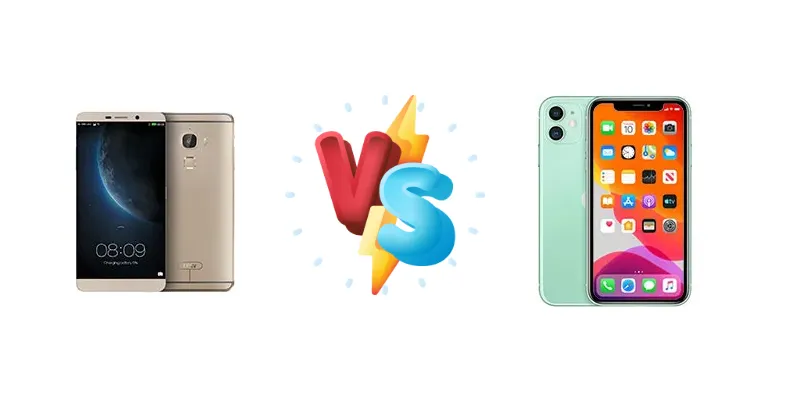
|
🏆 Quick Verdict
For the average user in 2024, the Apple iPhone 11 is the superior choice. While the LeEco Le Max offered impressive specs for its time, the A13 Bionic’s architectural advantages, coupled with Apple’s software optimization and continued support, deliver a smoother, more reliable, and longer-lasting experience.
| PHONES | ||
|---|---|---|
| Phone Names | LeEco Le Max | Apple iPhone 11 |
| Network | ||
|---|---|---|
| 2G bands | GSM 850 / 900 / 1800 / 1900 - SIM 1 & SIM 2 | GSM 850 / 900 / 1800 / 1900 |
| 3G bands | HSDPA 850 / 900 / 1900 / 2100 | HSDPA 850 / 900 / 1700(AWS) / 1900 / 2100 |
| 4G bands | 1, 3, 7, 38, 40 | 1, 2, 3, 4, 5, 7, 8, 11, 12, 13, 17, 18, 19, 20, 21, 25, 26, 28, 29, 30, 32, 34, 38, 39, 40, 41, 42, 46, 48, 66 - A2221 |
| Speed | HSPA, LTE | HSPA 42.2/5.76 Mbps, LTE Cat16 1024/150 Mbps, EV-DO Rev.A 3.1 Mbps |
| Technology | GSM / HSPA / LTE | GSM / CDMA / HSPA / EVDO / LTE |
| - | 1, 2, 3, 4, 5, 7, 8, 12, 13, 14, 17, 18, 19, 20, 25, 26, 29, 30, 34, 38, 39, 40, 41, 42, 46, 48, 66, 71 - A2111, A2223 | |
| Launch | ||
|---|---|---|
| Announced | 2016, January. Released 2016, January | 2019, September 10 |
| Status | Discontinued | Available. Released 2019, September 20 |
| Body | ||
|---|---|---|
| Build | - | Glass front (Corning-made glass), glass back (Corning-made glass), aluminum frame (7000 series) |
| Dimensions | 167.1 x 83.5 x 9 mm (6.58 x 3.29 x 0.35 in) | 150.9 x 75.7 x 8.3 mm (5.94 x 2.98 x 0.33 in) |
| SIM | Nano-SIM + Micro-SIM | · Nano-SIM + eSIM· Nano-SIM + Nano-SIM (China) |
| Weight | 204 g (7.20 oz) | 194 g (6.84 oz) |
| - | IP68 dust/water resistant (up to 2m for 30 min) Apple Pay (Visa, MasterCard, AMEX certified) | |
| Display | ||
|---|---|---|
| Protection | Corning Gorilla Glass 3 | Scratch-resistant glass |
| Resolution | 1440 x 2560 pixels, 16:9 ratio (~464 ppi density) | 828 x 1792 pixels, 19.5:9 ratio (~326 ppi density) |
| Size | 6.33 inches, 110.5 cm2 (~79.2% screen-to-body ratio) | 6.1 inches, 90.3 cm2 (~79.0% screen-to-body ratio) |
| Type | IPS LCD | Liquid Retina IPS LCD, 625 nits (typ) |
| Platform | ||
|---|---|---|
| CPU | Octa-core (4x1.5 GHz Cortex-A53 & 4x2.0 GHz Cortex-A57) | Hexa-core (2x2.65 GHz Lightning + 4x1.8 GHz Thunder) |
| Chipset | Qualcomm MSM8994 Snapdragon 810 (20 nm) | Apple A13 Bionic (7 nm+) |
| GPU | Adreno 430 | Apple GPU (4-core graphics) |
| OS | Android 5.1 (Lollipop) | iOS 13, upgradable to iOS 26.1 |
| Memory | ||
|---|---|---|
| Card slot | No | No |
| Internal | 64GB 4GB RAM, 128GB 4GB RAM | 64GB 4GB RAM, 128GB 4GB RAM, 256GB 4GB RAM |
| eMMC 5.0 | NVMe | |
| Main Camera | ||
|---|---|---|
| Dual | - | 12 MP, f/1.8, 26mm (wide), 1/2.55", 1.4µm, dual pixel PDAF, OIS 12 MP, f/2.4, 120˚, 13mm (ultrawide), 1/3.6" |
| Features | Dual-LED dual-tone flash, panorama, HDR | Dual-LED dual-tone flash, HDR (photo/panorama) |
| Single | 21 MP, f/2.0, 1/2.4", AF, OIS | - |
| Video | 4K@30fps, 1080p@30fps | 4K@24/25/30/60fps, 1080p@25/30/60/120/240fps, HDR, stereo sound rec. |
| Selfie camera | ||
|---|---|---|
| Features | - | HDR |
| Single | 4 MP, f/2.0, 1/3", 2µm | 12 MP, f/2.2, 23mm (wide), 1/3.6", 1.0µm SL 3D, (depth/biometrics sensor) |
| Video | 1080p@30fps | 4K@24/25/30/60fps, 1080p@25/30/60/120fps, gyro-EIS |
| Sound | ||
|---|---|---|
| 3.5mm jack | Yes | No |
| 35mm jack | Yes | No |
| Loudspeaker | Yes | Yes, with stereo speakers |
| 24-bit/192kHz audio | - | |
| Comms | ||
|---|---|---|
| Bluetooth | 4.1, A2DP, LE | 5.0, A2DP, LE |
| Infrared port | Yes | - |
| NFC | Yes | Yes |
| Positioning | GPS, GLONASS | GPS, GLONASS, GALILEO, QZSS |
| Radio | No | No |
| USB | USB Type-C (MHL2 TV-out) | Lightning, USB 2.0 |
| WLAN | Wi-Fi 802.11 a/b/g/n/ac, dual-band, Wi-Fi Direct, DLNA, hotspot | Wi-Fi 802.11 a/b/g/n/ac/6, dual-band, hotspot |
| Features | ||
|---|---|---|
| Sensors | Fingerprint (rear-mounted), accelerometer, gyro, proximity, compass | Face ID, accelerometer, gyro, proximity, compass, barometer |
| - | Ultra Wideband (UWB) support | |
| Battery | ||
|---|---|---|
| Charging | 18W wired | Wired, PD2.0, 50% in 30 min Wireless (Qi) |
| Type | Li-Po 3400 mAh, non-removable | Li-Ion 3110 mAh, non-removable (11.91 Wh) |
| Misc | ||
|---|---|---|
| Colors | Gold, Silver | Black, Green, Yellow, Purple, Red, White |
| Models | - | A2221, A2111, A2223, iPhone12,1 |
| Price | About 350 EUR | $ 167.50 / C$ 228.68 / £ 175.00 / € 193.32 |
| SAR | - | 1.09 W/kg (head) 1.18 W/kg (body) |
| SAR EU | - | 0.95 W/kg (head) 0.99 W/kg (body) |
| Pricing | ||
|---|---|---|
| 128GB 4GB RAM | - | $ 359.95 |
| 256GB 4GB RAM | - | $ 469.99 |
| 64GB 4GB RAM | - | $ 292.79 |
| RENEWED | - | £ 214.00 |
| Tests | ||
|---|---|---|
| Audio quality | - | Noise -94.2dB / Crosstalk -80.8dB |
| Battery life | - | Endurance rating 94h |
| Camera | - | Photo / Video |
| Display | - | Contrast ratio: 1505:1 (nominal) |
| Loudspeaker | - | Voice 70dB / Noise 72dB / Ring 76dB |
| Performance | - | AnTuTu: 419453 (v7) GeekBench: 13882 (v4.4) GFXBench: 60fps (ES 3.1 onscreen) |
LeEco Le Max
- Aggressive pricing at launch
- High-end specs for its time
- Potential for customization (Android)
- Software support is likely discontinued
- Snapdragon 810 prone to throttling
- Inferior camera performance
Apple iPhone 11
- Excellent performance with the A13 Bionic
- Superior camera system
- Long-term software support from Apple
- Higher initial cost (though decreasing)
- Less customization compared to Android
- Lightning port instead of USB-C
Display Comparison
The iPhone 11 boasts a significantly more refined display experience. While both phones achieve a 1505:1 contrast ratio, the iPhone 11’s measured peak brightness of 644 nits surpasses what was typical for the LeEco Le Max’s panel. The LeEco Le Max likely utilized an LCD panel, whereas the iPhone 11’s LCD benefits from Apple’s color calibration and True Tone technology, resulting in more accurate and pleasing visuals. Bezels on the iPhone 11 are also noticeably slimmer, contributing to a more modern aesthetic.
Camera Comparison
The iPhone 11’s camera system is a clear winner. While both devices offer photo and video capabilities, the iPhone 11 benefits from Apple’s advanced image signal processing (ISP) and computational photography algorithms. Details regarding the LeEco Le Max’s sensor size and aperture are unavailable, but it’s unlikely to match the iPhone 11’s capabilities. The iPhone 11’s Smart HDR and Deep Fusion features deliver consistently excellent results in various lighting conditions. The LeEco Le Max, while capable, would struggle to compete with the iPhone 11’s image quality and video stabilization.
Performance
The performance gap between the Snapdragon 810 and the A13 Bionic is substantial. The A13 Bionic, built on a 7nm+ process, features a hexa-core CPU with two high-performance 'Lightning' cores clocked at 2.65 GHz and four efficiency cores. This contrasts with the Snapdragon 810’s octa-core configuration (4x1.5 GHz Cortex-A53 & 4x2.0 GHz Cortex-A57) fabricated on a larger 20nm node. The A13’s architectural advantages and smaller process node translate to significantly higher single-core and multi-core performance, as well as superior power efficiency. The Snapdragon 810 was known for thermal throttling under sustained load, a problem largely mitigated by Apple’s efficient design in the iPhone 11.
Battery Life
Both devices achieve an endurance rating of 94 hours, suggesting comparable battery life under similar usage patterns. However, the iPhone 11’s charging capabilities are more versatile. It supports 18W wired charging with Power Delivery 2.0, achieving a 50% charge in 30 minutes, and also offers Qi wireless charging. The LeEco Le Max is limited to 18W wired charging, lacking wireless charging support. The A13 Bionic’s power efficiency also contributes to the iPhone 11’s ability to maintain its battery life over time, while the Snapdragon 810’s less efficient design may lead to faster battery degradation.
Buying Guide
Buy the LeEco Le Max if you are a hardware enthusiast comfortable with potential software limitations and are seeking a device for experimentation or tinkering. Its Snapdragon 810 offers a glimpse into early high-end Android performance. Buy the Apple iPhone 11 if you prioritize a polished user experience, long-term software support, a superior camera system, and reliable performance for everyday tasks and beyond.