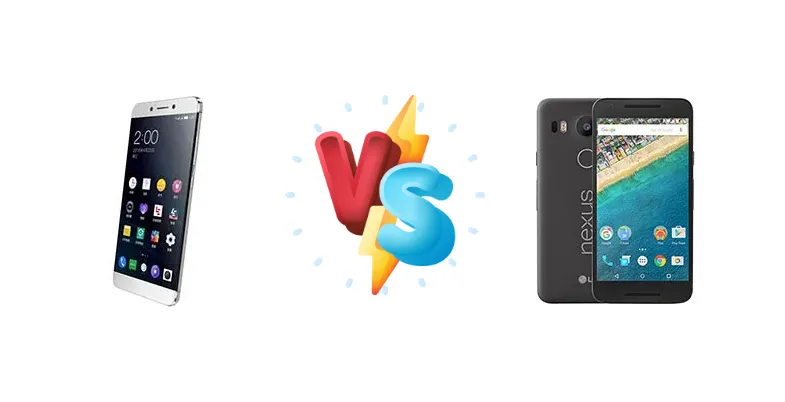
Released in 2016, the LeEco Le 2 and LG Nexus 5X represent different approaches to the mid-range smartphone market. The LeEco Le 2 aimed to disrupt with a deca-core processor and aggressive pricing, while the Nexus 5X offered a clean Android experience and a well-regarded camera. This comparison revisits these devices to determine which holds up better today, considering their original strengths and weaknesses.
🏆 Quick Verdict
For the average user in 2024, the LG Nexus 5X is the better choice. While the LeEco Le 2 boasts a more complex CPU, the Snapdragon 808 in the Nexus 5X provides a more consistently smooth experience, coupled with a better-supported software ecosystem and a more reliable camera. The LeEco Le 2's software support is a significant drawback.
| Network |
|---|
| 2G bands | GSM 850 / 900 / 1800 / 1900 - SIM 1 & SIM 2 | GSM 850 / 900 / 1800 / 1900 - all models |
| 3G bands | HSDPA 850 / 1700(AWS) / 1900 / 2100 | HSDPA 850 / 900 / 1700 / 1900 / 2100 - American model |
| 4G bands | 1, 2, 3, 4, 5, 7, 8, 20, 38, 40, 41 | 1, 2, 3, 4, 5, 7, 12, 13, 17, 20, 25, 26, 29 - American model |
| Speed | Yes, 384 kbps | HSPA 42.2/5.76 Mbps, LTE Cat6 300/50 Mbps |
| Technology | GSM / HSPA / LTE | GSM / CDMA / HSPA / LTE |
| | - | 1, 2, 3, 4, 5, 7, 8, 9, 17, 18, 19, 20, 26, 28, 38, 40, 41 - Global model |
| Launch |
|---|
| Announced | 2016, April. Released 2016, April | 2015, September. Released 2015, October |
| Status | Discontinued | Discontinued |
| Body |
|---|
| Build | - | Glass front (Gorilla Glass 3), plastic back, plastic frame |
| Dimensions | 151.1 x 74.2 x 7.5 mm (5.95 x 2.92 x 0.30 in) | 147 x 72.6 x 7.9 mm (5.79 x 2.86 x 0.31 in) |
| SIM | Nano-SIM + Nano-SIM | Nano-SIM |
| Weight | 153 g (5.40 oz) | 136 g (4.80 oz) |
| Display |
|---|
| Protection | - | Corning Gorilla Glass 3, oleophobic coating |
| Resolution | 1080 x 1920 pixels, 16:9 ratio (~401 ppi density) | 1080 x 1920 pixels, 16:9 ratio (~423 ppi density) |
| Size | 5.5 inches, 83.4 cm2 (~74.4% screen-to-body ratio) | 5.2 inches, 74.9 cm2 (~70.2% screen-to-body ratio) |
| Type | IPS LCD | IPS LCD |
| Platform |
|---|
| CPU | Deca-core (2x2.3 GHz Cortex-A72, 4x2 GHz Cortex-A53, 4x1.4 GHz Cortex-A53)Octa-core (4x1.4 GHz Cortex-A53 & 4x1.8 GHz Cortex-A72) | Hexa-core (4x1.4 GHz Cortex-A53 & 2x1.8 GHz Cortex-A57) |
| Chipset | Mediatek MT6797 Helio X20 (20 nm)Qualcomm MSM8976 Snapdragon 652 (28 nm) | Qualcomm MSM8992 Snapdragon 808 (20 nm) |
| GPU | Mali-T880 MP4Adreno 510 | Adreno 418 |
| OS | Android 6.0 (Marshmallow), EUI 5.6 | Android 6.0 (Marshmallow), upgradable to Android 8.0 (Oreo) |
| Memory |
|---|
| Card slot | No | No |
| Internal | 32GB 3GB RAM, 64GB 3GB RAM | 16GB 2GB RAM, 32GB 2GB RAM |
| | eMMC 5.1 | eMMC 5.0 |
| Main Camera |
|---|
| Features | Dual-LED dual-tone flash, panorama, HDR | Laser AF, Dual-LED dual-tone flash, HDR, panorama |
| Single | 16 MP, f/2.0, PDAF | 12.3 MP, f/2.0, 26mm (wide), 1/2.3", 1.55µm |
| Video | 4K@30fps, 1080p@30fps, 720p@120fps | 4K@30fps, 1080p@30fps, 720p@120fps, HDR |
| Selfie camera |
|---|
| Features | - | HDR |
| Single | 8 MP, f/2.2, 1/3.2", 1.4µm | 5 MP, f/2.0, 1/4.0", 1.4µm |
| Video | 1080p@30fps | 1080p@30fps |
| Sound |
|---|
| 3.5mm jack | No | Yes |
| 35mm jack | No | Yes |
| Loudspeaker | Yes | Yes |
| | 24-bit/192kHz audio | - |
| Comms |
|---|
| Bluetooth | 4.1, A2DP, LE | 4.2, A2DP |
| Infrared port | Yes | - |
| NFC | No | Yes |
| Positioning | GPS, GLONASS, BDS | GPS, GLONASS |
| Radio | No | No |
| USB | USB Type-C | USB Type-C 2.0 |
| WLAN | Wi-Fi 802.11 a/b/g/n/ac, dual-band, Wi-Fi Direct | Wi-Fi 802.11 a/b/g/n/ac, dual-band, Wi-Fi Direct, DLNA |
| Features |
|---|
| Sensors | Fingerprint (rear-mounted), accelerometer, gyro, proximity, compass | Fingerprint (rear-mounted), accelerometer, gyro, proximity, compass, barometer |
| Battery |
|---|
| Charging | 18W wired, QC2, 50% in 30 min | - |
| Type | Li-Ion 3000 mAh, non-removable | Li-Po 2700 mAh, non-removable |
| Misc |
|---|
| Colors | Rose gold, gold, silver, grey | Carbon, Quartz, Ice |
| Models | Le X526, Le X620, Le X520, Le X527, X526 | Nexus 5X, H791 |
| Price | About 190 EUR | About 270 EUR |
| Tests |
|---|
| Audio quality | - |
Noise -92.2dB / Crosstalk -90.9dB |
| Battery life | - |
Endurance rating 60h
|
| Camera | - |
Photo / Video |
| Display | - |
Contrast ratio: 1542 (nominal), 3.092 (sunlight) |
| Loudspeaker | - |
Voice 61dB / Noise 65dB / Ring 61dB
|
| Performance | - |
Basemark OS II 2.0: 1591Basemark X: 16609 |
LeEco Le 2
- Deca-core processor offers potential for high multi-core performance.
- Fast charging (18W with QC2) reduces downtime.
- Aggressive pricing at launch made it a value proposition.
- Software support is limited and potentially requires custom ROMs.
- Helio X20 prone to thermal throttling under sustained load.
- Camera quality is inferior to the Nexus 5X.
LG Nexus 5X
- Clean Android experience with timely updates (at launch).
- Reliable Snapdragon 808 processor with good thermal management.
- Excellent camera performance, especially in low light.
- Battery life is average compared to modern smartphones.
- Charging speed is slower than the LeEco Le 2.
- No expandable storage.
Display Comparison
Both the LeEco Le 2 and LG Nexus 5X share a similar display contrast ratio of 1542:1 (nominal) and 3.092:1 (sunlight), suggesting comparable visibility in bright conditions. However, the LeEco Le 2's display specifications are less readily available, making a detailed comparison of color accuracy and peak brightness difficult. The Nexus 5X's 5.2-inch display, while not cutting-edge in 2016, offered a solid viewing experience, and its consistent performance is a benefit.
Camera Comparison
The LG Nexus 5X is widely regarded as having a superior camera system. While both phones offer photo and video capabilities, the Nexus 5X's sensor and image processing algorithms consistently produced better results, particularly in low-light conditions. Details regarding the LeEco Le 2's camera sensor size and aperture are scarce, but user reviews suggest it struggles to match the Nexus 5X's image quality. The Nexus 5X's focus on computational photography, a hallmark of the Nexus line, gives it a clear advantage.
Performance
The LeEco Le 2's Mediatek Helio X20 deca-core CPU is a standout feature, combining two Cortex-A72 cores for peak performance with four Cortex-A53 cores for efficiency and another four for background tasks. However, the 20nm manufacturing process and the complexity of the core arrangement often led to thermal throttling. The LG Nexus 5X, powered by the Qualcomm Snapdragon 808 (20nm), utilizes a hexa-core configuration with two Cortex-A57 cores and four Cortex-A53 cores. While fewer cores, the Snapdragon 808's architecture and Qualcomm's optimizations generally resulted in more consistent performance and better thermal management. The Snapdragon 808's Adreno 330 GPU also likely outperforms the Mali-T880 MP4 in the LeEco Le 2, especially in sustained gaming scenarios.
Battery Life
The LG Nexus 5X boasts an endurance rating of 60 hours, indicating reasonable battery life for its time. The LeEco Le 2 features 18W wired charging with Quick Charge 2.0 support, capable of reaching 50% charge in 30 minutes. While the LeEco Le 2's faster charging is a plus, the Nexus 5X's overall efficiency and optimized software likely contribute to comparable real-world battery performance, despite lacking the same charging speed. The Nexus 5X's battery life is more predictable and less impacted by the CPU's tendency to throttle.
Buying Guide
Buy the LeEco Le 2 if you prioritize raw CPU core count and are comfortable with potential software limitations and the need for custom ROMs. It's a project phone for enthusiasts. Buy the LG Nexus 5X if you value a clean Android experience, a dependable camera, and a device that's more likely to receive community support for years to come. It's the safer, more user-friendly option.
Frequently Asked Questions
❓ Is the LeEco Le 2 still a viable option for daily use in 2024?
While the LeEco Le 2 can still perform basic tasks, its limited software support and potential for performance throttling make it less ideal for daily use. Finding compatible apps and security updates may be challenging, and the user experience may be inconsistent.
❓ Does the Snapdragon 808 in the Nexus 5X suffer from significant throttling during extended gaming sessions?
The Snapdragon 808 is known to throttle under sustained heavy load, but its throttling is generally less severe than the Helio X20. The Nexus 5X can handle moderate gaming sessions without significant performance drops, but demanding titles may experience frame rate dips over time.
❓ What is the current state of software support for the LeEco Le 2?
Official software support from LeEco has ended. Users typically rely on custom ROMs from the Android developer community to keep the device updated and secure. This requires technical expertise and carries inherent risks.
❓ How does the camera on the Nexus 5X compare to modern smartphone cameras?
The Nexus 5X's camera, while excellent for its time, is significantly behind modern smartphone cameras in terms of resolution, dynamic range, and low-light performance. However, it still produces usable and aesthetically pleasing photos in good lighting conditions.