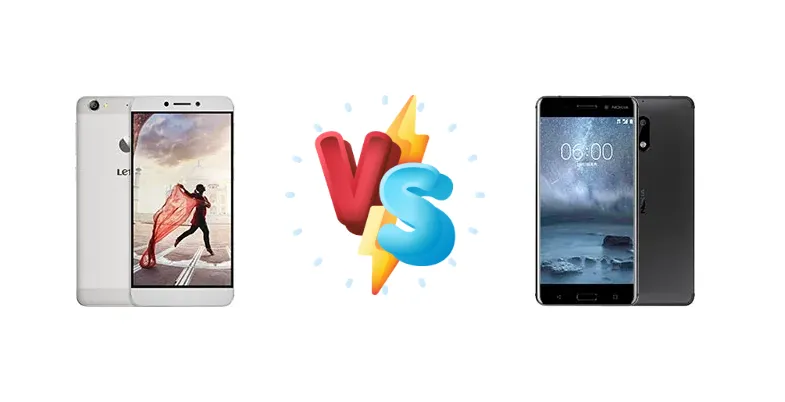
The LeEco Le 1s and Nokia 6 represent distinct approaches to the budget smartphone market. The LeEco, released with a focus on raw processing power, aimed to disrupt with a flagship-level chipset at a lower price. The Nokia 6, on the other hand, prioritized build quality and a clean Android experience. This comparison dissects their key differences to determine which offers the best value in today's market.
🏆 Quick Verdict
For the average user prioritizing a balanced experience, the Nokia 6 emerges as the better choice. While the LeEco Le 1s boasts a more powerful processor on paper, the Nokia 6’s optimized Snapdragon 430, coupled with its endurance rating, provides a smoother, more reliable daily experience.
| Network |
|---|
| 2G bands | GSM 850 / 900 / 1800 / 1900 - SIM 1 & SIM 2 | GSM 850 / 900 / 1800 / 1900 - SIM 1 & SIM 2 |
| 3G bands | HSDPA 850 / 900 / 1900 / 2100 | HSDPA 850 / 900 / 1900 / 2100 |
| 4G bands | 1, 3, 7, 38, 39, 40, 41 | 1, 3, 5, 7, 8, 20, 28, 38, 40 |
| Speed | HSPA, LTE | HSPA 42.2/5.76 Mbps, LTE Cat4 150/50 Mbps |
| Technology | GSM / HSPA / LTE | GSM / HSPA / LTE |
| Launch |
|---|
| Announced | 2016, February. Released 2016, February | 2017, January. Released 2017, January 19 |
| Status | Discontinued | Discontinued |
| Body |
|---|
| Build | - | Glass front (Gorilla Glass 3), aluminum back, aluminum frame |
| Dimensions | 151.1 x 74.2 x 7.6 mm (5.95 x 2.92 x 0.30 in) | 154 x 75.8 x 7.9 mm (6.06 x 2.98 x 0.31 in) |
| SIM | Nano-SIM + Micro-SIM | Nano-SIM + Nano-SIM |
| Weight | 169 g (5.96 oz) | 169 g (5.96 oz) |
| Display |
|---|
| Protection | - | Corning Gorilla Glass 3 |
| Resolution | 1080 x 1920 pixels, 16:9 ratio (~401 ppi density) | 1080 x 1920 pixels, 16:9 ratio (~403 ppi density) |
| Size | 5.5 inches, 83.4 cm2 (~74.4% screen-to-body ratio) | 5.5 inches, 82.6 cm2 (~70.7% screen-to-body ratio) |
| Type | IPS LCD | IPS LCD |
| Platform |
|---|
| CPU | Octa-core 2.2 GHz Cortex-A53 | Octa-core 1.4 GHz Cortex-A53 |
| Chipset | Mediatek MT6795 Helio X10 (28 nm) | Qualcomm MSM8937 Snapdragon 430 (28 nm) |
| GPU | PowerVR G6200 | Adreno 505 |
| OS | Android 5.0 (Lollipop) - LeEco Le 1sAndroid 6.0 (Marshmallow) - LeEco Le 1s Eco | Android 7.1.1 (Nougat), upgradable to Android 9.0 (Pie) |
| Memory |
|---|
| Card slot | No | microSDXC (uses shared SIM slot) |
| Internal | 32GB 3GB RAM | 32GB 3GB RAM, 64GB 4GB RAM |
| | eMMC 5.0 | eMMC 5.1 |
| Main Camera |
|---|
| Features | LED flash, panorama, HDR | Dual-LED dual-tone flash, panorama, HDR |
| Single | 13 MP, AF | 16 MP, f/2.0, 1.0µm, PDAF |
| Video | 4K@30fps | 1080p@30fps |
| Selfie camera |
|---|
| Single | 5 MP | 8 MP, f/2.0, 1/4.0", 1.12µm, AF |
| Video | - | 1080p@30fps |
| Sound |
|---|
| 3.5mm jack | Yes | Yes |
| 35mm jack | Yes | Yes |
| Loudspeaker | Yes | Yes, with stereo speakers |
| Comms |
|---|
| Bluetooth | 4.1, A2DP, LE | 4.1, A2DP, LE |
| Infrared port | Yes | - |
| NFC | No | Yes |
| Positioning | GPS, GLONASS | GPS, GLONASS |
| Radio | No | FM radio |
| USB | USB Type-C (MHL2 TV-out) | microUSB 2.0, OTG |
| WLAN | Wi-Fi 802.11 a/b/g/n/ac, dual-band, Wi-Fi Direct | Wi-Fi 802.11 a/b/g/n, Wi-Fi Direct |
| Features |
|---|
| Sensors | Fingerprint (rear-mounted), accelerometer, proximity, compass | Fingerprint (front-mounted), accelerometer, gyro, proximity, compass |
| Battery |
|---|
| Charging | - | 10W wired |
| Music play | - | Up to 22 h |
| Stand-by | - | Up to 768 h (3G) |
| Talk time | - | Up to 18 h (3G) |
| Type | Li-Ion 3000 mAh, non-removable | Li-Ion 3000 mAh, non-removable |
| Misc |
|---|
| Colors | Gold, Silver, Gray | Arte Black, Matte Black, Tempered Blue, Silver, Copper |
| Models | Le X507, Le X509, Letv X500 | TA-1021, TA-1033, TA-1000, TA-1003, TA-1025, TA-1039 |
| Price | About 210 EUR | About 400 EUR |
| SAR EU | - | 0.29 W/kg (head) |
| Tests |
|---|
| Battery life | - | Endurance rating 62h |
| Camera | - |
Photo / Video |
| Display | - |
Contrast ratio: 1330 (nominal), 3.238 (sunlight) |
| Loudspeaker | - |
Voice 63dB / Noise 70dB / Ring 82dB |
| Performance | - |
GeekBench: 2841 (v4.4)
GFXBench: 2.5fps (ES 3.1 onscreen) |
LeEco Le 1s
- More powerful processor (Helio X10)
- Potentially better performance in demanding apps
- Aggressive pricing at launch
- Likely less efficient battery life
- Potential software instability (LeEco's history)
- Missing battery capacity information
Nokia 6
- Better battery endurance (62h rating)
- More stable software experience (Nokia's Android One)
- Robust build quality
- Less powerful processor (Snapdragon 430)
- May struggle with very demanding games
- 10W charging is relatively slow
Display Comparison
Both the LeEco Le 1s and Nokia 6 share a contrast ratio of 1330 (nominal) and 3.238 (sunlight), suggesting similar outdoor visibility. However, the context data lacks specifics on panel type (IPS, AMOLED) or resolution. Given the price points, both likely utilize IPS LCDs. The Nokia 6’s build quality, featuring a more robust aluminum frame, likely contributes to a more premium feel around the display, though this isn't directly reflected in the provided specs. Without resolution data, it's difficult to assess sharpness differences.
Camera Comparison
Both devices are listed with 'Photo / Video' capabilities, offering minimal insight. Without sensor size, aperture, or image processing details, a meaningful comparison is impossible. It’s reasonable to assume both feature modest camera systems geared towards casual photography. The absence of any mention of advanced features like OIS or high-resolution sensors suggests neither phone will excel in low-light conditions or offer exceptional image quality. The Nokia 6, benefiting from Qualcomm’s image signal processor, may offer slightly better image processing, but this is speculative.
Performance
The LeEco Le 1s’ Mediatek MT6795 Helio X10, with its octa-core 2.2 GHz Cortex-A53 CPU, appears superior to the Nokia 6’s Qualcomm MSM8937 Snapdragon 430 (octa-core 1.4 GHz Cortex-A53) on paper. However, clock speed isn't the whole story. The Snapdragon 430 benefits from Qualcomm’s optimizations and a more efficient architecture. While the Helio X10 may excel in benchmark scores, the Snapdragon 430 is likely to provide a smoother, more consistent experience in daily use due to better thermal management and software integration. The 28nm fabrication process is shared by both, meaning neither will be a thermal powerhouse.
Battery Life
The Nokia 6’s endurance rating of 62 hours is a significant advantage. While the LeEco Le 1s’ battery capacity isn’t specified, the more powerful Helio X10 processor likely consumes more power. The Nokia 6’s 10W wired charging is standard for the time, but the focus is on efficiency. The endurance rating suggests the Nokia 6 can comfortably last a full day of moderate use, while the LeEco Le 1s may require more frequent charging, especially with demanding applications.
Buying Guide
Buy the LeEco Le 1s if you prioritize maximum processing power for demanding tasks like emulation or older, less optimized games, and are comfortable with potential software quirks. Buy the Nokia 6 if you value a stable software experience, consistent performance for everyday tasks, and a longer-lasting battery life, even if it means sacrificing some raw speed.
Frequently Asked Questions
❓ Is the LeEco Le 1s still receiving software updates?
LeEco’s software support has been historically inconsistent. It’s highly unlikely the LeEco Le 1s is receiving regular security updates or major Android version upgrades at this point. This poses a security risk and may limit compatibility with newer apps.
❓ Will the Nokia 6 struggle with modern mobile games like PUBG Mobile or Call of Duty Mobile?
The Snapdragon 430 in the Nokia 6 is capable of running PUBG Mobile and Call of Duty Mobile, but you’ll likely need to play at lower graphics settings to maintain a stable frame rate. Don't expect a high-end gaming experience, but it's playable for casual gamers.
❓ How does the build quality of the Nokia 6 compare to the LeEco Le 1s?
The Nokia 6 features a more premium build with an aluminum frame, offering a more solid and durable feel. The LeEco Le 1s likely utilizes a plastic construction, which is common in its price range, but may feel less robust.
❓ What type of charging port does each phone use?
Both the LeEco Le 1s and Nokia 6 utilize a Micro-USB port for charging and data transfer. This is slower than the USB-C standard found on more modern devices.