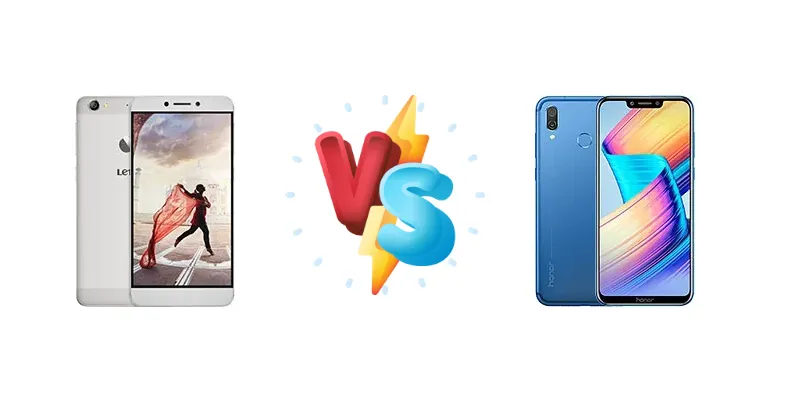
Released in different eras, the LeEco Le 1s (2015) and the Honor Play (2018) represent distinct approaches to the mid-range smartphone market. The Le 1s aimed to disrupt with aggressive pricing, while the Honor Play focused on bringing flagship-level performance to a more accessible price point. This comparison dissects their key differences, focusing on the impact of their respective chipsets and features.
🏆 Quick Verdict
For the average user in 2024, the Honor Play is the clear winner. While both phones achieve a similar 94-hour endurance rating, the Honor Play’s Kirin 970 chipset, built on a 10nm process, offers a substantial performance advantage over the LeEco Le 1s’ older 28nm Helio X10, making it better suited for modern applications and gaming.
| Network |
|---|
| 2G bands | GSM 850 / 900 / 1800 / 1900 - SIM 1 & SIM 2 | GSM 850 / 900 / 1800 / 1900 |
| 3G bands | HSDPA 850 / 900 / 1900 / 2100 | HSDPA 850 / 900 / 2100 - India |
| 4G bands | 1, 3, 7, 38, 39, 40, 41 | 1, 3, 5, 7, 8, 20, 38, 40, 41 - Global |
| Speed | HSPA, LTE | HSPA 42.2/5.76 Mbps, LTE (3CA) Cat16 1024/150 Mbps |
| Technology | GSM / HSPA / LTE | GSM / CDMA / HSPA / LTE |
| | - | 1, 3, 5, 8, 38, 39, 40, 41 - China |
| Launch |
|---|
| Announced | 2016, February. Released 2016, February | 2018, July. Released 2018, August |
| Status | Discontinued | Discontinued |
| Body |
|---|
| Build | - | Glass front, aluminum back, aluminum frame |
| Dimensions | 151.1 x 74.2 x 7.6 mm (5.95 x 2.92 x 0.30 in) | 157.9 x 74.3 x 7.5 mm (6.22 x 2.93 x 0.30 in) |
| SIM | Nano-SIM + Micro-SIM | Nano-SIM + Nano-SIM |
| Weight | 169 g (5.96 oz) | 176 g (6.21 oz) |
| Display |
|---|
| Resolution | 1080 x 1920 pixels, 16:9 ratio (~401 ppi density) | 1080 x 2340 pixels, 19.5:9 ratio (~409 ppi density) |
| Size | 5.5 inches, 83.4 cm2 (~74.4% screen-to-body ratio) | 6.3 inches, 97.4 cm2 (~83.0% screen-to-body ratio) |
| Type | IPS LCD | IPS LCD |
| Platform |
|---|
| CPU | Octa-core 2.2 GHz Cortex-A53 | Octa-core (4x2.4 GHz Cortex-A73 & 4x1.8 GHz Cortex-A53) |
| Chipset | Mediatek MT6795 Helio X10 (28 nm) | Kirin 970 (10 nm) |
| GPU | PowerVR G6200 | Mali-G72 MP12 |
| OS | Android 5.0 (Lollipop) - LeEco Le 1sAndroid 6.0 (Marshmallow) - LeEco Le 1s Eco | Android 8.1 (Oreo), upgradable to Android 9.0 (Pie), EMUI 9.1 |
| Memory |
|---|
| Card slot | No | microSDXC (uses shared SIM slot) |
| Internal | 32GB 3GB RAM | 64GB 4GB RAM, 64GB 6GB RAM, 128GB 6GB RAM |
| | eMMC 5.0 | UFS 2.1 |
| Main Camera |
|---|
| Dual | - | 16 MP, f/2.2, PDAF
Auxiliary lens |
| Features | LED flash, panorama, HDR | LED flash, HDR, panorama |
| Single | 13 MP, AF | - |
| Video | 4K@30fps | 4K@30fps, 1080p@60fps, 1080p@30fps (gyro-EIS) |
| Selfie camera |
|---|
| Single | 5 MP | 16 MP, f/2.0, 26mm (wide), 1/3.06", 1.0µm |
| Video | - | 1080p@30fps |
| Sound |
|---|
| 3.5mm jack | Yes | Yes |
| 35mm jack | Yes | Yes |
| Loudspeaker | Yes | Yes |
| Comms |
|---|
| Bluetooth | 4.1, A2DP, LE | 4.2, A2DP, LE, EDR, aptX HD |
| Infrared port | Yes | - |
| NFC | No | Yes (market dependent) |
| Positioning | GPS, GLONASS | GPS, GLONASS, BDS |
| Radio | No | No |
| USB | USB Type-C (MHL2 TV-out) | USB Type-C 2.0 |
| WLAN | Wi-Fi 802.11 a/b/g/n/ac, dual-band, Wi-Fi Direct | Wi-Fi 802.11 a/b/g/n/ac, dual-band, Wi-Fi Direct |
| Features |
|---|
| Sensors | Fingerprint (rear-mounted), accelerometer, proximity, compass | Fingerprint (rear-mounted), accelerometer, gyro, proximity, compass |
| Battery |
|---|
| Charging | - | 18W wired |
| Type | Li-Ion 3000 mAh, non-removable | Li-Po 3750 mAh, non-removable |
| Misc |
|---|
| Colors | Gold, Silver, Gray | Midnight Black, Navy Blue, Violet, Player Edition Red, Player Edition Black |
| Models | Le X507, Le X509, Letv X500 | COR-L29, COR-L09, COR-AL00, COR-AL10, COR-TL10 |
| Price | About 210 EUR | About 250 EUR |
| SAR | - | 1.10 W/kg (head) |
| Tests |
|---|
| Battery life | - |
Endurance rating 94h
|
| Camera | - |
Photo / Video |
| Display | - |
Contrast ratio: 1135:1 (nominal), 3.349 (sunlight) |
| Loudspeaker | - |
Voice 68dB / Noise 73dB / Ring 75dB
|
| Performance | - |
AnTuTu: 204876 (v7), 238754 (v8)
GeekBench: 6696 (v4.4), 1647 (v5.1)
GFXBench: 21fps (ES 3.1 onscreen) |
LeEco Le 1s
- Extremely affordable (when originally released)
- Decent battery endurance for basic use
- Compact form factor
- Outdated chipset with limited performance
- Likely limited software support and security updates
- Inferior camera performance
Honor Play
- Significantly faster and more efficient Kirin 970 chipset
- Faster 18W charging
- Potentially better camera quality and features
- Higher initial cost (when originally released)
- Software support is likely ending
- Larger size compared to the LeEco Le 1s
Display Comparison
Both devices share a similar contrast ratio of 1135:1 (nominal) and 3.349 (sunlight), suggesting comparable outdoor visibility. However, the LeEco Le 1s’ display specifications are less readily available, making a detailed comparison of color accuracy and peak brightness difficult. The Honor Play’s display benefits from the more advanced image processing capabilities of the Kirin 970, potentially resulting in more vibrant and accurate colors. The Honor Play's later release date likely means a more refined display assembly process.
Camera Comparison
Both phones are listed as having 'Photo / Video' capabilities, but detailed camera specifications are lacking. Given the LeEco Le 1s’ focus on cost reduction, its camera likely features a simpler sensor and image processing pipeline. The Honor Play, benefiting from the Kirin 970’s ISP (Image Signal Processor), likely offers superior image quality, particularly in low-light conditions and with dynamic range. The Kirin 970’s ISP also enables more advanced features like AI scene recognition, which were becoming prevalent at the time of the Honor Play’s release.
Performance
The core difference lies in the chipsets. The LeEco Le 1s utilizes the Mediatek MT6795 Helio X10, a 28nm octa-core processor with Cortex-A53 cores clocked at 2.2 GHz. The Honor Play, however, boasts the Kirin 970, a 10nm chip featuring a heterogeneous architecture with four Cortex-A73 cores at 2.4 GHz and four Cortex-A53 cores at 1.8 GHz. This architectural difference is crucial; the A73 cores offer significantly higher single-core performance, vital for responsive app loading and smoother multitasking. The 10nm process also translates to improved power efficiency, reducing thermal throttling during sustained workloads. The Honor Play will demonstrably outperform the LeEco Le 1s in virtually all performance benchmarks.
Battery Life
Interestingly, both devices achieve an endurance rating of 94 hours. This suggests similar real-world battery life despite the Kirin 970’s higher performance. The 10nm process of the Kirin 970 contributes significantly to this, offsetting the power demands of its more powerful cores. The Honor Play also supports 18W wired charging, allowing for faster replenishment compared to the LeEco Le 1s, which likely has slower charging capabilities. This faster charging is a tangible benefit for users who need to quickly top up their battery.
Buying Guide
Buy the LeEco Le 1s if you need a very inexpensive device for basic tasks like calling, texting, and light web browsing, and are comfortable with a significantly older software experience. Buy the Honor Play if you prioritize performance for gaming, multitasking, and future-proofing, and value a more modern feature set and potentially better software support (though end-of-life is a factor for both).
Frequently Asked Questions
❓ Is the Honor Play still a good gaming phone in 2024?
While the Kirin 970 is no longer a flagship-level chipset, it remains capable of running many popular mobile games at medium to high settings. However, demanding titles may require reduced graphics settings. The Honor Play’s thermal management is decent, but prolonged gaming sessions may lead to some throttling.
❓ Can I expect software updates on either of these phones?
Software support for both the LeEco Le 1s and the Honor Play is extremely limited at this point. LeEco has largely exited the smartphone market, and Honor’s support for older devices has ended. Users should not expect any further security or feature updates.
❓ What type of charging does the LeEco Le 1s support?
Specific charging specifications for the LeEco Le 1s are difficult to find, but it likely supports standard 5W charging via Micro-USB. This is significantly slower than the Honor Play’s 18W fast charging.
❓ How does the Helio X10 compare to other chipsets of its time?
The Helio X10 was a competitive mid-range chipset in 2015, but it has been surpassed by newer processors in terms of performance and efficiency. It struggles with modern applications and multitasking compared to the Kirin 970.