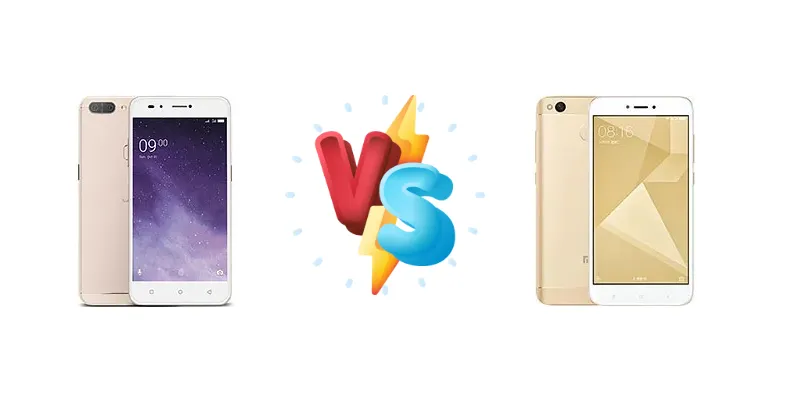
The Xiaomi Redmi 4 (4X) and Lava Z90 represent a segment of the market where value is paramount. Both phones aimed to deliver a functional smartphone experience at an incredibly accessible price point. However, despite similar target audiences, they diverge significantly in their core hardware, particularly in the chipset department, impacting overall performance and user experience.
🏆 Quick Verdict
For the average user prioritizing responsiveness and a smoother experience, the Xiaomi Redmi 4 (4X) is the better choice. Its octa-core Snapdragon 435 processor provides a noticeable performance advantage over the Lava Z90’s quad-core Mediatek MT6737, making everyday tasks and light multitasking more fluid.
| Network |
|---|
| 2G bands | GSM 900 / 1800 - SIM 1 & SIM 2 | GSM 850 / 900 / 1800 / 1900 - SIM 1 & SIM 2 |
| 3G bands | HSDPA 900 / 2100 | HSDPA 850 / 900 / 1900 / 2100 |
| 4G bands | 1, 3, 5, 40, 41 | 1, 3, 5, 7, 8, 38, 39, 40, 41 |
| Speed | HSPA 42.2/5.76 Mbps, LTE Cat4 150/50 Mbps | HSPA 42.2/5.76 Mbps, LTE (2CA) Cat6 300/100 Mbps |
| Technology | GSM / HSPA / LTE | GSM / HSPA / LTE |
| Launch |
|---|
| Announced | 2017, September. Released 2017, September | 2017, May. Released 2017, May |
| Status | Discontinued | Discontinued |
| Body |
|---|
| Build | - | Glass front (Gorilla Glass), aluminum back, aluminum frame, plastic ends |
| Dimensions | 148.5 x 73.1 x 8.1 mm (5.85 x 2.88 x 0.32 in) | 139.2 x 70 x 8.7 mm (5.48 x 2.76 x 0.34 in) |
| SIM | Hybrid Dual SIM (Micro-SIM, dual stand-by) | Nano-SIM + Micro-SIM |
| Weight | 159 g (5.61 oz) | 150 g (5.29 oz) |
| Display |
|---|
| Protection | Corning Gorilla Glass 3 | Corning Gorilla Glass (unspecified version) |
| Resolution | 720 x 1280 pixels, 16:9 ratio (~282 ppi density) | 720 x 1280 pixels, 16:9 ratio (~294 ppi density) |
| Size | 5.2 inches, 74.5 cm2 (~68.7% screen-to-body ratio) | 5.0 inches, 68.9 cm2 (~70.7% screen-to-body ratio) |
| Type | IPS LCD | IPS LCD |
| Platform |
|---|
| CPU | Quad-core 1.3 GHz Cortex-A53 | Octa-core 1.4 GHz Cortex-A53 |
| Chipset | Mediatek MT6737 (28 nm) | Qualcomm MSM8940 Snapdragon 435 (28 nm) |
| GPU | Mali-T720MP2 | Adreno 505 |
| OS | Android 7.0 (Nougat) | Android 6.0.1 (Marshmallow), upgradable to 7.1.2 (Nougat), MIUI 11 |
| Memory |
|---|
| Card slot | microSDXC (uses shared SIM slot) | microSDXC (uses shared SIM slot) |
| Internal | 32GB 3GB RAM | 16GB 2GB RAM, 16GB 3GB RAM, 32GB 3GB RAM, 64GB 3GB RAM, 64GB 4GB RAM |
| | eMMC 5.0 | eMMC 5.1 |
| Main Camera |
|---|
| Dual | 8 MP, f/2.0, AF
Auxiliary lens | - |
| Features | LED flash | LED flash, HDR, panorama |
| Single | - | 13 MP, f/2.0, PDAF |
| Video | 1080p@30fps | 1080p@30fps |
| Selfie camera |
|---|
| Features | LED flash | - |
| Single | 8 MP, f/2.0 | 5 MP, f/2.2 |
| Video | - | 1080p@30fps |
| Sound |
|---|
| 3.5mm jack | Yes | Yes |
| 35mm jack | Yes | Yes |
| Loudspeaker | Yes | Yes |
| Comms |
|---|
| Bluetooth | 4.0, A2DP | 4.2, A2DP, LE |
| Infrared port | - | Yes |
| NFC | No | No |
| Positioning | GPS, GLONASS | GPS, GLONASS, BDS |
| Radio | FM radio | FM radio |
| USB | microUSB 2.0 | microUSB 2.0 |
| WLAN | Wi-Fi 802.11 a/b/g/n/ac, dual-band, Wi-Fi Direct | Wi-Fi 802.11 b/g/n, Wi-Fi Direct |
| Features |
|---|
| Sensors | Fingerprint (rear-mounted), accelerometer, gyro, proximity, compass | Fingerprint (rear-mounted), accelerometer, gyro, proximity, compass |
| Battery |
|---|
| Music play | - | Up to 87 h |
| Stand-by | - | Up to 432 h (3G) |
| Talk time | - | Up to 36 h (3G) |
| Type | Li-Ion 2750 mAh, non-removable | Li-Po 4100 mAh, non-removable |
| Misc |
|---|
| Colors | Blue, Gold | Black, Gold |
| Models | Z90 | 2016060, 2016090, MAG138, MAE136, Redmi 4, Redmi 4X |
| Price | About 10750 INR | About 110 EUR |
| SAR | - | 0.77 W/kg (head) 0.83 W/kg (body) |
| Tests |
|---|
| Audio quality | - |
Noise -94.3dB / Crosstalk -94dB |
| Battery life | - |
Endurance rating 80h
|
| Camera | - |
Photo / Video |
| Display | - |
Contrast ratio: 915 (nominal), 2.920 (sunlight) |
| Loudspeaker | - |
Voice 64dB / Noise 70dB / Ring 72dB
|
| Performance | - |
GeekBench: 1819 (v4.4)
GFXBench: 5.1fps (ES 3.1 onscreen) |
Lava Z90
- Potentially lower price point (depending on market)
- Acceptable battery life (80h endurance)
- Functional for basic smartphone tasks
- Significantly weaker processor performance
- Likely slower app loading times
- Less capable for multitasking and gaming
Xiaomi Redmi 4 (4X)
- Faster and more responsive performance
- Octa-core processor for smoother multitasking
- Better gaming capabilities (relative to the Z90)
- Good battery life (80h endurance)
- May be slightly more expensive
- Camera performance likely similar to Lava Z90 (no specific advantage)
- Display details are limited
Display Comparison
Both the Lava Z90 and Xiaomi Redmi 4 (4X) share the same nominal and sunlight contrast ratios of 915 and 2.920 respectively, suggesting a similar viewing experience in various lighting conditions. However, the context data lacks specifics on panel type (IPS, TFT) or resolution. Given the price bracket, both likely utilize TFT panels. The absence of information regarding color gamut coverage suggests neither phone excels in color accuracy, but they should be adequate for everyday use. Bezels are expected to be substantial on both devices, typical of phones in this price range.
Camera Comparison
Both devices are listed with 'Photo / Video' capabilities, but lack any specific details regarding sensor size, aperture, or features like Optical Image Stabilization (OIS). Given the market segment, image quality is likely to be similar – adequate for casual snapshots in good lighting conditions, but struggling in low-light scenarios. The absence of details makes it difficult to assess any meaningful difference in camera performance. It's safe to assume both phones rely heavily on software processing to enhance image quality.
Performance
The core difference lies in the chipsets. The Xiaomi Redmi 4 (4X) boasts the Qualcomm MSM8940 Snapdragon 435, an octa-core processor clocked at 1.4 GHz, built on a 28nm process. This contrasts with the Lava Z90’s Mediatek MT6737, a quad-core processor at 1.3 GHz, also on a 28nm node. The Snapdragon 435’s octa-core configuration provides a significant advantage in multi-threaded tasks and multitasking. While both use Cortex-A53 cores, the sheer number of cores and Qualcomm’s optimizations give the Redmi 4 (4X) a clear edge in application launch speeds and overall system responsiveness. The GPU within the Snapdragon 435 will also deliver a better, though still limited, gaming experience.
Battery Life
Both the Lava Z90 and Xiaomi Redmi 4 (4X) achieve an endurance rating of 80 hours, indicating comparable battery life under similar usage patterns. This suggests that despite potential differences in battery capacity (which isn't specified), the power efficiency of the Snapdragon 435 and the software optimizations on the Redmi 4 (4X) effectively balance out the power draw of the more powerful processor. Neither phone is expected to offer particularly fast charging, relying on standard 5W or 10W charging solutions.
Buying Guide
Buy the Lava Z90 if you need a basic, functional smartphone for essential tasks like calls, texts, and light web browsing, and are on an extremely tight budget. Buy the Xiaomi Redmi 4 (4X) if you prefer a more responsive device capable of handling moderate multitasking, occasional gaming, and benefit from a slightly more refined software experience, even if it means spending a bit more.
Frequently Asked Questions
❓ Will the Xiaomi Redmi 4 (4X) handle popular apps like WhatsApp and Facebook smoothly?
Yes, the Snapdragon 435 in the Redmi 4 (4X) is sufficiently powerful to run apps like WhatsApp and Facebook without significant lag. The octa-core processor and optimized software will provide a smoother experience compared to the Lava Z90’s Mediatek MT6737.
❓ Is the Lava Z90 a good option for someone who primarily uses their phone for calls and texts?
Yes, the Lava Z90 is a viable option for basic communication. Its Mediatek MT6737 processor is adequate for making calls, sending texts, and using simple applications. However, if you anticipate using more demanding apps, the Redmi 4 (4X) is a better investment.
❓ Can either of these phones play PUBG Mobile?
While technically possible to *launch* PUBG Mobile on both devices, the experience will be far from ideal. The Snapdragon 435 in the Redmi 4 (4X) will offer slightly better frame rates at the lowest settings, but both phones will likely struggle with consistent performance and may experience significant lag and overheating.
❓ What about software updates? Which phone is more likely to receive them?
Xiaomi generally provides more consistent software updates for its devices, even in the budget segment, compared to Lava. While neither phone is guaranteed long-term support, the Redmi 4 (4X) has a higher probability of receiving security patches and minor software improvements.