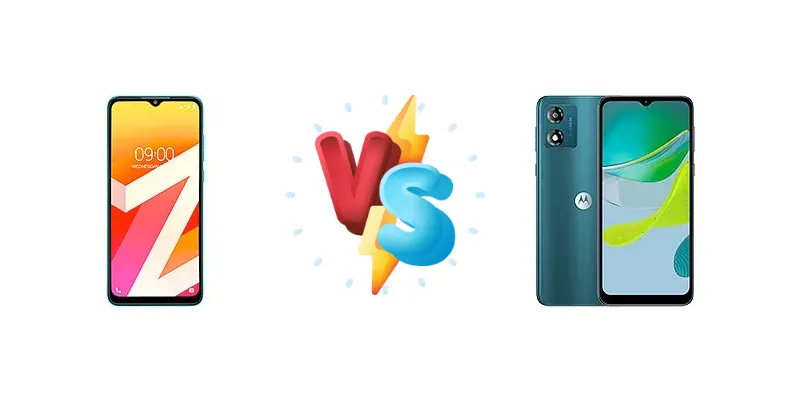
The sub-$150 smartphone market is fiercely competitive. Both the Lava Z6 and Motorola Moto E13 aim to deliver essential smartphone functionality at an accessible price point. However, they take different approaches to achieving this, primarily through their chipset choices. This comparison dissects the key differences between the Mediatek Helio G35-powered Lava Z6 and the Unisoc T606-equipped Motorola Moto E13, focusing on performance, efficiency, and user experience.
🏆 Quick Verdict
For the average user prioritizing consistent, if not blazing-fast, performance, the Motorola Moto E13 emerges as the better choice. The Unisoc T606’s Cortex-A75 cores provide a noticeable advantage in responsiveness and multitasking compared to the Lava Z6’s all-Cortex-A53 configuration, despite both being fabricated on a 12nm process.
| Network |
|---|
| 2G bands | GSM 900 / 1800 | GSM 850 / 900 / 1800 / 1900 |
| 3G bands | HSDPA 900 / 2100 | HSDPA 850 / 900 / 2100 |
| 4G bands | 1, 3, 5, 8, 40, 41 | 1, 3, 5, 7, 8, 28, 38, 40, 41 |
| Speed | HSPA 42.2/5.76 Mbps, LTE Cat4 150/50 Mbps | HSPA, LTE |
| Technology | GSM / HSPA / LTE | GSM / HSPA / LTE |
| | - | 1, 3, 5, 7, 8, 20, 28, 38, 40, 41 |
| Launch |
|---|
| Announced | 2021, January 07 | 2023, January 24 |
| Status | Available. Released 2021, January 11 | Available. Released 2023, February 13 |
| Body |
|---|
| Build | Glass front, plastic back, plastic frame | Glass front, plastic frame, plastic back |
| Dimensions | 164.5 x 75.8 x 9 mm (6.48 x 2.98 x 0.35 in) | 164.2 x 75 x 8.5 mm (6.46 x 2.95 x 0.33 in) |
| SIM | Nano-SIM + Nano-SIM | Nano-SIM + Nano-SIM |
| Weight | 190 g (6.70 oz) | 179.5 g (6.35 oz) |
| | - | Water-resistant design |
| Display |
|---|
| Protection | Corning Gorilla Glass 3 | - |
| Resolution | 720 x 1600 pixels, 20:9 ratio (~270 ppi density) | 720 x 1600 pixels, 20:9 ratio (~270 ppi density) |
| Size | 6.51 inches, 102.3 cm2 (~82.1% screen-to-body ratio) | 6.5 inches, 102.0 cm2 (~82.8% screen-to-body ratio) |
| Type | IPS LCD | IPS LCD |
| Platform |
|---|
| CPU | Octa-core (4x2.3 GHz Cortex-A53 & 4x1.8 GHz Cortex-A53) | Octa-core (2x1.6 GHz Cortex-A75 & 6x1.6 GHz Cortex-A55) |
| Chipset | Mediatek MT6765G Helio G35 (12 nm) | Unisoc T606 (12 nm) |
| GPU | PowerVR GE8320 | Mali-G57 MP1 |
| OS | Android 10 | Android 13 (Go edition) |
| Memory |
|---|
| Card slot | microSDXC (dedicated slot) | microSDXC (dedicated slot) |
| Internal | 64GB 6GB RAM | 32GB 2GB RAM, 64GB 2GB RAM, 64GB 4GB RAM, 128GB 8GB RAM |
| | eMMC 5.1 | eMMC 5.1 |
| Main Camera |
|---|
| Features | LED flash | LED flash, HDR, panorama |
| Single | - | 13 MP, f/2.2, (wide), 1.12µm, PDAF |
| Triple | 13 MP, f/1.9, (wide), 1/3.0", 1.12µm, AF
5 MP, (ultrawide)
Auxiliary lens | - |
| Video | 1080p@30fps | 1080p@30fps |
| Selfie camera |
|---|
| Features | LED flash | - |
| Single | 16 MP, f/2.0, (wide), 1/3.06" 1.0µm | 5 MP, f/2.4, (wide), 1/5.0", 1.12µm |
| Video | 1080p@30fps | 1080p@30fps |
| Sound |
|---|
| 3.5mm jack | Yes | Yes |
| 35mm jack | Yes | Yes |
| Loudspeaker | Yes | Yes |
| Comms |
|---|
| Bluetooth | 5.0, A2DP, LE | 5.0, A2DP, LE |
| NFC | No | No |
| Positioning | GPS | GPS, GLONASS, GALILEO |
| Radio | FM radio | FM radio, recording |
| USB | USB Type-C | USB Type-C 2.0, OTG |
| WLAN | Wi-Fi 802.11 b/g/n, Wi-Fi Direct | Wi-Fi 802.11 a/b/g/n/ac, dual-band |
| Features |
|---|
| Sensors | Fingerprint (rear-mounted), accelerometer, proximity | Accelerometer, proximity |
| Battery |
|---|
| Charging | - | 10W wired |
| Type | Li-Po 5000 mAh | Li-Po 5000 mAh |
| Misc |
|---|
| Colors | Blue, Red | Cosmic Black, Creamy White, Aurora Green |
| Models | LMX06 | - |
| Price | About 110 EUR | $ 119.99 / € 104.99 |
Lava Z6
- Potentially longer battery life due to Helio G35 efficiency.
- May be available at a slightly lower price point.
- Simple and straightforward user experience.
- Inferior CPU performance compared to the Unisoc T606.
- Struggles with multitasking and demanding apps.
- Limited future-proofing.
Motorola Moto E13
- More responsive user experience thanks to Cortex-A75 cores.
- Better multitasking capabilities.
- More modern CPU architecture for improved efficiency under load.
- Slower 10W charging.
- Potentially slightly shorter battery life under heavy use.
- May be slightly more expensive.
Display Comparison
Neither Lava nor Motorola provide detailed display specifications beyond the basic panel type. Given the price point, both likely utilize LCD panels. The absence of information regarding peak brightness, color gamut coverage, or refresh rates suggests a focus on cost reduction. Bezels are expected to be substantial on both devices, impacting the overall screen-to-body ratio. Color accuracy is likely to be standard for this segment, prioritizing power efficiency over color fidelity.
Camera Comparison
Detailed camera specifications are unavailable for either device. However, given the market segment, expectations should be tempered. Both phones likely feature a primary camera and potentially a secondary depth or macro sensor. Image processing will be basic, prioritizing speed over advanced features. The absence of Optical Image Stabilization (OIS) on either device suggests reliance on software-based stabilization, which may be limited in effectiveness. Sensor size is a critical factor, but without specific data, it’s difficult to assess which phone will deliver superior image quality. The Moto E13's image signal processor (ISP) within the Unisoc T606 may offer slightly better noise reduction capabilities.
Performance
The core difference lies in the chipsets. The Lava Z6’s Mediatek Helio G35 features an octa-core configuration comprised entirely of Cortex-A53 cores, split into two clusters of four cores clocked at 2.3 GHz and 1.8 GHz. The Motorola Moto E13, however, utilizes the Unisoc T606, which employs a more modern 'big.LITTLE' architecture with two Cortex-A75 cores at 1.6 GHz and six Cortex-A55 cores, also at 1.6 GHz. This architectural difference is crucial: the A75 cores offer significantly higher single-core performance, translating to snappier app launches and smoother multitasking. While both are 12nm chips, the A75’s superior IPC (Instructions Per Clock) gives the Moto E13 an edge. The Lava Z6 will likely struggle with more demanding applications and heavier multitasking loads.
Battery Life
Battery capacity is not specified for either device. However, the Helio G35 in the Lava Z6 is known for its relatively efficient power consumption. The Motorola Moto E13 includes 10W wired charging, indicating a slower charging speed. While the Lava Z6’s battery life *could* be longer due to the G35’s efficiency, the Moto E13’s more efficient CPU architecture under lighter loads could mitigate this difference. A full 0-100% charge on the Moto E13 is expected to take longer than on a device with faster charging capabilities.
Buying Guide
Buy the Lava Z6 if you prioritize a potentially longer-lasting battery due to the Helio G35’s generally conservative power draw and are primarily focused on basic tasks like calling, texting, and light social media. Buy the Motorola Moto E13 if you value a smoother, more responsive user experience, especially when switching between apps or handling slightly more demanding tasks, and appreciate the benefit of more modern CPU architecture.
Frequently Asked Questions
❓ Will the Unisoc T606 in the Moto E13 handle popular games like PUBG Mobile?
The Unisoc T606 can run PUBG Mobile, but expect to play at lower graphics settings (Balanced or Low) to maintain a playable frame rate. The Helio G35 in the Lava Z6 will likely struggle even at the lowest settings, experiencing significant frame drops and lag.
❓ Does the Motorola Moto E13 support fast charging, and how long does it take to fully charge?
The Motorola Moto E13 supports only 10W wired charging. A full 0-100% charge is estimated to take approximately 2.5 to 3.5 hours, depending on the charger and ambient temperature. The Lava Z6's charging speed is likely similar, given its budget positioning.
❓ Which phone is better for someone who primarily uses WhatsApp, Facebook, and YouTube?
The Motorola Moto E13 is the better choice for these common tasks. The Cortex-A75 cores provide a smoother and more responsive experience when switching between apps like WhatsApp, Facebook, and YouTube, resulting in less lag and a more enjoyable user experience.
❓ Is the difference in performance between the Helio G35 and Unisoc T606 noticeable in everyday use?
Yes, the difference is noticeable. While both chips can handle basic tasks, the Unisoc T606’s more powerful cores result in faster app loading times, smoother scrolling, and a more responsive overall experience. The Lava Z6 may exhibit noticeable lag when multitasking or opening multiple apps.