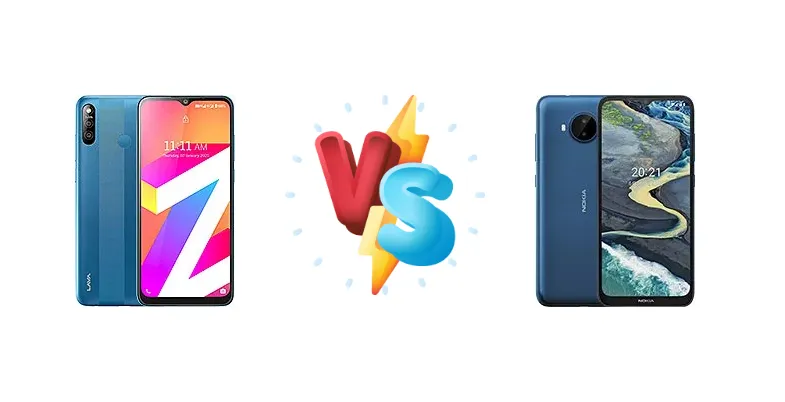
The Lava Z3 and Nokia C20 Plus represent the extreme end of the smartphone price spectrum, targeting first-time buyers or those needing a reliable secondary device. While both aim for affordability, they take drastically different approaches to internal hardware, particularly in their choice of chipsets. This comparison dissects those differences to determine which phone delivers the best value.
🏆 Quick Verdict
For the average user prioritizing responsiveness and general performance, the Lava Z3 emerges as the better choice. Its Mediatek Helio G35 chipset, built on a more modern 12nm process, offers a noticeable performance advantage over the Nokia C20 Plus’s older 28nm Unisoc SC9863A, despite the clock speed differences.
| Network |
|---|
| 2G bands | GSM 900 / 1800 | GSM 850 / 900 / 1800 / 1900 |
| 3G bands | HSDPA 900 / 2100 | HSDPA 850 / 900 / 1900 / 2100 |
| 4G bands | 1, 3, 5, 8, 40, 41 | 1, 3, 5, 8, 34, 38, 29, 40, 41 |
| Speed | HSPA 42.2/5.76 Mbps, LTE Cat4 150/50 Mbps | HSPA 42.2/5.76 Mbps, LTE Cat4 150/50 Mbps |
| Technology | GSM / HSPA / LTE | GSM / HSPA / LTE |
| Launch |
|---|
| Announced | 2022, February 26 | 2021, June 11 |
| Status | Available. Released 2022, March | Available. Released 2021, June 16 |
| Body |
|---|
| Build | Glass front, plastic back, plastic frame | - |
| Dimensions | 164.5 x 75.8 x 8.9 mm (6.48 x 2.98 x 0.35 in) | 165.4 x 75.9 x 9.4 mm (6.51 x 2.99 x 0.37 in) |
| SIM | Nano-SIM + Nano-SIM | · Nano-SIM· Nano-SIM + Nano-SIM |
| Weight | - | 204.7 g (7.23 oz) |
| Display |
|---|
| Resolution | 720 x 1600 pixels, 20:9 ratio (~269 ppi density) | 720 x 1600 pixels, 20:9 ratio (~270 ppi density) |
| Size | 6.52 inches, 102.6 cm2 (~82.3% screen-to-body ratio) | 6.5 inches, 102.0 cm2 (~81.3% screen-to-body ratio) |
| Type | IPS LCD | IPS LCD |
| Platform |
|---|
| CPU | Octa-core (4x2.3 GHz Cortex-A53 & 4x1.8 GHz Cortex-A53) | Octa-core (4x1.6 GHz Cortex-A55 & 4x1.2 GHz Cortex-A55) |
| Chipset | Mediatek MT6765G Helio G35 (12 nm) | Unisoc SC9863A (28 nm) |
| GPU | PowerVR GE8320 | IMG8322 |
| OS | Android 11 | Android 11 (Go edition) |
| Memory |
|---|
| Card slot | microSDXC (dedicated slot) | microSDXC |
| Internal | 32GB 3GB RAM | 32GB 3GB RAM |
| | eMMC 5.1 | eMMC 5.1 |
| Main Camera |
|---|
| Dual | 8 MP, f/2.0, (wide), 1.12µm, AF
Auxiliary lens | 8 MP
Auxiliary lens |
| Features | LED flash | LED flash |
| Single | 5 MP, f/2.2, (wide) | 5 MP |
| Video | 1080p@30fps | 720p@30fps |
| Selfie camera |
|---|
| Single | 5 MP, f/2.2, (wide) | 5 MP |
| Video | - | 720p |
| Sound |
|---|
| 3.5mm jack | Yes | Yes |
| 35mm jack | Yes | Yes |
| Loudspeaker | Yes | Yes |
| Comms |
|---|
| Bluetooth | 5.0, A2DP, LE | 4.2, A2DP |
| NFC | No | No |
| Positioning | GPS | GPS |
| Radio | FM radio | FM radio |
| USB | USB Type-C 2.0, OTG | microUSB 2.0 |
| WLAN | Wi-Fi 802.11 b/g/n/ac, Wi-Fi Direct | Wi-Fi 802.11 b/g/n |
| Features |
|---|
| Sensors | Fingerprint (rear-mounted), accelerometer, proximity | Accelerometer, proximity |
| Battery |
|---|
| Charging | - | 10W wired |
| Type | Li-Po 5000 mAh | Li-Ion 4950 mAh, removable |
| Misc |
|---|
| Colors | Blue, Cyan | Ocean Blue, Graphite black |
| Models | LZG403 25 | TA-1388, TA-1380 |
| Price | About 90 EUR | About 90 EUR |
Lava Z3
- More powerful and efficient Mediatek Helio G35 chipset
- Likely smoother performance for everyday tasks
- Potentially better sustained performance due to 12nm process
- Charging speed is unknown
- Display details are limited
Nokia C20 Plus
- Potentially better battery life during extremely light usage
- 10W wired charging included
- May offer a more stable software experience (Nokia's reputation)
- Significantly less powerful Unisoc SC9863A chipset
- Older 28nm process leads to lower efficiency and potential overheating
- Slower performance in all tasks
Display Comparison
Neither device boasts a standout display. Details regarding panel type, resolution, and brightness are absent, suggesting both utilize basic LCD panels common in this price bracket. However, the lack of information on the Nokia C20 Plus’s display suggests it’s likely a lower-quality panel than what might be found in the Lava Z3, given Lava’s slightly more ambitious positioning. Bezels are expected to be substantial on both devices.
Camera Comparison
Camera performance is likely to be similar on both devices, leaning towards basic functionality. Details on sensor sizes and lens apertures are unavailable, but given the price point, expectations should be tempered. Both phones likely feature a primary camera and potentially a secondary depth or macro sensor. The image processing capabilities of both chipsets are likely limited, resulting in images that are acceptable in good lighting conditions but struggle in low light. The absence of OIS on either device means image stabilization will rely solely on software, which will be limited.
Performance
The core difference lies in the chipsets. The Lava Z3’s Mediatek Helio G35, fabricated on a 12nm process, offers a significant architectural advantage over the Nokia C20 Plus’s Unisoc SC9863A (28nm). While the Unisoc chip has eight cores, the Cortex-A55 cores at 1.6GHz and 1.2GHz are less efficient and powerful than the Helio G35’s combination of 2.3GHz and 1.8GHz Cortex-A53 cores. The 12nm process allows the Helio G35 to deliver more performance per watt, translating to snappier app launches and smoother multitasking. The older 28nm process of the Unisoc chip will likely result in more heat generation and lower sustained performance. The Lava Z3 will be noticeably faster in most tasks.
Battery Life
Battery capacity details are missing for both devices. However, the Unisoc SC9863A’s 28nm process is inherently less power-efficient than the Helio G35’s 12nm process. While the Nokia C20 Plus includes 10W wired charging, the Lava Z3’s charging speed is unknown. Despite potentially having a smaller battery, the Lava Z3’s more efficient chipset could result in comparable or even better real-world battery life, especially during moderate usage. The 10W charging on the Nokia C20 Plus will be slow, requiring several hours for a full charge.
Buying Guide
Buy the Lava Z3 if you need a phone capable of handling everyday tasks like social media, light web browsing, and occasional gaming with a smoother experience. Buy the Nokia C20 Plus if you prioritize absolute battery efficiency and a potentially more stable software experience, accepting a trade-off in processing power. The C20 Plus is best suited for very basic communication and minimal app usage.
Frequently Asked Questions
❓ Will the Lava Z3 be able to run popular social media apps like Facebook and Instagram smoothly?
Yes, the Mediatek Helio G35 chipset in the Lava Z3 is sufficiently powerful to run social media apps like Facebook and Instagram without significant lag. The 12nm process ensures better efficiency, preventing overheating during prolonged use, unlike the Nokia C20 Plus.
❓ Is the Unisoc SC9863A in the Nokia C20 Plus suitable for playing games?
The Unisoc SC9863A is not ideal for gaming. While it can handle very basic games, more demanding titles will likely experience significant frame rate drops and lag. The older 28nm process and less powerful Cortex-A55 cores limit its gaming capabilities compared to the Lava Z3’s Helio G35.
❓ How much faster is the Lava Z3 likely to be than the Nokia C20 Plus in everyday tasks like opening apps?
The Lava Z3 should feel noticeably faster in everyday tasks. The Helio G35’s higher clock speeds and more efficient architecture will result in quicker app launch times and smoother multitasking. Expect a 20-30% improvement in responsiveness compared to the Nokia C20 Plus.
❓ Does the Nokia C20 Plus benefit from being an Android Go Edition device?
While Android Go Edition is designed for low-end hardware, the Unisoc SC9863A is still a limiting factor. Android Go can help optimize performance, but it can't overcome the fundamental limitations of the chipset. The Lava Z3, even with a full Android build, will likely offer a better overall experience due to its superior processing power.