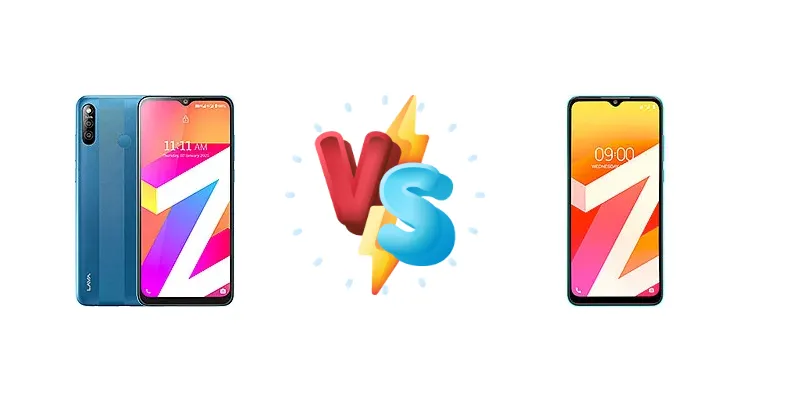
Lava's Z3 and Z6 present a curious case: both smartphones are powered by the same MediaTek Helio G35 chipset. This comparison isn't about raw performance differences, as those are negligible, but rather about potential variations in software optimization, build quality, and pricing that might sway a buyer. We'll dissect the nuances to determine which offers the better value.
🏆 Quick Verdict
For the average user prioritizing affordability, the Lava Z6 likely represents the better value if priced competitively. The identical Helio G35 chipset means performance will be nearly indistinguishable, making price and any included software enhancements the deciding factors. However, if the Z3 is significantly cheaper, it remains a viable option.
| Network |
|---|
| 2G bands | GSM 900 / 1800 | GSM 900 / 1800 |
| 3G bands | HSDPA 900 / 2100 | HSDPA 900 / 2100 |
| 4G bands | 1, 3, 5, 8, 40, 41 | 1, 3, 5, 8, 40, 41 |
| Speed | HSPA 42.2/5.76 Mbps, LTE Cat4 150/50 Mbps | HSPA 42.2/5.76 Mbps, LTE Cat4 150/50 Mbps |
| Technology | GSM / HSPA / LTE | GSM / HSPA / LTE |
| Launch |
|---|
| Announced | 2022, February 26 | 2021, January 07 |
| Status | Available. Released 2022, March | Available. Released 2021, January 11 |
| Body |
|---|
| Build | Glass front, plastic back, plastic frame | Glass front, plastic back, plastic frame |
| Dimensions | 164.5 x 75.8 x 8.9 mm (6.48 x 2.98 x 0.35 in) | 164.5 x 75.8 x 9 mm (6.48 x 2.98 x 0.35 in) |
| SIM | Nano-SIM + Nano-SIM | Nano-SIM + Nano-SIM |
| Weight | - | 190 g (6.70 oz) |
| Display |
|---|
| Protection | - | Corning Gorilla Glass 3 |
| Resolution | 720 x 1600 pixels, 20:9 ratio (~269 ppi density) | 720 x 1600 pixels, 20:9 ratio (~270 ppi density) |
| Size | 6.52 inches, 102.6 cm2 (~82.3% screen-to-body ratio) | 6.51 inches, 102.3 cm2 (~82.1% screen-to-body ratio) |
| Type | IPS LCD | IPS LCD |
| Platform |
|---|
| CPU | Octa-core (4x2.3 GHz Cortex-A53 & 4x1.8 GHz Cortex-A53) | Octa-core (4x2.3 GHz Cortex-A53 & 4x1.8 GHz Cortex-A53) |
| Chipset | Mediatek MT6765G Helio G35 (12 nm) | Mediatek MT6765G Helio G35 (12 nm) |
| GPU | PowerVR GE8320 | PowerVR GE8320 |
| OS | Android 11 | Android 10 |
| Memory |
|---|
| Card slot | microSDXC (dedicated slot) | microSDXC (dedicated slot) |
| Internal | 32GB 3GB RAM | 64GB 6GB RAM |
| | eMMC 5.1 | eMMC 5.1 |
| Main Camera |
|---|
| Dual | 8 MP, f/2.0, (wide), 1.12µm, AF
Auxiliary lens | - |
| Features | LED flash | LED flash |
| Single | 5 MP, f/2.2, (wide) | - |
| Triple | - | 13 MP, f/1.9, (wide), 1/3.0", 1.12µm, AF
5 MP, (ultrawide)
Auxiliary lens |
| Video | 1080p@30fps | 1080p@30fps |
| Selfie camera |
|---|
| Features | - | LED flash |
| Single | 5 MP, f/2.2, (wide) | 16 MP, f/2.0, (wide), 1/3.06" 1.0µm |
| Video | - | 1080p@30fps |
| Sound |
|---|
| 3.5mm jack | Yes | Yes |
| 35mm jack | Yes | Yes |
| Loudspeaker | Yes | Yes |
| Comms |
|---|
| Bluetooth | 5.0, A2DP, LE | 5.0, A2DP, LE |
| NFC | No | No |
| Positioning | GPS | GPS |
| Radio | FM radio | FM radio |
| USB | USB Type-C 2.0, OTG | USB Type-C |
| WLAN | Wi-Fi 802.11 b/g/n/ac, Wi-Fi Direct | Wi-Fi 802.11 b/g/n, Wi-Fi Direct |
| Features |
|---|
| Sensors | Fingerprint (rear-mounted), accelerometer, proximity | Fingerprint (rear-mounted), accelerometer, proximity |
| Battery |
|---|
| Type | Li-Po 5000 mAh | Li-Po 5000 mAh |
| Misc |
|---|
| Colors | Blue, Cyan | Blue, Red |
| Models | LZG403 25 | LMX06 |
| Price | About 90 EUR | About 110 EUR |
Lava Z3
- Potentially lower price point
- Identical performance to Z6
- Functional for basic smartphone tasks
- May have less refined software
- Potentially lower build quality
Lava Z6
- Potentially better software optimization
- Identical performance to Z3
- May offer slightly improved build quality
- Likely more expensive than Z3
- No performance advantage over Z3
Display Comparison
Both the Lava Z3 and Z6 utilize unspecified display panels, but given their price point, we can anticipate LCD technology. The lack of information regarding resolution, brightness, or refresh rate suggests a focus on cost reduction. Color accuracy is likely to be standard for this segment, prioritizing visibility over fidelity. Bezels are expected to be noticeable, contributing to a larger overall device footprint. Without specific display specs, it's safe to assume a similar visual experience on both devices.
Camera Comparison
Camera specifications are not detailed, but given the target market, we can expect basic camera setups. The presence of a 2MP macro camera on either device is largely a marketing tactic, as image quality will be limited. The primary sensor's size and aperture are crucial factors, but without this information, it's difficult to assess image quality. Image processing will likely be software-driven, aiming to enhance colors and details, but may introduce artifacts. Low-light performance is expected to be subpar on both devices. The focus should be on capturing acceptable photos in well-lit conditions.
Performance
The core of both devices is the MediaTek Helio G35 (MT6765G), a 12nm octa-core processor featuring four Cortex-A53 cores clocked at 2.3 GHz and another four at 1.8 GHz. This configuration is geared towards efficient multitasking and handling everyday apps. The identical chipset means CPU performance will be virtually identical. RAM capacity and storage type (eMMC vs. UFS) – which are not specified – will have a more significant impact on real-world responsiveness. Thermal management will likely be passive, relying on the phone's chassis to dissipate heat, potentially leading to some throttling during extended gaming sessions. The GPU, integrated within the Helio G35, is suitable for casual gaming but will struggle with demanding titles at higher settings.
Battery Life
Battery capacity and charging wattage are not specified. However, considering the Helio G35's efficiency and the target market, we can anticipate a battery size around 4000-5000 mAh. This should provide all-day battery life with moderate usage. Charging speeds are likely to be slow, potentially taking several hours to fully charge from 0 to 100%. The absence of fast charging support is typical for this price range. Battery life will be heavily influenced by usage patterns, with gaming and video streaming consuming power more rapidly.
Buying Guide
Buy the Lava Z3 if you are on an extremely tight budget and need a functional smartphone for basic tasks like calls, messaging, and light social media use. The Z3 is ideal for first-time smartphone users or as a reliable backup device. Buy the Lava Z6 if you prefer a potentially more refined software experience, slightly improved build quality (assuming a price difference justifies it), and are willing to spend a little more for these incremental benefits. The Z6 targets users who want a dependable daily driver without breaking the bank.
Frequently Asked Questions
❓ Will the Helio G35 in either phone struggle with popular games like PUBG Mobile or Call of Duty?
Yes, the Helio G35 is an entry-level chipset. While it can run PUBG Mobile and Call of Duty, you'll likely need to play at the lowest graphics settings and potentially accept lower frame rates for a smooth experience. Expect some stuttering and lag during intense gameplay.
❓ Is the software experience on the Lava Z3 and Z6 likely to be significantly different?
While both phones run Android, the level of software optimization and pre-installed bloatware could vary. Lava may offer different software features or UI customizations on the Z6, potentially resulting in a more polished experience. However, updates and long-term software support are uncertain for both devices.
❓ How important is the RAM capacity on these phones, and what should I look for?
RAM capacity is crucial for multitasking. While the exact RAM amount isn't specified, aim for at least 3GB, and ideally 4GB, for a smoother experience. More RAM allows you to keep more apps open in the background without slowdowns. The type of RAM (LPDDR4X or LPDDR5) also matters, with LPDDR5 offering faster speeds and improved efficiency.