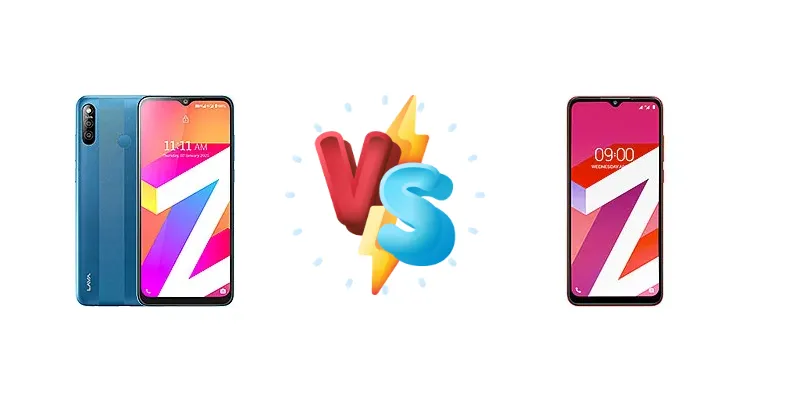
Lava has released the Z4 as a successor to the Z3, but a glance at the specifications reveals a startling similarity: both devices are powered by the MediaTek Helio G35 chipset. This comparison aims to dissect whether the Z4 offers any tangible improvements over the Z3, or if it's simply a rebranding exercise. We'll focus on how this shared hardware translates to real-world performance and value.
🏆 Quick Verdict
For the average user, the Lava Z3 represents the better value. Given the identical chipset and CPU configuration, any price difference favors the Z3. The Z4 may offer minor software tweaks or build quality improvements, but these are unlikely to justify a higher cost for most consumers.
| Network |
|---|
| 2G bands | GSM 900 / 1800 | GSM 900 / 1800 |
| 3G bands | HSDPA 900 / 2100 | HSDPA 900 / 2100 |
| 4G bands | 1, 3, 5, 8, 40, 41 | 1, 3, 5, 8, 40, 41 |
| Speed | HSPA 42.2/5.76 Mbps, LTE Cat4 150/50 Mbps | HSPA 42.2/5.76 Mbps, LTE Cat4 150/50 Mbps |
| Technology | GSM / HSPA / LTE | GSM / HSPA / LTE |
| Launch |
|---|
| Announced | 2022, February 26 | 2021, January 07 |
| Status | Available. Released 2022, March | Available. Released 2021, January 11 |
| Body |
|---|
| Build | Glass front, plastic back, plastic frame | Glass front, plastic back, plastic frame |
| Dimensions | 164.5 x 75.8 x 8.9 mm (6.48 x 2.98 x 0.35 in) | 164.5 x 75.8 x 9 mm (6.48 x 2.98 x 0.35 in) |
| SIM | Nano-SIM + Nano-SIM | Nano-SIM + Nano-SIM |
| Weight | - | 190 g (6.70 oz) |
| Display |
|---|
| Protection | - | Corning Gorilla Glass 3 |
| Resolution | 720 x 1600 pixels, 20:9 ratio (~269 ppi density) | 720 x 1600 pixels, 20:9 ratio (~270 ppi density) |
| Size | 6.52 inches, 102.6 cm2 (~82.3% screen-to-body ratio) | 6.51 inches, 102.3 cm2 (~82.1% screen-to-body ratio) |
| Type | IPS LCD | IPS LCD |
| Platform |
|---|
| CPU | Octa-core (4x2.3 GHz Cortex-A53 & 4x1.8 GHz Cortex-A53) | Octa-core (4x2.3 GHz Cortex-A53 & 4x1.8 GHz Cortex-A53) |
| Chipset | Mediatek MT6765G Helio G35 (12 nm) | Mediatek MT6765G Helio G35 (12 nm) |
| GPU | PowerVR GE8320 | PowerVR GE8320 |
| OS | Android 11 | Android 10 |
| Memory |
|---|
| Card slot | microSDXC (dedicated slot) | microSDXC (dedicated slot) |
| Internal | 32GB 3GB RAM | 64GB 4GB RAM |
| | eMMC 5.1 | eMMC 5.1 |
| Main Camera |
|---|
| Dual | 8 MP, f/2.0, (wide), 1.12µm, AF
Auxiliary lens | - |
| Features | LED flash | LED flash |
| Single | 5 MP, f/2.2, (wide) | 13 MP, f/2.0 AF |
| Triple | - | 13 MP, f/1.9, (wide), 1/3.0", 1.12µm, AF
5 MP, (ultrawide)
Auxiliary lens |
| Video | 1080p@30fps | 1080p@30fps |
| Selfie camera |
|---|
| Features | - | LED flash |
| Single | 5 MP, f/2.2, (wide) | 16 MP, f/2.0, (wide), 1/3.06" 1.0µm |
| Video | - | 1080p@30fps |
| Sound |
|---|
| 3.5mm jack | Yes | Yes |
| 35mm jack | Yes | Yes |
| Loudspeaker | Yes | Yes |
| Comms |
|---|
| Bluetooth | 5.0, A2DP, LE | 5.0, A2DP, LE |
| NFC | No | No |
| Positioning | GPS | GPS |
| Radio | FM radio | FM radio |
| USB | USB Type-C 2.0, OTG | USB Type-C |
| WLAN | Wi-Fi 802.11 b/g/n/ac, Wi-Fi Direct | Wi-Fi 802.11 b/g/n, Wi-Fi Direct |
| Features |
|---|
| Sensors | Fingerprint (rear-mounted), accelerometer, proximity | Fingerprint (rear-mounted), accelerometer, proximity |
| Battery |
|---|
| Stand-by | - | Up to 270 h |
| Talk time | - | Up to 24 h (2G) / Up to 15 h 30 min (3G) |
| Type | Li-Po 5000 mAh | Li-Po 5000 mAh |
| Misc |
|---|
| Colors | Blue, Cyan | Blue, Red |
| Models | LZG403 25 | S7 |
| Price | About 90 EUR | About 100 EUR |
| SAR | - | 0.52 W/kg (head) 0.64 W/kg (body) |
Lava Z3
- Likely lower price point due to being the older model.
- Identical performance to the Lava Z4.
- Good value for basic smartphone needs.
- May have slightly older software version.
- Potentially less refined build quality.
Lava Z4
- Potentially newer software version with bug fixes.
- May feature minor improvements in build quality.
- Slightly more modern aesthetic design (subjective).
- Likely higher price than the Lava Z3.
- No performance advantage over the Z3.
Display Comparison
Both the Lava Z3 and Z4 utilize unspecified display panels, but given their price point, we can anticipate IPS LCD technology. The lack of information regarding screen resolution, peak brightness, or color gamut coverage suggests a focus on cost reduction. The user experience will likely be similar on both devices, with standard viewing angles and color reproduction. Without further details, it's impossible to determine if either phone offers superior visual clarity or outdoor visibility.
Camera Comparison
Camera specifications are not detailed beyond the chipset information. Given the target market, it's reasonable to assume both phones feature basic camera setups. The absence of information regarding sensor size, aperture, or optical image stabilization (OIS) suggests a focus on affordability over image quality. Any differences in camera performance will likely stem from software processing rather than hardware capabilities. Expect acceptable results in well-lit conditions, but limited performance in low-light scenarios.
Performance
The core of both devices is the MediaTek Helio G35 (MT6765G) chipset, featuring an octa-core CPU configuration with 4x2.3 GHz Cortex-A53 cores and 4x1.8 GHz Cortex-A53 cores. This indicates identical processing power for everyday tasks and gaming. The 12nm manufacturing process suggests moderate power efficiency. Performance will be adequate for basic multitasking and less demanding applications, but users should expect limitations when running graphically intensive games or multiple apps simultaneously. The GPU, also integrated within the Helio G35, will deliver similar graphical performance on both phones.
Battery Life
Battery capacity and charging wattage are not specified. However, considering the Helio G35's power efficiency and the phones' budget nature, we can anticipate a battery life sufficient for a full day of moderate use. Charging speeds are likely to be standard, potentially utilizing a 10W or 15W charger. Without concrete data, it's difficult to assess which phone offers superior battery performance, but the shared chipset suggests similar endurance.
Buying Guide
Buy the Lava Z3 if you prioritize maximizing value and are looking for the most affordable option with the Helio G35. It's ideal for basic smartphone tasks like calling, texting, social media, and light web browsing. Buy the Lava Z4 if you find it at a comparable price to the Z3, potentially benefiting from any minor refinements in software or build quality, or if you specifically prefer its aesthetic design.
Frequently Asked Questions
❓ Will the Helio G35 in either phone struggle with popular games like PUBG Mobile or Call of Duty?
Yes, the MediaTek Helio G35 is an entry-level chipset. While it can run PUBG Mobile and Call of Duty, you'll likely need to use the lowest graphics settings and may experience frame rate drops, especially during intense action. These phones are not designed for demanding gaming.
❓ Are there any known overheating issues with the Helio G35 in the Lava Z3 or Z4?
The Helio G35 is a relatively power-efficient chipset, and overheating is not a widespread issue. However, prolonged gaming or running multiple demanding apps simultaneously could lead to some heat buildup. The phones' thermal management capabilities are unknown, but given their price point, they likely utilize passive cooling solutions.
❓ What type of storage does the Lava Z3 and Z4 use (eMMC or UFS)?
Given the price segment, it's highly probable that both the Lava Z3 and Z4 utilize eMMC storage. While slower than UFS, eMMC is a cost-effective solution for budget smartphones. This will impact app loading times and file transfer speeds compared to phones with UFS storage.