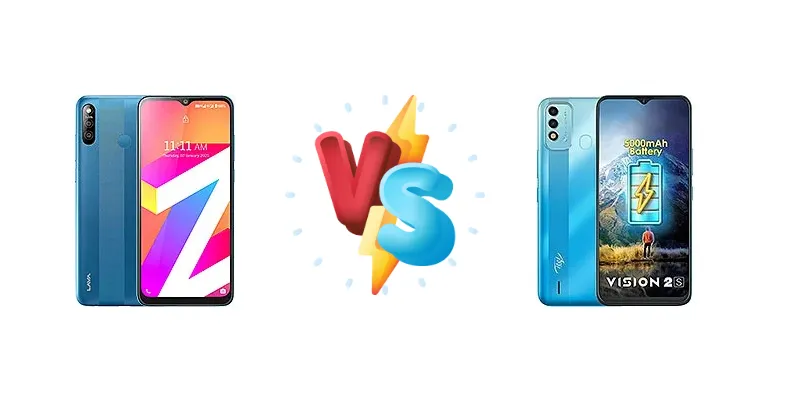
The Lava Z3 and itel Vision 2S represent the fiercely competitive sub-$150 smartphone market. Both aim to deliver essential functionality at an accessible price, but they take drastically different approaches to achieving this. The Z3 leverages a newer, albeit entry-level, Mediatek Helio G35, while the Vision 2S relies on the older, less efficient Unisoc SC9863A. This comparison will dissect these core differences and determine which device offers the best value for budget-conscious consumers.
🏆 Quick Verdict
For the average user prioritizing responsiveness and future-proofing, the Lava Z3 is the better choice. Its Mediatek Helio G35, built on a 12nm process, offers a noticeable performance advantage and improved efficiency compared to the itel Vision 2S’s 28nm Unisoc SC9863A. While the Vision 2S boasts 18W charging, the Z3’s more efficient chipset will likely translate to longer real-world battery life.
| Network |
|---|
| 2G bands | GSM 900 / 1800 | GSM 850 / 900 / 1800 / 1900 |
| 3G bands | HSDPA 900 / 2100 | HSDPA 850 / 900 / 2100 |
| 4G bands | 1, 3, 5, 8, 40, 41 | LTE |
| Speed | HSPA 42.2/5.76 Mbps, LTE Cat4 150/50 Mbps | HSPA, LTE |
| Technology | GSM / HSPA / LTE | GSM / HSPA / LTE |
| Launch |
|---|
| Announced | 2022, February 26 | 2021 |
| Status | Available. Released 2022, March | Available. Released 2021 |
| Body |
|---|
| Build | Glass front, plastic back, plastic frame | - |
| Dimensions | 164.5 x 75.8 x 8.9 mm (6.48 x 2.98 x 0.35 in) | 166 x 76.3 x 8.9 mm (6.54 x 3.00 x 0.35 in) |
| SIM | Nano-SIM + Nano-SIM | Dual SIM |
| Weight | - | - |
| Display |
|---|
| Resolution | 720 x 1600 pixels, 20:9 ratio (~269 ppi density) | 720 x 1600 pixels, 20:9 ratio (~269 ppi density) |
| Size | 6.52 inches, 102.6 cm2 (~82.3% screen-to-body ratio) | 6.52 inches, 102.6 cm2 (~81.0% screen-to-body ratio) |
| Type | IPS LCD | IPS LCD |
| Platform |
|---|
| CPU | Octa-core (4x2.3 GHz Cortex-A53 & 4x1.8 GHz Cortex-A53) | Octa-core (4x1.6 GHz Cortex-A55 & 4x1.2 GHz Cortex-A55) |
| Chipset | Mediatek MT6765G Helio G35 (12 nm) | Unisoc SC9863A (28 nm) |
| GPU | PowerVR GE8320 | IMG8322 |
| OS | Android 11 | Android 11 (Go edition) |
| Memory |
|---|
| Card slot | microSDXC (dedicated slot) | microSDXC |
| Internal | 32GB 3GB RAM | 32GB 2GB RAM |
| | eMMC 5.1 | - |
| Main Camera |
|---|
| Dual | 8 MP, f/2.0, (wide), 1.12µm, AF
Auxiliary lens | 8 MP
0.3 MP |
| Features | LED flash | LED flash |
| Single | 5 MP, f/2.2, (wide) | - |
| Video | 1080p@30fps | 1080p@30fps |
| Selfie camera |
|---|
| Single | 5 MP, f/2.2, (wide) | 5 MP |
| Video | - | Yes |
| Sound |
|---|
| 3.5mm jack | Yes | - |
| 35mm jack | Yes | Yes |
| Loudspeaker | Yes | Yes |
| Comms |
|---|
| Bluetooth | 5.0, A2DP, LE | Yes |
| NFC | No | No |
| Positioning | GPS | GPS |
| Radio | FM radio | Unspecified |
| USB | USB Type-C 2.0, OTG | microUSB |
| WLAN | Wi-Fi 802.11 b/g/n/ac, Wi-Fi Direct | Yes |
| Features |
|---|
| Sensors | Fingerprint (rear-mounted), accelerometer, proximity | Fingerprint (rear-mounted), accelerometer |
| Battery |
|---|
| Charging | - | 18W wired |
| Type | Li-Po 5000 mAh | 5000 mAh |
| Misc |
|---|
| Colors | Blue, Cyan | Gradation Purple, Gradation Blue, Deep Blue |
| Models | LZG403 25 | - |
| Price | About 90 EUR | - |
Lava Z3
- More efficient Mediatek Helio G35 chipset
- Potentially longer battery life due to 12nm process
- Likely smoother performance for everyday tasks
- Charging speed not specified (likely slower than itel)
- Camera specifications unknown, likely basic
itel Vision 2S
- 18W wired charging for faster top-ups
- Potentially lower price point
- Acceptable performance for basic tasks
- Less efficient Unisoc SC9863A chipset (28nm)
- Likely shorter battery life
- Potentially noticeable lag with demanding apps
Display Comparison
Neither device’s display specifications are provided, so a direct comparison is limited. However, given the price point, both likely utilize LCD panels with 720p+ resolution. The itel Vision 2S’s inclusion of 18W charging suggests a focus on quick top-ups, potentially compensating for a less efficient display. Without knowing panel technology or brightness levels, it’s difficult to declare a clear winner; however, the Z3’s more efficient chipset could indirectly benefit display-related power consumption.
Camera Comparison
No camera specifications are provided for either device. Given the price bracket, we can expect basic camera setups focused on affordability rather than image quality. It’s highly probable both phones will feature a primary sensor paired with auxiliary lenses of limited utility (e.g., 2MP macro). Without knowing sensor sizes, apertures, or image processing capabilities, a meaningful comparison is impossible. However, the Z3’s more capable chipset *could* potentially handle image processing tasks slightly faster.
Performance
The core difference lies in the chipsets. The Lava Z3’s Mediatek Helio G35 (12nm) features an octa-core configuration with a split of 4x2.3 GHz Cortex-A53 and 4x1.8 GHz Cortex-A53 cores. This is a more modern architecture than the itel Vision 2S’s Unisoc SC9863A (28nm), which also uses an octa-core setup but with 4x1.6 GHz Cortex-A55 and 4x1.2 GHz Cortex-A55 cores. The 12nm process of the Helio G35 is significantly more efficient than the 28nm process of the Unisoc chip, meaning less heat generation and better sustained performance. The Cortex-A53 cores in the Z3, while older, are clocked higher, and the more efficient process will likely result in a smoother user experience, especially when multitasking. The Vision 2S’s A55 cores are more efficient *per core*, but the overall system efficiency is hampered by the larger node size.
Battery Life
Battery capacity isn’t specified for either device. However, the itel Vision 2S’s 18W wired charging is a key differentiator. While the Lava Z3’s battery capacity remains unknown, the Helio G35’s 12nm process will contribute to better power efficiency. This means the Z3 could potentially offer comparable or even longer battery life despite a potentially smaller battery capacity, as it consumes less power during operation. The 18W charging on the Vision 2S will allow for quicker top-ups, but the Z3’s efficiency may reduce the frequency of those top-ups.
Buying Guide
Buy the Lava Z3 if you need a phone that feels reasonably snappy for everyday tasks like browsing, social media, and light gaming. Its more modern processor architecture will provide a smoother experience and potentially longer software support. Buy the itel Vision 2S if you prioritize faster charging speeds and are willing to compromise on overall performance and efficiency. The 18W charging is a definite plus, but the older chipset may struggle with demanding applications.
Frequently Asked Questions
❓ Will the Unisoc SC9863A in the itel Vision 2S struggle with popular apps like Facebook or WhatsApp?
While the Unisoc SC9863A can handle basic apps like Facebook and WhatsApp, its older architecture and lower efficiency may result in noticeable lag or slowdowns when multitasking or using more demanding features within those apps. The Lava Z3’s Helio G35 is better equipped to handle these workloads smoothly.
❓ How much faster is the charging on the itel Vision 2S compared to a phone without fast charging?
The itel Vision 2S’s 18W charging is significantly faster than standard 5W or 10W charging. While a precise 0-100% time isn’t available, expect a full charge in approximately 2-3 hours, compared to 4-6 hours with slower charging methods. However, the Lava Z3’s more efficient chipset may mean you need to charge it less frequently.
❓ Is the Lava Z3 suitable for playing mobile games?
The Lava Z3’s Helio G35 is an entry-level gaming chip. It can handle less demanding 2D games and older 3D titles at lower settings. However, it will likely struggle with graphically intensive games like PUBG or Call of Duty Mobile, even on the lowest settings. The itel Vision 2S would perform similarly or slightly worse.