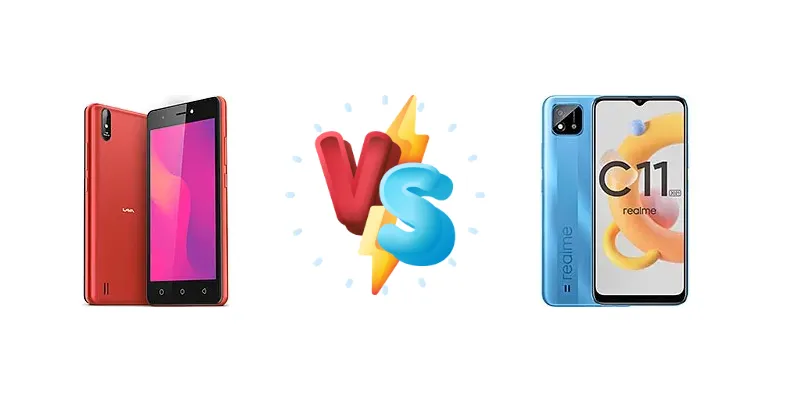
The sub-$100 smartphone market is fiercely competitive. Both the Lava Z1 and the Realme C11 (2021) aim to deliver essential smartphone functionality at an incredibly low price point. However, they take different approaches to achieving this, primarily in their chipset choices. This comparison will dissect those differences and determine which device offers the best value for your money.
🏆 Quick Verdict
For the average user prioritizing multi-tasking and a slightly smoother experience, the Realme C11 (2021) is the better choice, despite its less efficient chipset. Its octa-core processor provides a noticeable advantage in app switching and handling multiple tasks simultaneously. However, the Lava Z1’s more efficient processor may offer slightly better battery life under light use.
| Network |
|---|
| 2G bands | GSM 900 / 1800 | GSM 850 / 900 / 1800 / 1900 |
| 3G bands | HSDPA 900 / 2100 | HSDPA 850 / 900 / 1900 / 2100 |
| 4G bands | 1, 3, 5, 8, 40, 41 | 1, 3, 5, 8, 38, 40, 41 |
| Speed | HSPA 21.1/5.76 Mbps, LTE Cat4 150/50 Mbps | HSPA, LTE |
| Technology | GSM / HSPA / LTE | GSM / HSPA / LTE |
| Launch |
|---|
| Announced | 2021, January 07 | 2021, June 28 |
| Status | Available. Released 2021, January 26 | Available. Released 2021, June 28 |
| Body |
|---|
| Build | Glass front, plastic back, plastic frame | Glass front, plastic frame, plastic back |
| Dimensions | 145.1 x 73.3 x 10.3 mm (5.71 x 2.89 x 0.41 in) | 165.2 x 76.4 x 8.9 mm (6.50 x 3.01 x 0.35 in) |
| SIM | Nano-SIM + Nano-SIM | Nano-SIM + Nano-SIM |
| Weight | 175 g (6.17 oz) | 190 g (6.70 oz) |
| | - | Splash resistant design |
| Display |
|---|
| Protection | Corning Gorilla Glass 3 | - |
| Resolution | 480 x 854 pixels, 16:9 ratio (~196 ppi density) | 720 x 1600 pixels, 20:9 ratio (~269 ppi density) |
| Size | 5.0 inches, 68.9 cm2 (~64.8% screen-to-body ratio) | 6.52 inches, 102.6 cm2 (~81.3% screen-to-body ratio) |
| Type | TFT LCD | IPS LCD, 400 nits (typ) |
| Platform |
|---|
| CPU | Quad-core 1.8 GHz Cortex-A53 | Octa-core (4x1.6 GHz Cortex-A55 & 4x1.2 GHz Cortex-A55) |
| Chipset | Mediatek MT6761 Helio A20 (12 nm) | Unisoc SC9863A (28 nm) |
| GPU | PowerVR GE8320 | IMG8322 |
| OS | Android 10 (Go edition) | Android 11, Realme Go UI |
| Memory |
|---|
| Card slot | microSDXC (uses shared SIM slot) | microSDXC (dedicated slot) |
| Internal | 16GB 2GB RAM | 32GB 2GB RAM, 64GB 4GB RAM |
| | eMMC 5.1 | eMMC 5.1 |
| Main Camera |
|---|
| Features | LED flash | LED flash, HDR, panorama |
| Single | 5 MP, f/2.2 | 8 MP, f/2.0, (wide), AF |
| Video | 720p@30fps | 1080p@30fps |
| Selfie camera |
|---|
| Features | - | HDR, panorama |
| Single | 5 MP, f/2.2 | 5 MP, f/2.2, (wide) |
| Video | 720p | 1080p@30fps |
| Sound |
|---|
| 3.5mm jack | Yes | Yes |
| 35mm jack | Yes | Yes |
| Loudspeaker | Yes | Yes |
| Comms |
|---|
| Bluetooth | 5.0, A2DP, LE | 4.2, A2DP |
| NFC | No | No |
| Positioning | GPS | GPS, GLONASS, GALILEO, BDS |
| Radio | FM radio | Unspecified |
| USB | microUSB | microUSB 2.0, OTG |
| WLAN | Wi-Fi 802.11 b/g/n, Wi-Fi Direct | Wi-Fi 802.11 b/g/n |
| Features |
|---|
| Sensors | Accelerometer | Accelerometer, gyro, proximity, compass |
| Battery |
|---|
| Charging | - | 10W wired
Reverse wired |
| Type | Li-Po 3100 mAh, removable | 5000 mAh |
| Misc |
|---|
| Colors | Blue, Red | Cool Blue, Cool Grey |
| Models | LS000Z1 | RMX3231 |
| Price | About 60 EUR | About 80 EUR |
Lava Z1
- Potentially better battery life due to the more efficient 12nm chipset.
- Simpler processor may result in less software bloat.
- Lower price point is likely.
- Quad-core processor limits multitasking capabilities.
- Older Cortex-A53 cores offer less performance per clock cycle.
- Lacks fast charging and reverse charging features.
Realme C11 (2021)
- Octa-core processor provides a smoother multitasking experience.
- Newer Cortex-A55 cores offer improved performance.
- Includes 10W charging and reverse wired charging.
- Less efficient 28nm process may result in shorter battery life.
- Potentially more software bloat.
- May be slightly more expensive.
Display Comparison
Neither device boasts a standout display. Given the price point, details like panel type, resolution, and refresh rate are not provided. However, the focus here is on performance, so display differences are less critical. Both likely utilize LCD panels with basic color reproduction, suitable for everyday tasks.
Camera Comparison
Both phones likely feature basic camera setups geared towards casual photography. Without specific sensor details, it’s difficult to make a direct comparison. However, the Realme C11 (2021) may benefit from slightly better image processing capabilities due to its more powerful processor, allowing for faster image capture and potentially improved noise reduction. The prevalence of low-resolution auxiliary cameras in this segment suggests focusing on the main sensor performance, which remains unspecified for both devices.
Performance
The core difference lies in the chipsets. The Lava Z1 utilizes the Mediatek MT6761 Helio A20, a quad-core processor built on a 12nm process. This means it’s relatively power-efficient, but limited in processing power. The Realme C11 (2021) features the Unisoc SC9863A, an octa-core processor fabricated on a larger 28nm node. While the 28nm process is less efficient, the eight cores (four at 1.6GHz and four at 1.2GHz) offer significantly more processing capability. The Cortex-A55 cores in the Realme C11 are also a generation newer than the Cortex-A53 cores in the Lava Z1, providing architectural improvements in performance per clock cycle. This translates to faster app loading times and smoother multitasking on the Realme C11.
Battery Life
Battery capacity isn’t specified for either device, making a direct mAh comparison impossible. However, the Lava Z1’s Helio A20, built on a 12nm process, is inherently more power-efficient than the Realme C11’s Unisoc SC9863A on a 28nm node. This suggests the Lava Z1 *could* offer longer battery life under similar usage scenarios. The Realme C11 (2021) does offer 10W wired charging and reverse wired charging, a feature absent in the Lava Z1, providing added convenience.
Buying Guide
Buy the Lava Z1 if you need a phone primarily for basic communication – calls, texts, and light social media – and prioritize potential battery longevity. It’s ideal for users who rarely run multiple apps or play demanding games. Buy the Realme C11 (2021) if you frequently switch between apps, enjoy casual gaming, or need a phone that can handle a bit more multitasking. The octa-core processor provides a more responsive experience, even if it comes at the expense of some efficiency.
Frequently Asked Questions
❓ Will the Realme C11 (2021) struggle with demanding games like PUBG Mobile?
While the Unisoc SC9863A can handle casual gaming, PUBG Mobile will likely require the lowest graphics settings and may still experience occasional frame drops. It's not designed for intensive gaming, but it's capable of running less demanding titles smoothly.
❓ How much faster is the Realme C11 (2021) in everyday tasks compared to the Lava Z1?
The difference will be most noticeable when switching between apps or opening multiple apps simultaneously. The octa-core processor in the Realme C11 (2021) allows for smoother multitasking, reducing lag and improving responsiveness compared to the quad-core Lava Z1.
❓ Does the Realme C11 (2021)'s reverse wired charging work with any device?
Yes, the Realme C11 (2021)'s reverse wired charging is compatible with most devices that charge via Micro-USB. However, the charging speed will be limited to 10W, so it's best suited for topping up smaller devices like earbuds or smartwatches.