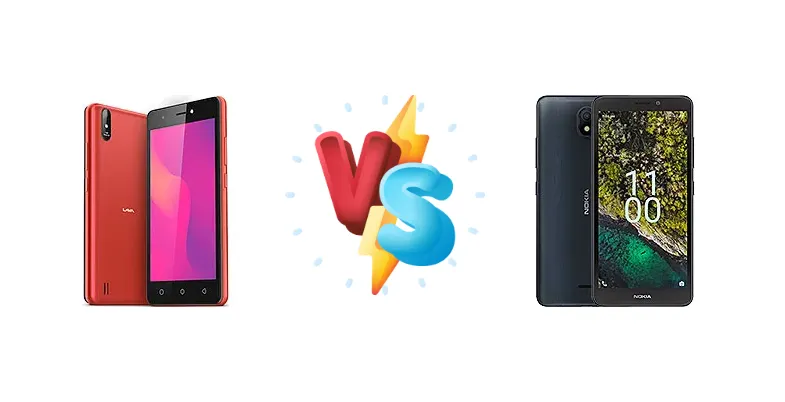
The Lava Z1 and Nokia C100 represent the extreme end of the budget smartphone market, targeting first-time smartphone buyers or those needing a reliable secondary device. Both rely on MediaTek’s Helio A-series, but a subtle difference in CPU clock speed and chipset version raises the question: does the Nokia C100’s Helio A22 offer a meaningfully better experience than the Lava Z1’s Helio A20?
🏆 Quick Verdict
For the average user prioritizing basic functionality like calling, messaging, and light social media, the Nokia C100 edges out the Lava Z1. The 2.0 GHz CPU clock speed of the Helio A22 provides a noticeable, albeit modest, performance boost over the Z1’s 1.8 GHz Helio A20, resulting in slightly smoother app loading and multitasking.
| Network |
|---|
| 2G bands | GSM 900 / 1800 | GSM 850 / 900 / 1800 / 1900 |
| 3G bands | HSDPA 900 / 2100 | HSDPA 850 / 1700(AWS) / 1900 |
| 4G bands | 1, 3, 5, 8, 40, 41 | 2, 4, 5, 12, 13, 41, 66, 71 |
| Speed | HSPA 21.1/5.76 Mbps, LTE Cat4 150/50 Mbps | HSPA, LTE |
| Technology | GSM / HSPA / LTE | GSM / HSPA / LTE |
| Launch |
|---|
| Announced | 2021, January 07 | 2022, January 05 |
| Status | Available. Released 2021, January 26 | Available. Released 2022, Q2 |
| Body |
|---|
| Build | Glass front, plastic back, plastic frame | - |
| Dimensions | 145.1 x 73.3 x 10.3 mm (5.71 x 2.89 x 0.41 in) | 149.6 x 71.9 x 9.7 mm (5.89 x 2.83 x 0.38 in) |
| SIM | Nano-SIM + Nano-SIM | Nano-SIM |
| Weight | 175 g (6.17 oz) | - |
| | - | Splash protection |
| Display |
|---|
| Protection | Corning Gorilla Glass 3 | - |
| Resolution | 480 x 854 pixels, 16:9 ratio (~196 ppi density) | 720 x 1440 pixels, 18:9 ratio (~295 ppi density) |
| Size | 5.0 inches, 68.9 cm2 (~64.8% screen-to-body ratio) | 5.45 inches, 76.7 cm2 (~71.3% screen-to-body ratio) |
| Type | TFT LCD | IPS LCD |
| Platform |
|---|
| CPU | Quad-core 1.8 GHz Cortex-A53 | Quad-core 2.0 GHz Cortex-A53 |
| Chipset | Mediatek MT6761 Helio A20 (12 nm) | Mediatek MT6761 Helio A22 (12 nm) |
| GPU | PowerVR GE8320 | PowerVR GE8320 |
| OS | Android 10 (Go edition) | Android 12 |
| Memory |
|---|
| Card slot | microSDXC (uses shared SIM slot) | microSDXC (dedicated slot) |
| Internal | 16GB 2GB RAM | 32GB 3GB RAM |
| | eMMC 5.1 | eMMC 5.1 |
| Main Camera |
|---|
| Features | LED flash | LED flash |
| Single | 5 MP, f/2.2 | 8 MP, AF |
| Video | 720p@30fps | 1080p@30fps |
| Selfie camera |
|---|
| Single | 5 MP, f/2.2 | 5 MP |
| Video | 720p | 720p |
| Sound |
|---|
| 3.5mm jack | Yes | Yes |
| 35mm jack | Yes | Yes |
| Loudspeaker | Yes | Yes |
| Comms |
|---|
| Bluetooth | 5.0, A2DP, LE | 5.0, A2DP, LE |
| NFC | No | No |
| Positioning | GPS | GPS |
| Radio | FM radio | No |
| USB | microUSB | USB Type-C 2.0 |
| WLAN | Wi-Fi 802.11 b/g/n, Wi-Fi Direct | Wi-Fi 802.11 b/g/n/ac |
| Features |
|---|
| Sensors | Accelerometer | Accelerometer, proximity, barometer |
| Battery |
|---|
| Type | Li-Po 3100 mAh, removable | Li-Ion 3000 mAh, removable |
| Misc |
|---|
| Colors | Blue, Red | Blue |
| Models | LS000Z1 | TA-1484, TA-1520, N152DL |
| Price | About 60 EUR | About 50 EUR |
| SAR | - | 1.03 W/kg (head) 1.35 W/kg (body) |
Lava Z1
- Potentially lower price point
- Reliable for basic communication
- Decent battery life due to efficient chipset
- Slower processor compared to the C100
- May struggle with multitasking
- Limited app performance
Nokia C100
- Slightly faster processor for smoother app usage
- Improved multitasking capabilities
- Better overall responsiveness
- Likely a slightly higher price
- Still limited for demanding tasks
- Battery life may be marginally lower due to higher clock speed
Display Comparison
Neither Lava nor Nokia provide detailed display specifications beyond resolution. Given the price point, both likely utilize LCD panels. The absence of information regarding brightness nits suggests neither device will excel in direct sunlight. Bezels are expected to be substantial on both, maximizing screen real estate within a compact form factor. Color accuracy is unlikely to be a priority, with both likely targeting the sRGB color space with limited calibration.
Camera Comparison
Camera details are sparse for both devices. It’s safe to assume both feature basic camera setups geared towards casual photography. Without sensor size or aperture information, a direct comparison is difficult. The market segment suggests both will rely heavily on software processing to enhance image quality. Any mention of a 'macro' camera on either device should be viewed with skepticism, as 2MP macro sensors typically produce low-quality results. Image processing style will likely differ between the two, potentially favoring different color profiles or sharpening levels.
Performance
The core difference lies in the chipset: the Lava Z1 uses the MediaTek MT6761 Helio A20, while the Nokia C100 features the MT6761 Helio A22. Both are built on a 12nm process, meaning power efficiency is similar. However, the A22 boasts a 2.0 GHz quad-core Cortex-A53 CPU, compared to the A20’s 1.8 GHz configuration. This 10% clock speed increase translates to faster processing of tasks, though the overall performance difference will be most noticeable in app launch times and light multitasking. Both devices will struggle with demanding games or resource-intensive applications. RAM configurations are not specified, but are likely to be limited (2GB or less) on both, further impacting multitasking capabilities.
Battery Life
Battery capacity is not specified for either device. However, given the low-power chipsets and basic feature sets, both should offer all-day battery life with moderate usage. Charging wattage is also unknown, but is likely to be limited to 5W or 10W, resulting in relatively slow charging times. The 12nm process node of both chipsets contributes to reasonable power efficiency, minimizing battery drain during standby.
Buying Guide
Buy the Lava Z1 if you need a functional smartphone at the absolute lowest possible price point and are willing to accept slightly slower performance. It’s ideal for users who primarily need a device for calls and texts. Buy the Nokia C100 if you prefer a marginally more responsive experience for basic app usage and multitasking, and are willing to spend a little extra for that incremental performance gain. It’s a better choice for those who occasionally browse the web or use social media apps.
Frequently Asked Questions
❓ Will the Nokia C100 handle popular social media apps like Facebook and WhatsApp smoothly?
The Nokia C100, with its slightly faster Helio A22 processor, will offer a more responsive experience when using Facebook and WhatsApp compared to the Lava Z1. While not lightning-fast, it should handle basic scrolling and message sending without significant lag. However, heavy usage with multiple apps open simultaneously may still result in slowdowns.
❓ Is the performance difference between the Helio A20 and A22 noticeable in everyday use?
The performance difference is subtle but present. The 10% clock speed increase in the Helio A22 translates to faster app launch times and slightly smoother multitasking. Users upgrading from a feature phone will likely find both devices adequate, but those accustomed to more powerful smartphones will notice the limitations of both.
❓ Can either of these phones play modern mobile games like PUBG Mobile or Call of Duty Mobile?
Neither the Lava Z1 nor the Nokia C100 are suitable for playing demanding games like PUBG Mobile or Call of Duty Mobile. The Helio A20 and A22 chipsets lack the processing power and graphics capabilities required for a playable experience. Attempting to run these games will likely result in significant lag, low frame rates, and overheating.