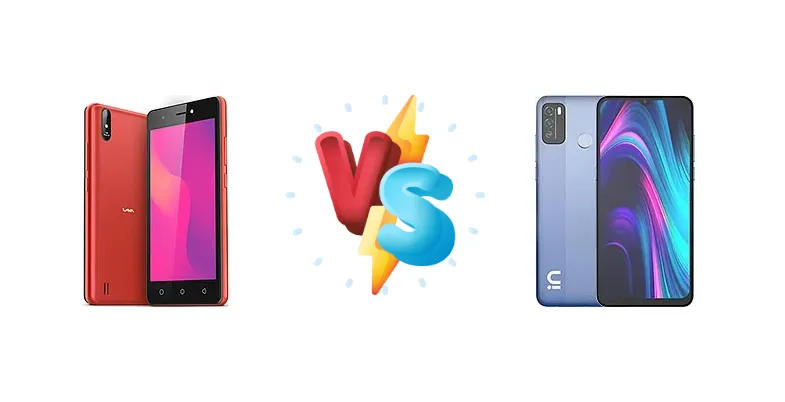
The Lava Z1 and Micromax In 1b represent a resurgence of Indian smartphone brands aiming for the ultra-budget segment. Both phones target first-time smartphone buyers or those needing a reliable secondary device. However, a key difference lies under the hood: the Micromax In 1b boasts a more powerful, octa-core chipset, while the Lava Z1 relies on a quad-core processor. This comparison dives deep into the implications of this difference and other key features to determine which phone offers the best value.
🏆 Quick Verdict
For most users, the Micromax In 1b is the better choice. Its Helio G35 chipset, with its octa-core configuration and higher clock speeds, provides a noticeably smoother experience for multitasking and light gaming. While both phones are firmly in the entry-level category, the In 1b’s performance advantage justifies the potentially slight price premium.
| Network |
|---|
| 2G bands | GSM 900 / 1800 | GSM 850 / 900 / 1800 / 1900 |
| 3G bands | HSDPA 900 / 2100 | HSDPA 850 / 2100 |
| 4G bands | 1, 3, 5, 8, 40, 41 | 1, 3, 5, 8, 40, 41 |
| Speed | HSPA 21.1/5.76 Mbps, LTE Cat4 150/50 Mbps | HSPA, LTE |
| Technology | GSM / HSPA / LTE | GSM / HSPA / LTE |
| Launch |
|---|
| Announced | 2021, January 07 | 2020, November 03. Released 2020, November 26 |
| Status | Available. Released 2021, January 26 | Discontinued |
| Body |
|---|
| Build | Glass front, plastic back, plastic frame | - |
| Dimensions | 145.1 x 73.3 x 10.3 mm (5.71 x 2.89 x 0.41 in) | 164.5 x 75.8 x 8.9 mm (6.48 x 2.98 x 0.35 in) |
| SIM | Nano-SIM + Nano-SIM | Nano-SIM + Nano-SIM |
| Weight | 175 g (6.17 oz) | 188 g (6.63 oz) |
| Display |
|---|
| Protection | Corning Gorilla Glass 3 | - |
| Resolution | 480 x 854 pixels, 16:9 ratio (~196 ppi density) | 720 x 1600 pixels, 20:9 ratio (~269 ppi density) |
| Size | 5.0 inches, 68.9 cm2 (~64.8% screen-to-body ratio) | 6.52 inches, 102.6 cm2 (~82.3% screen-to-body ratio) |
| Type | TFT LCD | IPS LCD, 400 nits (typ) |
| Platform |
|---|
| CPU | Quad-core 1.8 GHz Cortex-A53 | Octa-core (4x2.3 GHz Cortex-A53 & 4x1.8 GHz Cortex-A53) |
| Chipset | Mediatek MT6761 Helio A20 (12 nm) | Mediatek MT6765G Helio G35 (12 nm) |
| GPU | PowerVR GE8320 | PowerVR GE8320 |
| OS | Android 10 (Go edition) | Android 10 (Go edition) |
| Memory |
|---|
| Card slot | microSDXC (uses shared SIM slot) | microSDXC (dedicated slot) |
| Internal | 16GB 2GB RAM | 32GB 2GB RAM, 64GB 4GB RAM |
| | eMMC 5.1 | eMMC 5.1 |
| Main Camera |
|---|
| Dual | - | 13 MP, f/1.9, 26mm (wide), PDAF
Auxiliary lens |
| Features | LED flash | LED flash, panorama |
| Single | 5 MP, f/2.2 | - |
| Video | 720p@30fps | 1080p@30fps |
| Selfie camera |
|---|
| Single | 5 MP, f/2.2 | 8 MP, f/2.0 |
| Video | 720p | 1080p@30fps |
| Sound |
|---|
| 3.5mm jack | Yes | Yes |
| 35mm jack | Yes | Yes |
| Loudspeaker | Yes | Yes |
| Comms |
|---|
| Bluetooth | 5.0, A2DP, LE | 5.0, A2DP, LE |
| NFC | No | No |
| Positioning | GPS | GPS, GLONASS, GALILEO |
| Radio | FM radio | Unspecified |
| USB | microUSB | USB Type-C 2.0, OTG |
| WLAN | Wi-Fi 802.11 b/g/n, Wi-Fi Direct | Wi-Fi 802.11 a/b/g/n/ac, Wi-Fi Direct |
| Features |
|---|
| Sensors | Accelerometer | Fingerprint (rear-mounted), accelerometer, gyro, proximity |
| Battery |
|---|
| Charging | - | 10W wired
Reverse wired |
| Type | Li-Po 3100 mAh, removable | Li-Po 5000 mAh |
| Misc |
|---|
| Colors | Blue, Red | Blue, Purple, Green |
| Models | LS000Z1 | E6523, E7533 |
| Price | About 60 EUR | About 80 EUR |
| SAR | - | 0.57 W/kg (head) 0.90 W/kg (body) |
Lava Z1
- Extremely affordable
- Simple and easy to use
- Suitable for basic communication
- Weak processor performance
- Limited multitasking capabilities
- Poor gaming performance
Micromax In 1b
- More powerful octa-core processor
- Smoother multitasking experience
- Reverse wired charging capability
- Slow 10W charging
- Basic camera system
- May be slightly more expensive
Display Comparison
Neither Lava nor Micromax provide detailed display specifications beyond resolution. Given the price point, both likely utilize IPS LCD panels. The absence of information regarding brightness nits or color gamut coverage suggests neither phone will excel in outdoor visibility or color accuracy. Bezels are expected to be substantial on both devices, contributing to a larger overall footprint. The display experience will likely be similar on both, focusing on functionality over visual fidelity.
Camera Comparison
Detailed camera specifications are scarce for both devices. It’s safe to assume both feature basic camera setups geared towards casual photography. Without sensor size or aperture information, it’s difficult to assess image quality. The presence of a 2MP macro camera on the In 1b is largely a marketing gimmick, offering limited practical benefit due to the low resolution. Image processing will likely be basic on both phones, prioritizing speed over detail and dynamic range. Expect acceptable results in well-lit conditions, but poor performance in low light.
Performance
The core difference lies in the chipsets. The Lava Z1’s MediaTek Helio A20 is a quad-core processor clocked at 1.8 GHz, built on a 12nm process. This is adequate for basic tasks but will struggle with demanding applications. The Micromax In 1b, however, features the Helio G35, an octa-core processor with a combination of 2.3 GHz and 1.8 GHz Cortex-A53 cores, also on a 12nm process. This configuration provides a significant performance boost, particularly in multi-threaded tasks and gaming. The higher clock speeds and additional cores translate to faster app loading times and smoother multitasking. While neither chipset is a gaming powerhouse, the G35 will handle less intensive games more comfortably. The In 1b’s CPU architecture, while still Cortex-A53, benefits from the increased core count.
Battery Life
Battery capacity isn’t specified for the Lava Z1, but given its focus on affordability, it’s likely around 3000-4000 mAh. The Micromax In 1b supports 10W wired charging and reverse wired charging. While 10W is slow by modern standards, it’s typical for this price segment. The In 1b’s reverse wired charging is a unique feature, allowing it to act as a power bank for other devices, albeit at a slow charging rate. The actual battery life will depend heavily on usage patterns, but the more efficient Helio G35 in the In 1b may offer slightly better endurance despite potentially having a similar capacity battery.
Buying Guide
Buy the Lava Z1 if you prioritize extreme affordability and only need a phone for basic tasks like calls, texts, and WhatsApp. It’s a suitable option for users upgrading from feature phones and who don’t intend to run demanding applications. Buy the Micromax In 1b if you want a more responsive experience, occasional gaming, and the flexibility to handle multiple apps simultaneously. The In 1b is ideal for students or users who need a bit more power without breaking the bank.
Frequently Asked Questions
❓ Will the Micromax In 1b be able to run PUBG Mobile?
While the Helio G35 can technically run PUBG Mobile, expect to play at the lowest graphics settings and potentially experience frame drops, especially in intense combat situations. It's not optimized for demanding games like PUBG, but it's playable for casual gamers.
❓ Is the Lava Z1 a good option for someone upgrading from a feature phone?
Yes, the Lava Z1 is a suitable choice for first-time smartphone users. Its simplicity and affordability make it an easy entry point into the world of smartphones, allowing users to learn the basics without a significant investment.
❓ Does the Micromax In 1b support VoWiFi (Wi-Fi Calling)?
Support for VoWiFi varies by carrier and software updates. While the chipset is capable, it's crucial to check with your mobile network operator to confirm if they support VoWiFi on the Micromax In 1b.
❓ What version of Android do these phones run?
Both phones likely run Android Go Edition, a lightweight version of Android designed for devices with limited RAM and storage. This ensures a smoother experience on these entry-level devices.