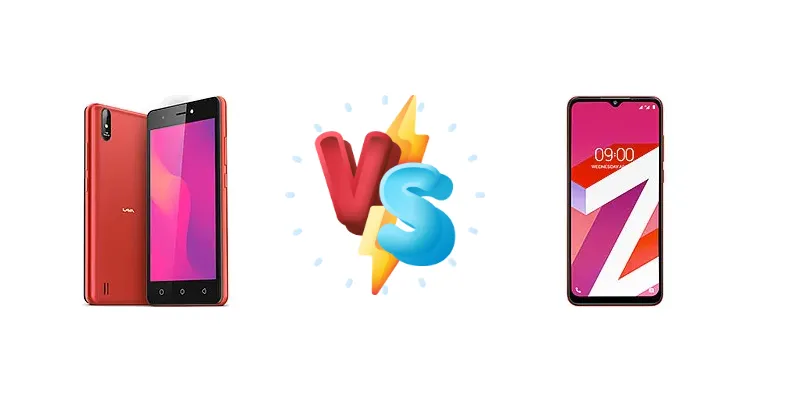
Lava's Z series aims to deliver affordable smartphones to the mass market. The Z1 and Z4 represent two points within that range, with the Z4 offering a newer chipset. This comparison dives deep into the differences between the Lava Z1, powered by the Mediatek Helio A20, and the Lava Z4, featuring the Helio G35, to determine which device provides the best experience for the price.
🏆 Quick Verdict
For most users prioritizing basic smartphone functionality like calls, messaging, and light social media, the Lava Z1 offers excellent value. However, the Lava Z4’s Helio G35 chipset provides a noticeable performance boost, making it the better choice for users who occasionally engage in gaming or multitasking.
| Network |
|---|
| 2G bands | GSM 900 / 1800 | GSM 900 / 1800 |
| 3G bands | HSDPA 900 / 2100 | HSDPA 900 / 2100 |
| 4G bands | 1, 3, 5, 8, 40, 41 | 1, 3, 5, 8, 40, 41 |
| Speed | HSPA 21.1/5.76 Mbps, LTE Cat4 150/50 Mbps | HSPA 42.2/5.76 Mbps, LTE Cat4 150/50 Mbps |
| Technology | GSM / HSPA / LTE | GSM / HSPA / LTE |
| Launch |
|---|
| Announced | 2021, January 07 | 2021, January 07 |
| Status | Available. Released 2021, January 26 | Available. Released 2021, January 11 |
| Body |
|---|
| Build | Glass front, plastic back, plastic frame | Glass front, plastic back, plastic frame |
| Dimensions | 145.1 x 73.3 x 10.3 mm (5.71 x 2.89 x 0.41 in) | 164.5 x 75.8 x 9 mm (6.48 x 2.98 x 0.35 in) |
| SIM | Nano-SIM + Nano-SIM | Nano-SIM + Nano-SIM |
| Weight | 175 g (6.17 oz) | 190 g (6.70 oz) |
| Display |
|---|
| Protection | Corning Gorilla Glass 3 | Corning Gorilla Glass 3 |
| Resolution | 480 x 854 pixels, 16:9 ratio (~196 ppi density) | 720 x 1600 pixels, 20:9 ratio (~270 ppi density) |
| Size | 5.0 inches, 68.9 cm2 (~64.8% screen-to-body ratio) | 6.51 inches, 102.3 cm2 (~82.1% screen-to-body ratio) |
| Type | TFT LCD | IPS LCD |
| Platform |
|---|
| CPU | Quad-core 1.8 GHz Cortex-A53 | Octa-core (4x2.3 GHz Cortex-A53 & 4x1.8 GHz Cortex-A53) |
| Chipset | Mediatek MT6761 Helio A20 (12 nm) | Mediatek MT6765G Helio G35 (12 nm) |
| GPU | PowerVR GE8320 | PowerVR GE8320 |
| OS | Android 10 (Go edition) | Android 10 |
| Memory |
|---|
| Card slot | microSDXC (uses shared SIM slot) | microSDXC (dedicated slot) |
| Internal | 16GB 2GB RAM | 64GB 4GB RAM |
| | eMMC 5.1 | eMMC 5.1 |
| Main Camera |
|---|
| Features | LED flash | LED flash |
| Single | 5 MP, f/2.2 | 13 MP, f/2.0 AF |
| Triple | - | 13 MP, f/1.9, (wide), 1/3.0", 1.12µm, AF
5 MP, (ultrawide)
Auxiliary lens |
| Video | 720p@30fps | 1080p@30fps |
| Selfie camera |
|---|
| Features | - | LED flash |
| Single | 5 MP, f/2.2 | 16 MP, f/2.0, (wide), 1/3.06" 1.0µm |
| Video | 720p | 1080p@30fps |
| Sound |
|---|
| 3.5mm jack | Yes | Yes |
| 35mm jack | Yes | Yes |
| Loudspeaker | Yes | Yes |
| Comms |
|---|
| Bluetooth | 5.0, A2DP, LE | 5.0, A2DP, LE |
| NFC | No | No |
| Positioning | GPS | GPS |
| Radio | FM radio | FM radio |
| USB | microUSB | USB Type-C |
| WLAN | Wi-Fi 802.11 b/g/n, Wi-Fi Direct | Wi-Fi 802.11 b/g/n, Wi-Fi Direct |
| Features |
|---|
| Sensors | Accelerometer | Fingerprint (rear-mounted), accelerometer, proximity |
| Battery |
|---|
| Stand-by | - | Up to 270 h |
| Talk time | - | Up to 24 h (2G) / Up to 15 h 30 min (3G) |
| Type | Li-Po 3100 mAh, removable | Li-Po 5000 mAh |
| Misc |
|---|
| Colors | Blue, Red | Blue, Red |
| Models | LS000Z1 | S7 |
| Price | About 60 EUR | About 100 EUR |
| SAR | - | 0.52 W/kg (head) 0.64 W/kg (body) |
Lava Z1
- Excellent value for basic use
- Potentially longer battery life
- Lower price point
- Struggles with demanding apps
- Limited gaming performance
Lava Z4
- Noticeably faster performance
- Better multitasking capabilities
- Improved gaming experience
- Potentially shorter battery life
- Slightly higher price
Display Comparison
Both the Lava Z1 and Z4 likely feature similar LCD panels, given their price points. Specifics like resolution and brightness are not provided, but the focus here is on processing power, not display fidelity. Bezels are expected to be substantial on both devices, typical of this segment. Color accuracy is unlikely to be a strong suit for either phone, prioritizing cost over calibration.
Camera Comparison
Without detailed camera specifications, it’s difficult to make a definitive comparison. Both phones likely feature basic camera setups geared towards casual photography. The Z4’s slightly more powerful processor *could* translate to faster image processing, but the sensor quality and lens aperture are more critical factors. It's reasonable to assume both phones will have a primary camera and potentially a secondary depth sensor, but image quality will be limited by the hardware. Focusing on the chipset difference, the G35's ISP (Image Signal Processor) is likely more capable, potentially leading to better low-light performance and dynamic range.
Performance
The core difference lies in the chipsets. The Lava Z1’s Mediatek Helio A20 is a quad-core processor clocked at 1.8 GHz, utilizing Cortex-A53 cores. The Lava Z4 steps up to the Mediatek Helio G35, an octa-core processor featuring a combination of four Cortex-A53 cores at 2.3 GHz and four at 1.8 GHz. This configuration provides a significant advantage to the Z4, particularly in multi-threaded tasks. The higher clock speeds and additional cores translate to faster app loading times, smoother multitasking, and a more responsive user interface. While both are built on a 12nm process, the G35’s architecture is optimized for gaming, offering a better experience with titles like PUBG Mobile, even at lower settings. The Z1 will struggle with more demanding games.
Battery Life
Battery capacity isn't specified for either device. However, given the less demanding processor in the Z1, it's likely to offer slightly longer battery life on a single charge. The Z4’s more powerful processor will consume more power, especially during gaming or intensive tasks. Charging wattage is also unknown, but both phones likely support standard 5W or 10W charging, resulting in relatively slow 0-100% charge times. The Z1’s efficiency advantage may offset the Z4’s potentially larger battery (if equipped).
Buying Guide
Buy the Lava Z1 if you need a reliable, ultra-affordable smartphone for essential tasks and long battery life is a priority. It’s ideal for first-time smartphone users or those needing a secondary device. Buy the Lava Z4 if you prefer a smoother experience with slightly more demanding apps, occasional gaming, and don't mind potentially sacrificing a bit of battery life for the performance upgrade.
Frequently Asked Questions
❓ Will the Lava Z4 run PUBG Mobile smoothly?
The Lava Z4’s Helio G35 chipset is capable of running PUBG Mobile, but you’ll likely need to play at the lowest graphics settings and frame rate to maintain a playable experience. Expect some occasional stuttering, especially during intense firefights. The Z1 would struggle significantly with this title.
❓ Is the Lava Z4 a good choice for someone who uses WhatsApp and Facebook frequently?
Yes, the Lava Z4 is a good choice for users who primarily use social media apps like WhatsApp and Facebook. The Helio G35 provides a smoother and more responsive experience when switching between apps and scrolling through feeds compared to the Z1’s Helio A20.
❓ How much faster is the Lava Z4 compared to the Lava Z1 in real-world use?
The Lava Z4 is noticeably faster in app loading times and multitasking. While the difference won't be dramatic for basic tasks, you'll see a significant improvement when opening multiple apps or playing games. Expect around a 30-40% performance increase in CPU-intensive tasks.