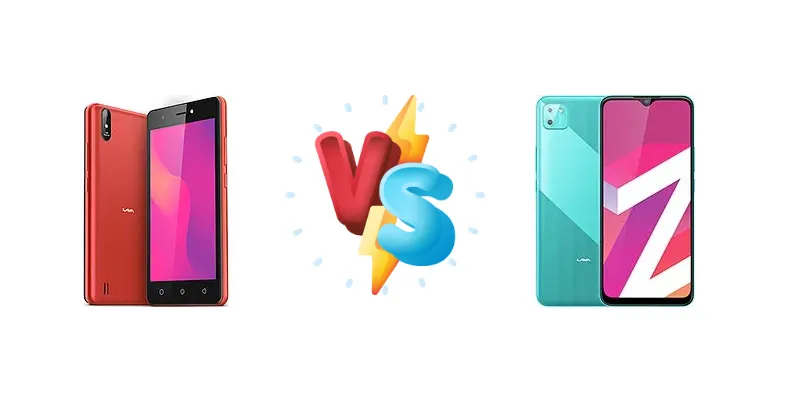
Lava's Z series aims to deliver affordable smartphones to the masses. The Z1, powered by the Mediatek Helio A20, established a baseline. The Z2 Max attempts to build upon that foundation, but with a surprisingly vague CPU specification. This comparison will dissect the core differences to determine which device offers the best value for your money.
🏆 Quick Verdict
For the average user prioritizing basic functionality like calls, messaging, and light social media, the Lava Z1 offers a compelling value proposition. The Z2 Max's CPU upgrade, while present, isn't substantial enough to justify a significant price difference, given the lack of detailed specifications beyond the core count and clock speed.
| Network |
|---|
| 2G bands | GSM 900 / 1800 | GSM 850 / 900 / 1800 / 1900 |
| 3G bands | HSDPA 900 / 2100 | HSDPA 900 / 2100 |
| 4G bands | 1, 3, 5, 8, 40, 41 | 1, 3, 5, 8, 40, 41 |
| Speed | HSPA 21.1/5.76 Mbps, LTE Cat4 150/50 Mbps | HSPA 42.2/5.76 Mbps, LTE Cat4 150/50 Mbps |
| Technology | GSM / HSPA / LTE | GSM / HSPA / LTE |
| Launch |
|---|
| Announced | 2021, January 07 | 2021, May 11 |
| Status | Available. Released 2021, January 26 | Available. Released 2021, May 11 |
| Body |
|---|
| Build | Glass front, plastic back, plastic frame | Glass front, plastic back, plastic frame |
| Dimensions | 145.1 x 73.3 x 10.3 mm (5.71 x 2.89 x 0.41 in) | 174.7 x 78.6 x 9.1 mm (6.88 x 3.09 x 0.36 in) |
| SIM | Nano-SIM + Nano-SIM | Nano-SIM + Nano-SIM |
| Weight | 175 g (6.17 oz) | 216 g (7.62 oz) |
| Display |
|---|
| Protection | Corning Gorilla Glass 3 | Corning Gorilla Glass 3 |
| Resolution | 480 x 854 pixels, 16:9 ratio (~196 ppi density) | 720 x 1640 pixels (~256 ppi density) |
| Size | 5.0 inches, 68.9 cm2 (~64.8% screen-to-body ratio) | 7.0 inches, 116.4 cm2 (~84.7% screen-to-body ratio) |
| Type | TFT LCD | IPS LCD |
| Platform |
|---|
| CPU | Quad-core 1.8 GHz Cortex-A53 | Quad-core 1.8 GHz |
| Chipset | Mediatek MT6761 Helio A20 (12 nm) | - |
| GPU | PowerVR GE8320 | - |
| OS | Android 10 (Go edition) | Android 10 (Go edition) |
| Memory |
|---|
| Card slot | microSDXC (uses shared SIM slot) | microSDXC (dedicated slot) |
| Internal | 16GB 2GB RAM | 32GB 2GB RAM |
| | eMMC 5.1 | eMMC 5.1 |
| Main Camera |
|---|
| Dual | - | 13 MP, f/1.9, (wide), 1/3.0", 1.12µm, AF
Auxiliary lens |
| Features | LED flash | LED flash |
| Single | 5 MP, f/2.2 | 8 MP, f/2.0, (wide), 1.12µm |
| Video | 720p@30fps | 720p@30fps |
| Selfie camera |
|---|
| Single | 5 MP, f/2.2 | 8 MP, f/2.0, (wide), 1.12µm |
| Video | 720p | - |
| Sound |
|---|
| 3.5mm jack | Yes | Yes |
| 35mm jack | Yes | Yes |
| Loudspeaker | Yes | Yes |
| Comms |
|---|
| Bluetooth | 5.0, A2DP, LE | 5.0, A2DP, LE |
| NFC | No | No |
| Positioning | GPS | GPS |
| Radio | FM radio | FM radio |
| USB | microUSB | USB Type-C 2.0, OTG |
| WLAN | Wi-Fi 802.11 b/g/n, Wi-Fi Direct | Wi-Fi 802.11 b/g/n, Wi-Fi Direct |
| Features |
|---|
| Sensors | Accelerometer | Accelerometer |
| Battery |
|---|
| Type | Li-Po 3100 mAh, removable | Li-Po 6000 mAh |
| Misc |
|---|
| Colors | Blue, Red | Stroked Blue, Stroked Cyan |
| Models | LS000Z1 | LS0001 |
| Price | About 60 EUR | About 90 EUR |
Lava Z1
- Known and predictable performance with the Helio A20 chipset.
- Likely more affordable than the Z2 Max.
- Sufficient for basic smartphone tasks.
- Struggles with demanding applications and multitasking.
- Limited camera capabilities.
- Display quality likely to be basic.
Lava Z2 Max
- Potentially smoother performance due to the CPU upgrade (though unconfirmed).
- May offer slightly better multitasking capabilities.
- Could be a better choice for light gaming.
- Vague CPU specifications make it difficult to assess performance gains.
- Likely more expensive than the Z1.
- Camera and display quality likely similar to the Z1.
Display Comparison
Both devices lack detailed display specifications in the provided data. Given their budget positioning, it's reasonable to assume both utilize LCD panels with 720p+ resolution. The absence of information regarding brightness, color gamut coverage, or refresh rate suggests neither device will excel in visual fidelity. Users seeking vibrant displays or smooth scrolling should consider alternatives.
Camera Comparison
Neither device is expected to deliver exceptional camera performance. The lack of sensor size or aperture information suggests both rely on basic image sensors. The absence of Optical Image Stabilization (OIS) on either device indicates image quality will suffer in low-light conditions. Any additional camera lenses (often 2MP macro lenses found on budget phones) are likely to be of limited utility, serving primarily as marketing features rather than enhancing image quality.
Performance
The core difference lies in the chipset. The Lava Z1 features the Mediatek MT6761 Helio A20 (12nm), a quad-core processor based on the Cortex-A53 architecture. The Lava Z2 Max simply states 'Quad-core 1.8 GHz'. While the clock speed is identical, the underlying architecture and manufacturing process of the Z2 Max's CPU are unknown. The Helio A20's 12nm process node is relatively efficient for its class, but without knowing the Z2 Max's node size (e.g., 16nm, 12nm, or even older), it's impossible to assess thermal performance or sustained clock speeds. The Z1's Helio A20 is known to handle basic tasks adequately, but struggles with demanding applications. The Z2 Max *may* offer a slight improvement, but the ambiguity surrounding its CPU is a significant drawback.
Battery Life
Battery capacity and charging wattage are not specified for either device. Given their budget nature, it's likely both feature batteries in the 3000-4000 mAh range. Without knowing the charging wattage, it's difficult to estimate 0-100% charging times. Users should expect all-day battery life with moderate usage on both devices, but heavy users may need to top up during the day.
Buying Guide
Buy the Lava Z1 if you need a reliably functional smartphone for essential tasks and prioritize affordability above all else. Its Helio A20 chipset is sufficient for basic operations and offers a predictable experience. Buy the Lava Z2 Max if you anticipate slightly heavier usage – perhaps occasional gaming or multitasking – and are willing to pay a premium for a potentially smoother, though not dramatically improved, experience. However, be aware that the lack of detailed CPU information makes it difficult to quantify the performance gain.
Frequently Asked Questions
❓ What kind of gaming performance can I expect from the Lava Z2 Max, given the limited CPU information?
While the Z2 Max's CPU is clocked at 1.8 GHz, the lack of details about its architecture and manufacturing process makes predicting gaming performance difficult. Expect only basic 2D games and very light 3D titles to run smoothly. Demanding games like PUBG Mobile will likely require significant graphics settings reductions and may still experience lag.
❓ Is the Lava Z1 still a viable option in 2024, or is it too outdated?
The Lava Z1 remains a viable option for users with extremely basic smartphone needs – calls, texts, and light social media. However, its Helio A20 chipset is showing its age, and newer budget smartphones offer significantly better performance for a similar price. It's best suited for first-time smartphone users or those on a very tight budget.
❓ Does the Lava Z2 Max offer any noticeable improvements in multitasking compared to the Z1?
The Z2 Max *may* offer a slight improvement in multitasking, but it's unlikely to be dramatic. The core count remains the same (quad-core), and without knowing the CPU architecture, it's difficult to assess whether the Z2 Max's processor is more efficient at handling multiple tasks simultaneously. Expect only modest gains.