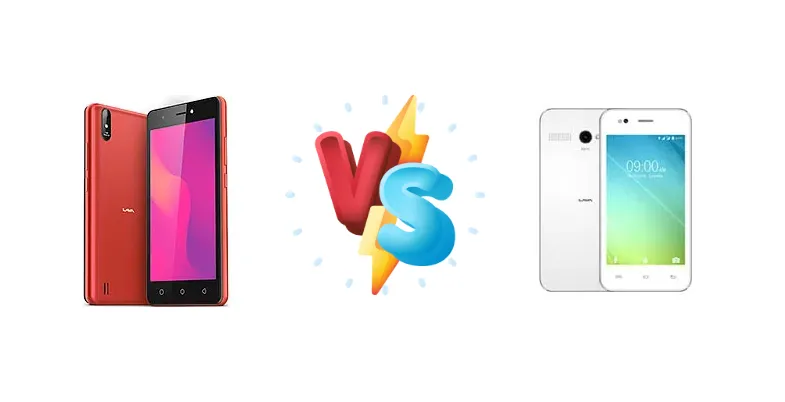
Lava's Z1 and A50 represent two distinct approaches to the ultra-budget smartphone market. The Z1, powered by the Mediatek Helio A20, aims for a slight performance edge, while the A50 focuses on basic functionality at an even lower price point. This comparison dissects the key differences to help you determine which device best suits your needs.
🏆 Quick Verdict
For users prioritizing even a modest level of responsiveness for apps and multitasking, the Lava Z1 is the clear winner. Its Helio A20 chipset, while still entry-level, offers a noticeable performance boost over the A50's unspecified CPU, making it a more usable daily driver.
| Network |
|---|
| 2G bands | GSM 900 / 1800 | GSM 900 / 1800 - SIM 1 & SIM 2 |
| 3G bands | HSDPA 900 / 2100 | HSDPA 900 / 2100 |
| 4G bands | 1, 3, 5, 8, 40, 41 | - |
| Speed | HSPA 21.1/5.76 Mbps, LTE Cat4 150/50 Mbps | HSPA |
| Technology | GSM / HSPA / LTE | GSM / HSPA |
| Launch |
|---|
| Announced | 2021, January 07 | 2016, November. Released 2016, November |
| Status | Available. Released 2021, January 26 | Discontinued |
| Body |
|---|
| Build | Glass front, plastic back, plastic frame | - |
| Dimensions | 145.1 x 73.3 x 10.3 mm (5.71 x 2.89 x 0.41 in) | 123 x 63.4 x 9.7 mm (4.84 x 2.50 x 0.38 in) |
| SIM | Nano-SIM + Nano-SIM | Dual SIM |
| Weight | 175 g (6.17 oz) | - |
| Display |
|---|
| Protection | Corning Gorilla Glass 3 | - |
| Resolution | 480 x 854 pixels, 16:9 ratio (~196 ppi density) | 480 x 800 pixels, 5:3 ratio (~233 ppi density) |
| Size | 5.0 inches, 68.9 cm2 (~64.8% screen-to-body ratio) | 4.0 inches, 45.5 cm2 (~58.4% screen-to-body ratio) |
| Type | TFT LCD | TFT |
| Platform |
|---|
| CPU | Quad-core 1.8 GHz Cortex-A53 | Quad-core 1.2 GHz |
| Chipset | Mediatek MT6761 Helio A20 (12 nm) | - |
| GPU | PowerVR GE8320 | - |
| OS | Android 10 (Go edition) | Android 6.0 (Marshmallow) |
| Memory |
|---|
| Card slot | microSDXC (uses shared SIM slot) | microSDHC |
| Internal | 16GB 2GB RAM | 8GB 512MB RAM |
| | eMMC 5.1 | - |
| Main Camera |
|---|
| Features | LED flash | LED flash, panorama |
| Single | 5 MP, f/2.2 | 5 MP |
| Video | 720p@30fps | Yes |
| Selfie camera |
|---|
| Single | 5 MP, f/2.2 | VGA |
| Video | 720p | - |
| Sound |
|---|
| 3.5mm jack | Yes | Yes |
| 35mm jack | Yes | Yes |
| Loudspeaker | Yes | Yes |
| Comms |
|---|
| Bluetooth | 5.0, A2DP, LE | 2.1, EDR |
| NFC | No | No |
| Positioning | GPS | GPS |
| Radio | FM radio | FM radio |
| USB | microUSB | microUSB 2.0 |
| WLAN | Wi-Fi 802.11 b/g/n, Wi-Fi Direct | Wi-Fi 802.11 b/g/n |
| Features |
|---|
| Sensors | Accelerometer | Accelerometer |
| Battery |
|---|
| Stand-by | - | Up to 388 h |
| Talk time | - | Up to 9 h |
| Type | Li-Po 3100 mAh, removable | Li-Ion 1550 mAh, removable |
| Misc |
|---|
| Colors | Blue, Red | Black + Silver |
| Models | LS000Z1 | - |
| Price | About 60 EUR | - |
Lava Z1
- More powerful Helio A20 chipset
- Potentially better power efficiency
- Slightly improved multitasking capabilities
- Still an entry-level processor
- Likely limited camera performance
- Display quality is likely basic
Lava A50
- Extremely affordable price point
- Basic functionality for calls and texts
- Simple and easy to use
- Significantly slower CPU performance
- Limited app compatibility
- Poor multitasking capabilities
Display Comparison
Both devices likely feature LCD panels, common in this price segment. However, detailed display specifications like resolution and brightness are unavailable for the A50. The Z1's display quality will be adequate for basic tasks, but neither phone is expected to deliver vibrant colors or high brightness levels. Bezels are likely to be substantial on both models, maximizing screen real estate within their respective budgets.
Camera Comparison
Camera details are sparse for both devices. It's safe to assume both phones feature basic camera setups geared towards casual snapshots. Without sensor size or aperture information, a direct comparison is difficult. However, the Z1’s Helio A20 chipset includes a basic image signal processor (ISP) that may offer slightly better image processing capabilities than the A50’s, potentially resulting in marginally improved photo quality in good lighting conditions. Expect limited low-light performance from both.
Performance
The core difference lies in the chipset. The Lava Z1’s Mediatek MT6761 Helio A20 (12nm) features a quad-core 1.8 GHz Cortex-A53 CPU. This 12nm process node, while not cutting-edge, is more efficient than older, larger node processes likely used in the A50. The A50’s quad-core 1.2 GHz CPU lacks the clock speed and architectural refinement of the Helio A20, resulting in slower app launch times and a less fluid user experience. The Z1 will handle multitasking slightly better, though both phones will struggle with demanding applications.
Battery Life
Battery capacity details are missing for both devices. Given their price points, both likely house batteries in the 3000-4000 mAh range. The Helio A20’s 12nm process contributes to better power efficiency, potentially giving the Z1 a slight edge in battery life despite potentially similar capacity. Charging wattage is also unknown, but expect slow charging speeds on both devices.
Buying Guide
Buy the Lava Z1 if you need a phone capable of handling basic social media, light web browsing, and occasional app usage without significant lag. It's ideal for first-time smartphone users or those needing a reliable secondary device. Buy the Lava A50 if your primary needs are making and receiving calls, sending texts, and minimal app usage – it's a no-frills option for the most budget-conscious consumers.
Frequently Asked Questions
❓ Will the Lava Z1 be able to run popular social media apps like Facebook and WhatsApp smoothly?
Yes, the Lava Z1’s Helio A20 chipset should be capable of running Facebook and WhatsApp without significant issues. However, expect some lag when switching between apps or loading media-heavy content. The A50 may struggle with these apps, experiencing more noticeable slowdowns.
❓ Is the Lava A50 suitable for someone who primarily uses their phone for calls and texts?
Absolutely. The Lava A50 is designed for basic communication. Its lower processing requirements mean it will excel at making and receiving calls and sending text messages, even with limited network connectivity. It’s a reliable option for those who don’t need smartphone features.
❓ Can I expect to play games on the Lava Z1?
While the Lava Z1 can technically run some basic Android games, its Helio A20 chipset is not designed for gaming. Expect low frame rates and significant lag in most titles. It's best suited for simple, 2D games rather than graphically demanding 3D games.