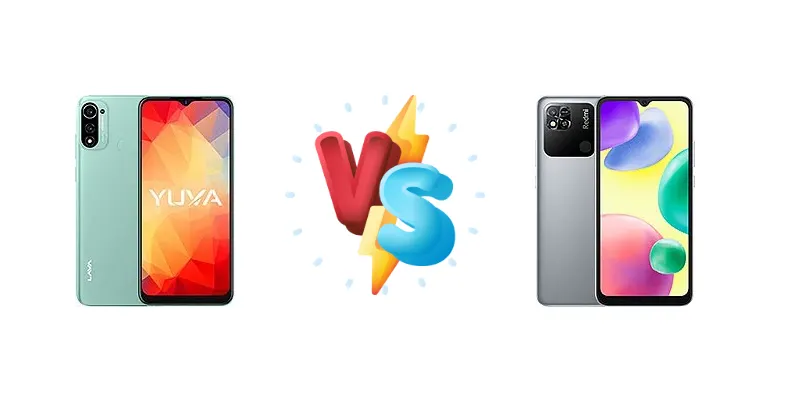
The Lava Yuva and Xiaomi Redmi 10A occupy the ultra-budget smartphone segment, a market where incremental differences can sway purchasing decisions. Both devices share the same Mediatek Helio G25 chipset, making a direct performance comparison less critical than examining the nuances in design, software, and brand reputation. This comparison aims to dissect those subtle distinctions to help you choose the right phone.
🏆 Quick Verdict
For the average user prioritizing brand recognition and potentially a slightly more refined software experience, the Xiaomi Redmi 10A is the better choice. However, the Lava Yuva presents a compelling alternative for those seeking a locally-supported brand and potentially a more aggressive price point, given the identical core hardware.
| Network |
|---|
| 2G bands | GSM 900 / 1800 | GSM 850 / 900 / 1800 / 1900 |
| 3G bands | HSDPA 900 / 2100 | HSDPA 850 / 900 / 2100 |
| 4G bands | 1, 3, 5, 8, 40, 41 | 1, 3, 5, 8, 40, 41 - International |
| Speed | HSPA, LTE | HSPA, LTE |
| Technology | GSM / HSPA / LTE | GSM / HSPA / CDMA2000 / LTE |
| | - | 1, 3, 5, 8, 34, 38, 39, 40, 41 - China |
| Launch |
|---|
| Announced | 2021 | 2022, March 29 |
| Status | Available. Released 2021 | Available. Released 2022, March 31 |
| Body |
|---|
| Dimensions | 164.6 x 75.8 x 9.2 mm (6.48 x 2.98 x 0.36 in) | 164.9 x 77.1 x 9 mm (6.49 x 3.04 x 0.35 in) |
| SIM | Nano-SIM + Nano-SIM | Nano-SIM + Nano-SIM |
| Weight | 210 g (7.41 oz) | 194 g (6.84 oz) |
| Display |
|---|
| Resolution | 720 x 1600 pixels, 20:9 ratio (~270 ppi density) | 720 x 1600 pixels, 20:9 ratio (~269 ppi density) |
| Size | 6.5 inches, 102.0 cm2 (~81.8% screen-to-body ratio) | 6.53 inches, 102.9 cm2 (~81.0% screen-to-body ratio) |
| Type | IPS LCD | IPS LCD, 400 nits (typ) |
| Platform |
|---|
| CPU | Octa-core (4x2.0 GHz Cortex-A53 & 4x1.5 GHz Cortex-A53) | Octa-core (4x2.0 GHz Cortex-A53 & 4x1.5 GHz Cortex-A53) |
| Chipset | Mediatek Helio G25 (12 nm) | Mediatek MT6762G Helio G25 (12 nm) |
| GPU | PowerVR GE8320 | PowerVR GE8320 |
| OS | Android 11 (Go edition) | Android 11, MIUI 12.5 |
| Memory |
|---|
| Card slot | microSDXC (dedicated slot) | microSDXC |
| Internal | 32GB 2GB RAM | 32GB 2GB RAM, 32GB 3GB RAM, 64GB 3GB RAM, 64GB 4GB RAM, 128GB 4GB RAM, 128GB 6GB RAM |
| Main Camera |
|---|
| Features | LED flash, HDR | LED flash |
| Single | 8 MP, (wide)
Auxiliary lens | 13 MP, f/2.2, (wide), 1.0µm, AF |
| Video | Yes | 1080p@30fps |
| Selfie camera |
|---|
| Features | - | HDR |
| Single | 5 MP | 5 MP |
| Video | Yes | 1080p@30fps |
| Sound |
|---|
| 3.5mm jack | - | Yes |
| 35mm jack | Yes | Yes |
| Loudspeaker | Yes, with stereo speakers | Yes |
| Comms |
|---|
| Bluetooth | 5.0, A2DP | 5.0, A2DP, LE |
| NFC | No | No |
| Positioning | Luster Blue, Luster Green | GPS, GLONASS, BDS |
| Radio | FM radio | No |
| USB | USB Type-C 2.0, OTG | microUSB 2.0 |
| WLAN | Wi-Fi 802.11 b/g | Wi-Fi 802.11 a/b/g/n, Wi-Fi Direct |
| Features |
|---|
| Sensors | Fingerprint (side-mounted), accelerometer, proximity | Fingerprint (rear-mounted), accelerometer, proximity |
| Battery |
|---|
| Charging | 10W wired | 10W wired |
| Type | Li-Ion 4000 mAh | Li-Ion 5000 mAh |
| Misc |
|---|
| Colors | Metallic Black, Metallic Blue, Metallic Grey | Charcoal Black, Sea Blue, Slate Grey |
| Models | - | 220233L2C, 220233L2G, 220233L2I |
| Price | - | € 60.00 / $ 66.55 |
| SAR | 0.44 W/kg (head) 0.14 W/kg (body) | 0.90 W/kg (head) 0.65 W/kg (body) |
| SAR EU | - | 0.40 W/kg (head) 0.99 W/kg (body) |
Lava Yuva
- Potential for lower price point
- Supports an Indian brand
- Identical performance to Redmi 10A
- Less established brand reputation
- Potentially slower software updates
- Limited information on display quality
Xiaomi Redmi 10A
- Globally recognized brand
- Potentially better software support
- Wider availability of accessories
- May be slightly more expensive
- Identical performance to Lava Yuva
- 10W charging is slow
Display Comparison
Neither Lava nor Xiaomi disclose detailed display specifications beyond size. Both phones likely utilize a standard LCD panel, given their price point. The absence of information regarding peak brightness, color gamut coverage, or resolution suggests a focus on cost reduction. Expect similar viewing experiences in typical indoor lighting conditions, but both will struggle in direct sunlight. The lack of higher refresh rates (90Hz or 120Hz) is standard for this segment, prioritizing battery life over visual fluidity.
Camera Comparison
Camera specifications are not detailed enough to draw meaningful conclusions. Both phones likely feature a primary camera and potentially a secondary depth sensor. The image processing algorithms will differ between Lava and Xiaomi, potentially leading to variations in color accuracy and dynamic range. However, the underlying sensor and chipset limitations will prevent either phone from delivering exceptional image quality. Focusing on megapixel counts alone is misleading; sensor size and lens aperture are far more critical, and these details are unavailable.
Performance
The core of both devices is the Mediatek Helio G25 (12 nm) chipset, featuring an identical octa-core CPU configuration (4x2.0 GHz Cortex-A53 & 4x1.5 GHz Cortex-A53). This means performance in everyday tasks – browsing, social media, and light app usage – will be virtually indistinguishable. The GPU performance will also be identical, limiting gaming to less demanding titles at lower settings. RAM configurations are not specified, but the Helio G25 typically pairs with 2GB or 3GB, which will impact multitasking capabilities. Thermal management is unlikely to be a concern given the low-power chipset.
Battery Life
Both the Lava Yuva and Xiaomi Redmi 10A support 10W wired charging. Battery capacity is also not specified, but typical capacities for phones in this segment range from 4000mAh to 5000mAh. With the power-efficient Helio G25 chipset, both phones should comfortably last a full day of moderate usage. The 10W charging speed is slow by modern standards, requiring several hours for a full charge. The lack of fast charging is a common trade-off in this price bracket.
Buying Guide
Buy the Lava Yuva if you prioritize supporting an Indian brand and value potential cost savings, understanding that software updates and long-term support might be less consistent. Buy the Xiaomi Redmi 10A if you prefer a globally recognized brand with a more established track record for software updates and a wider ecosystem of accessories, even if it means paying a slight premium.
Frequently Asked Questions
❓ Will the Helio G25 handle popular games like PUBG Mobile?
The Mediatek Helio G25 is an entry-level chipset. While it can *run* PUBG Mobile, expect to play at the lowest graphics settings and potentially experience frame drops, even on the lowest settings. It's best suited for less demanding games.
❓ How long will it take to fully charge the Lava Yuva or Redmi 10A with the 10W charger?
With the 10W charging, a full charge from 0% will likely take between 3 to 4 hours, depending on the battery capacity (estimated between 4000mAh and 5000mAh). It's best to charge overnight.
❓ What version of Android do these phones run?
Both devices likely ship with Android Go Edition, a lightweight version of Android designed for phones with limited RAM. This ensures smoother performance on the Helio G25 chipset and conserves storage space.
❓ Is the lack of a fingerprint sensor a significant drawback?
Both phones likely rely on traditional PIN or pattern unlock methods. While a fingerprint sensor adds convenience, its absence is common in this price segment and doesn't significantly impact core functionality.