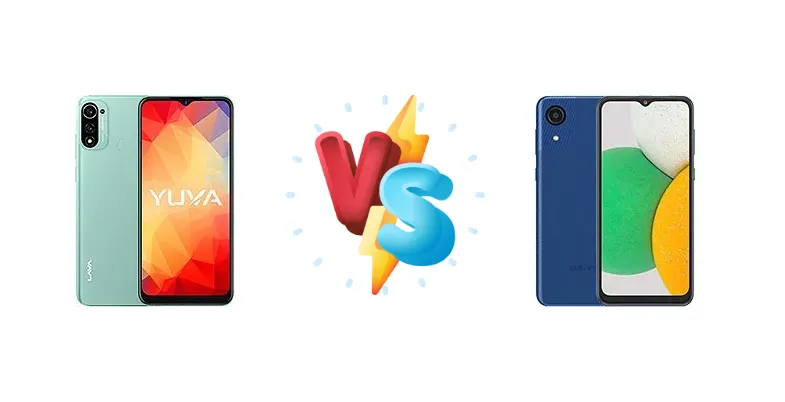
The sub-$100 smartphone market is fiercely competitive, and the Lava Yuva and Samsung Galaxy A03 Core represent two key contenders. Both aim to deliver essential smartphone functionality at an incredibly accessible price point, but they take drastically different approaches to achieving this. This comparison dissects their core components to reveal which device offers the best value for users prioritizing performance and efficiency.
🏆 Quick Verdict
For the average user seeking the best overall experience, the Lava Yuva is the stronger choice. Its Mediatek Helio G25 chipset, built on a more modern 12nm process, provides a noticeable performance advantage and better power efficiency compared to the Samsung Galaxy A03 Core’s older 28nm Unisoc SC9863A. While both phones are entry-level, the Yuva offers a smoother user experience.
| Network |
|---|
| 2G bands | GSM 900 / 1800 | GSM 850 / 900 / 1800 / 1900 |
| 3G bands | HSDPA 900 / 2100 | HSDPA 850 / 900 / 2100 |
| 4G bands | 1, 3, 5, 8, 40, 41 | 1, 3, 5, 7, 8, 20, 28, 38, 40, 41 |
| Speed | HSPA, LTE | HSPA 21.1/5.76 Mbps, LTE |
| Technology | GSM / HSPA / LTE | GSM / HSPA / LTE |
| Launch |
|---|
| Announced | 2021 | 2021, November 15 |
| Status | Available. Released 2021 | Available. Released 2021, December 06 |
| Body |
|---|
| Build | - | Plastic back, plastic frame |
| Dimensions | 164.6 x 75.8 x 9.2 mm (6.48 x 2.98 x 0.36 in) | 164.2 x 75.9 x 9.1 mm (6.46 x 2.99 x 0.36 in) |
| SIM | Nano-SIM + Nano-SIM | · Nano-SIM· Nano-SIM + Nano-SIM |
| Weight | 210 g (7.41 oz) | 211 g (7.44 oz) |
| Display |
|---|
| Resolution | 720 x 1600 pixels, 20:9 ratio (~270 ppi density) | 720 x 1600 pixels, 20:9 ratio (~270 ppi density) |
| Size | 6.5 inches, 102.0 cm2 (~81.8% screen-to-body ratio) | 6.5 inches, 102.0 cm2 (~81.8% screen-to-body ratio) |
| Type | IPS LCD | PLS LCD |
| Platform |
|---|
| CPU | Octa-core (4x2.0 GHz Cortex-A53 & 4x1.5 GHz Cortex-A53) | Octa-core (4x1.6 GHz Cortex-A55 & 4x1.2 GHz Cortex-A55) |
| Chipset | Mediatek Helio G25 (12 nm) | Unisoc SC9863A (28 nm) |
| GPU | PowerVR GE8320 | IMG8322 |
| OS | Android 11 (Go edition) | Android 11 (Go edition) |
| Memory |
|---|
| Card slot | microSDXC (dedicated slot) | microSDXC (dedicated slot) |
| Internal | 32GB 2GB RAM | 32GB 2GB RAM |
| | - | eMMC 5.1 |
| Main Camera |
|---|
| Features | LED flash, HDR | LED flash |
| Single | 8 MP, (wide)
Auxiliary lens | 8 MP, f/2.0, AF |
| Video | Yes | 1080p@30fps |
| Selfie camera |
|---|
| Single | 5 MP | 5 MP, f/2.2 |
| Video | Yes | - |
| Sound |
|---|
| 3.5mm jack | - | Yes |
| 35mm jack | Yes | Yes |
| Loudspeaker | Yes, with stereo speakers | Yes |
| Comms |
|---|
| Bluetooth | 5.0, A2DP | 4.2, A2DP |
| NFC | No | No |
| Positioning | Luster Blue, Luster Green | GPS, GLONASS |
| Radio | FM radio | Unspecified |
| USB | USB Type-C 2.0, OTG | microUSB 2.0, OTG |
| WLAN | Wi-Fi 802.11 b/g | Wi-Fi 802.11 b/g/n, Wi-Fi Direct |
| Features |
|---|
| Sensors | Fingerprint (side-mounted), accelerometer, proximity | Accelerometer, proximity |
| Battery |
|---|
| Charging | 10W wired | - |
| Type | Li-Ion 4000 mAh | Li-Ion 5000 mAh |
| Misc |
|---|
| Colors | Metallic Black, Metallic Blue, Metallic Grey | Black, Blue |
| Models | - | SM-A032F, SM-A032F/DS, SM-A032M |
| Price | - | £ 74.99 |
| SAR | 0.44 W/kg (head) 0.14 W/kg (body) | 0.30 W/kg (head) |
| SAR EU | - | 0.24 W/kg (head) 1.39 W/kg (body) |
Lava Yuva
- More efficient processor (12nm)
- Potentially better sustained performance
- Likely better battery life
- Less brand recognition
- Potentially less refined software experience
Samsung Galaxy A03 Core
- Stronger brand recognition
- Potentially more polished software
- Wider availability in some markets
- Less efficient processor (28nm)
- Lower sustained performance
- Potentially shorter battery life
Display Comparison
Neither device boasts a standout display. Both are likely to feature basic LCD panels with resolutions around 720p+, typical for this price bracket. However, the lack of detailed display specifications necessitates focusing on the chipset impact on UI smoothness. A faster processor, like the one in the Yuva, will contribute more to a fluid visual experience than a marginal difference in display quality.
Camera Comparison
Both phones are expected to feature basic camera setups, likely headlined by an 8MP or 13MP main sensor. Given the price point, image quality will be heavily reliant on software processing. However, the chipset’s image signal processor (ISP) plays a crucial role. The Helio G25’s ISP, while not high-end, is likely more capable than the one found in the SC9863A, potentially leading to slightly better dynamic range and noise reduction in the Yuva’s photos. The inclusion of 2MP macro/depth sensors on both devices is largely marketing fluff and shouldn’t be a deciding factor.
Performance
The core difference lies in the chipsets. The Lava Yuva’s Mediatek Helio G25 (12nm) utilizes Cortex-A53 cores clocked up to 2.0 GHz. This contrasts sharply with the Samsung Galaxy A03 Core’s Unisoc SC9863A (28nm) and its Cortex-A55 cores peaking at 1.6 GHz. The 12nm fabrication process of the Helio G25 is significantly more efficient than the 28nm process of the Unisoc chip. This means the Yuva will generate less heat and consume less power for the same level of performance. While both are octa-core, the newer Cortex-A55 architecture in the A03 Core doesn't fully compensate for the process node disadvantage. The Yuva will likely exhibit less throttling under sustained load, resulting in more consistent performance.
Battery Life
While battery capacity isn’t specified, both devices likely house around a 4000-5000 mAh battery. The key differentiator is charging speed and power efficiency. The Lava Yuva’s 10W charging is standard for this segment. However, the Helio G25’s 12nm process will allow the Yuva to extract more usage time from a full charge compared to the A03 Core’s less efficient Unisoc chip. The A03 Core will likely require more frequent charging due to its higher power consumption.
Buying Guide
Buy the Lava Yuva if you need a phone that feels responsive for basic tasks like messaging, social media, and light web browsing. Its more efficient processor translates to better battery life during everyday use. Buy the Samsung Galaxy A03 Core if you prioritize brand recognition and a slightly more polished software experience, understanding that you’ll be making a trade-off in raw performance and potentially battery longevity.
Frequently Asked Questions
❓ Will the Unisoc SC9863A in the Samsung A03 Core struggle with multitasking?
Yes, the Unisoc SC9863A, built on a 28nm process, is less efficient and has lower processing power than the Helio G25. This means the A03 Core will likely exhibit noticeable slowdowns when running multiple apps simultaneously, especially more demanding ones. The Yuva will handle multitasking more smoothly.
❓ Is the 10W charging on the Lava Yuva slow compared to other phones?
10W charging is standard for phones in this price range. While it's not fast charging, the Lava Yuva’s more efficient processor means you’ll likely be charging it less frequently, mitigating the slower charging speed. The A03 Core, despite potentially having a similar charging rate, will need more frequent top-ups due to its higher power consumption.
❓ Can either of these phones handle popular games like PUBG Mobile?
Both phones will struggle to run PUBG Mobile at high settings. You’ll likely need to play at the lowest graphics settings and frame rates to achieve a playable experience. The Lava Yuva, with its more capable processor, will offer a slightly smoother experience, but don’t expect flagship-level gaming performance.