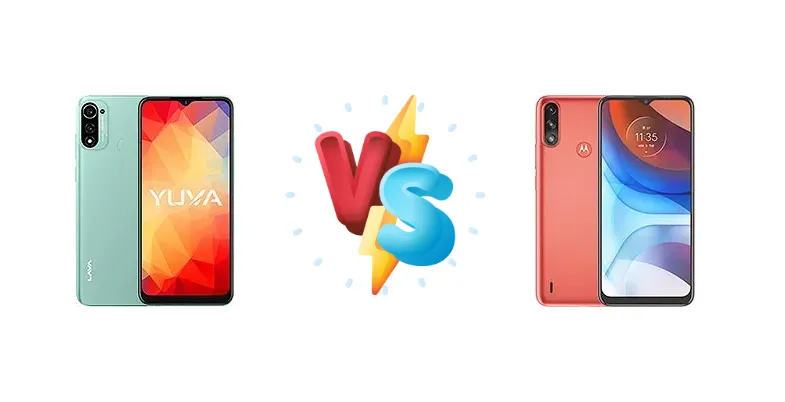
The Lava Yuva and Motorola Moto E7 Power represent the extreme end of the smartphone price spectrum, targeting first-time buyers or those needing a reliable secondary device. Both devices center around the Mediatek Helio G25 chipset, making a direct performance comparison less crucial than examining brand reputation, software experience, and subtle hardware variations.
🏆 Quick Verdict
For the average user prioritizing brand recognition and potentially more consistent software updates, the Motorola Moto E7 Power is the slightly better choice. However, the Lava Yuva offers a compelling alternative if you're seeking a potentially lower price point and are comfortable with a less established brand.
| Network |
|---|
| 2G bands | GSM 900 / 1800 | GSM 850 / 900 / 1800 / 1900 |
| 3G bands | HSDPA 900 / 2100 | HSDPA 850 / 900 / 1700(AWS) / 1900 / 2100 |
| 4G bands | 1, 3, 5, 8, 40, 41 | 1, 3, 5, 7, 8, 20, 38, 40, 41 |
| Speed | HSPA, LTE | HSPA, LTE |
| Technology | GSM / HSPA / LTE | GSM / HSPA / LTE |
| Launch |
|---|
| Announced | 2021 | 2021, February 19 |
| Status | Available. Released 2021 | Available. Released 2021, February 26 |
| Body |
|---|
| Build | - | Glass front, plastic back, plastic frame |
| Dimensions | 164.6 x 75.8 x 9.2 mm (6.48 x 2.98 x 0.36 in) | 165.1 x 75.9 x 9.2 mm (6.5 x 2.99 x 0.36 in) |
| SIM | Nano-SIM + Nano-SIM | Nano-SIM + Nano-SIM |
| Weight | 210 g (7.41 oz) | 200 g (7.05 oz) |
| | - | Water-repellent design |
| Display |
|---|
| Resolution | 720 x 1600 pixels, 20:9 ratio (~270 ppi density) | 720 x 1600 pixels, 20:9 ratio (~269 ppi density) |
| Size | 6.5 inches, 102.0 cm2 (~81.8% screen-to-body ratio) | 6.51 inches, 103.1 cm2 (~82.3% screen-to-body ratio) |
| Type | IPS LCD | IPS LCD, 380 nits (typ) |
| Platform |
|---|
| CPU | Octa-core (4x2.0 GHz Cortex-A53 & 4x1.5 GHz Cortex-A53) | Octa-core (4x2.0 GHz Cortex-A53 & 4x1.5 GHz Cortex-A53) |
| Chipset | Mediatek Helio G25 (12 nm) | Mediatek MT6762G Helio G25 (12 nm) |
| GPU | PowerVR GE8320 | PowerVR GE8320 |
| OS | Android 11 (Go edition) | Android 10 |
| Memory |
|---|
| Card slot | microSDXC (dedicated slot) | microSDXC (uses shared SIM slot) |
| Internal | 32GB 2GB RAM | 32GB 2GB RAM, 64GB 4GB RAM |
| | - | eMCP |
| Main Camera |
|---|
| Dual | - | 13 MP, f/2.0, 26mm (wide), 1/3.1", 1.12µm, PDAF
2 MP (macro) |
| Features | LED flash, HDR | LED flash, HDR, panorama |
| Single | 8 MP, (wide)
Auxiliary lens | - |
| Video | Yes | 1080p@30fps |
| Selfie camera |
|---|
| Features | - | HDR |
| Single | 5 MP | 5 MP, f/2.2, 27mm (wide), 1.12µm |
| Video | Yes | 1080p@30fps |
| Sound |
|---|
| 3.5mm jack | - | Yes |
| 35mm jack | Yes | Yes |
| Loudspeaker | Yes, with stereo speakers | Yes |
| Comms |
|---|
| Bluetooth | 5.0, A2DP | 5.0, A2DP, LE |
| NFC | No | No |
| Positioning | Luster Blue, Luster Green | GPS, GLONASS, GALILEO |
| Radio | FM radio | FM radio |
| USB | USB Type-C 2.0, OTG | USB Type-C 2.0, OTG |
| WLAN | Wi-Fi 802.11 b/g | Wi-Fi 802.11 b/g/n |
| Features |
|---|
| Sensors | Fingerprint (side-mounted), accelerometer, proximity | Fingerprint (rear-mounted), accelerometer, proximity |
| Battery |
|---|
| Charging | 10W wired | 10W wired |
| Type | Li-Ion 4000 mAh | Li-Ion 5000 mAh |
| Misc |
|---|
| Colors | Metallic Black, Metallic Blue, Metallic Grey | Tahiti Blue, Coral Red |
| Models | - | PAMH0001IN, PAMH0010IN, PAMH0019IN |
| Price | - | About 140 EUR |
| SAR | 0.44 W/kg (head) 0.14 W/kg (body) | - |
Lava Yuva
- Potentially lower price point compared to Motorola.
- Mediatek Helio G25 provides adequate performance for basic tasks.
- Likely to offer a clean Android experience (potentially Android Go Edition).
- Lava is a less established brand with potentially limited software support.
- Camera performance is likely to be basic.
Motorola Moto E7 Power
- Motorola has a strong brand reputation and a history of software updates.
- Wider service network and availability of spare parts.
- Mediatek Helio G25 provides adequate performance for basic tasks.
- May be slightly more expensive than the Lava Yuva.
- Camera performance is likely to be basic.
Display Comparison
Both the Lava Yuva and Motorola Moto E7 Power are expected to feature LCD panels, typical for this price bracket. Specific details like resolution and peak brightness are not provided, but we can anticipate a 720p+ resolution to balance clarity and battery life. The absence of features like high refresh rates or HDR support is standard. The user experience will likely be similar, focusing on basic readability rather than immersive visuals.
Camera Comparison
Camera specifications are not detailed beyond the presence of a camera system. Given the price point, image quality will be adequate for casual snapshots in good lighting conditions. Expect limited low-light performance and a reliance on software processing to enhance images. The inclusion of a 2MP macro camera on either device is largely a marketing tactic, offering minimal practical benefit due to the low resolution and lack of optical image stabilization (OIS).
Performance
The core of both devices is the Mediatek Helio G25 (MT6762G), a 12nm chipset featuring an octa-core CPU configuration with 4x2.0 GHz Cortex-A53 and 4x1.5 GHz Cortex-A53 cores. This means performance will be virtually identical for everyday tasks like browsing, social media, and light app usage. The GPU performance will also be the same, limiting gaming to less demanding titles at lower settings. RAM configurations are not specified, but the performance will be heavily influenced by the amount of RAM installed; 3GB is likely the minimum for acceptable multitasking.
Battery Life
Both devices utilize 10W wired charging, indicating a similar charging experience – expect approximately 2.5 to 3.5 hours for a full charge from 0%. Battery capacity is not specified, but a 4000mAh to 5000mAh battery is a reasonable expectation for this segment. Real-world battery life will depend on usage patterns, but both phones should comfortably last a full day with moderate use, prioritizing efficiency due to the Helio G25 chipset.
Buying Guide
Buy the Lava Yuva if you need a functional, no-frills smartphone and are comfortable exploring a newer brand with potentially aggressive pricing. Buy the Motorola Moto E7 Power if you prefer a more established brand with a longer track record of software support and a wider service network, even if it means paying a small premium.
Frequently Asked Questions
❓ Will either of these phones struggle with popular apps like WhatsApp and Facebook?
No, both the Lava Yuva and Motorola Moto E7 Power, powered by the Mediatek Helio G25, are capable of running popular apps like WhatsApp and Facebook smoothly. However, multitasking with many apps open simultaneously might lead to some slowdowns, especially if the device has only 2GB or 3GB of RAM.
❓ How long can I expect the battery to last with typical daily use (calls, messaging, social media)?
With typical daily use, both phones should comfortably last a full day on a single charge. The Helio G25 chipset is relatively power-efficient, and the expected battery capacity (4000-5000mAh) is sufficient for moderate usage. However, heavy gaming or prolonged video streaming will significantly reduce battery life.
❓ Are these phones suitable for playing demanding games like PUBG Mobile or Call of Duty Mobile?
While technically capable of running these games, the Helio G25 chipset is not designed for demanding gaming. You'll likely need to play at the lowest graphics settings and frame rates to achieve a playable experience, and even then, you may encounter occasional lag or stuttering.
❓ What version of Android do these phones run, and will they receive software updates?
The Lava Yuva may ship with Android Go Edition, a lightweight version of Android designed for entry-level smartphones. The Motorola Moto E7 Power typically runs a near-stock version of Android. Motorola generally provides at least one major Android update, while Lava's update policy is less predictable.