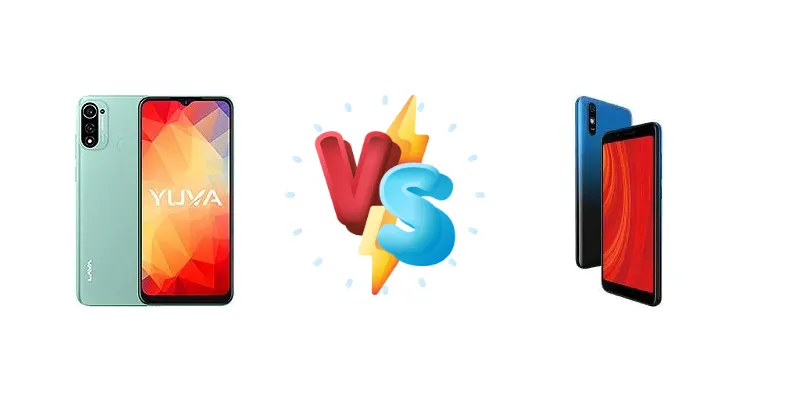
Lava is targeting the entry-level smartphone market with the Yuva and Z61 Pro, both aiming to deliver essential features at incredibly affordable prices. This comparison dissects the key differences between these two models, focusing on performance, charging, and overall user experience to help you determine which best suits your needs.
🏆 Quick Verdict
For most users, the Lava Yuva emerges as the better choice. Its Mediatek Helio G25 chipset, while not a powerhouse, offers a more modern architecture and potentially smoother performance than the Z61 Pro’s unspecified octa-core processor, especially in multi-tasking scenarios. The slightly faster 10W charging is also a benefit.
| Network |
|---|
| 2G bands | GSM 900 / 1800 | GSM 900 / 1800 |
| 3G bands | HSDPA 900 / 2100 | HSDPA 900 / 2100 |
| 4G bands | 1, 3, 5, 8, 40, 41 | 1, 3, 5, 8, 40, 41 |
| Speed | HSPA, LTE | HSPA 42.2/5.76 Mbps, LTE Cat4 150/50 Mbps |
| Technology | GSM / HSPA / LTE | GSM / HSPA / LTE |
| Launch |
|---|
| Announced | 2021 | 2020, July 09. Released 2020, July |
| Status | Available. Released 2021 | Discontinued |
| Body |
|---|
| Build | - | Glass front, plastic back, plastic frame |
| Dimensions | 164.6 x 75.8 x 9.2 mm (6.48 x 2.98 x 0.36 in) | 147 x 71.8 x 9.2 mm (5.79 x 2.83 x 0.36 in) |
| SIM | Nano-SIM + Nano-SIM | Nano-SIM + Nano-SIM |
| Weight | 210 g (7.41 oz) | 160 g (5.64 oz) |
| Display |
|---|
| Resolution | 720 x 1600 pixels, 20:9 ratio (~270 ppi density) | 720 x 1440 pixels, 18:9 ratio (~295 ppi density) |
| Size | 6.5 inches, 102.0 cm2 (~81.8% screen-to-body ratio) | 5.45 inches, 76.7 cm2 (~72.6% screen-to-body ratio) |
| Type | IPS LCD | TFT LCD |
| Platform |
|---|
| CPU | Octa-core (4x2.0 GHz Cortex-A53 & 4x1.5 GHz Cortex-A53) | Octa-core 1.6 GHz processor |
| Chipset | Mediatek Helio G25 (12 nm) | - |
| GPU | PowerVR GE8320 | - |
| OS | Android 11 (Go edition) | Android 9.0 (Pie) |
| Memory |
|---|
| Card slot | microSDXC (dedicated slot) | microSDXC (dedicated slot) |
| Internal | 32GB 2GB RAM | 16GB 2GB RAM |
| | - | eMMC 5.1 |
| Main Camera |
|---|
| Features | LED flash, HDR | LED flash, HDR, panorama |
| Single | 8 MP, (wide)
Auxiliary lens | 8 MP, f/2.0, (wide), 1.12µ |
| Video | Yes | 1080p@30fps |
| Selfie camera |
|---|
| Features | - | LED flash |
| Single | 5 MP | 5 MP, f/2.2, (wide), 1.12µ |
| Video | Yes | - |
| Sound |
|---|
| 3.5mm jack | - | Yes |
| 35mm jack | Yes | Yes |
| Loudspeaker | Yes, with stereo speakers | Yes |
| Comms |
|---|
| Bluetooth | 5.0, A2DP | 4.2, A2DP, LE |
| NFC | No | No |
| Positioning | Luster Blue, Luster Green | GPS, GLONASS |
| Radio | FM radio | FM radio |
| USB | USB Type-C 2.0, OTG | microUSB 2.0, OTG |
| WLAN | Wi-Fi 802.11 b/g | Wi-Fi 802.11 b/g/n, Wi-Fi Direct |
| Features |
|---|
| Sensors | Fingerprint (side-mounted), accelerometer, proximity | Accelerometer, proximity |
| Battery |
|---|
| Charging | 10W wired | 5W, 100% in 3h 30 min |
| Type | Li-Ion 4000 mAh | Li-Po 3100 mAh |
| Misc |
|---|
| Colors | Metallic Black, Metallic Blue, Metallic Grey | Midnight Blue, Amber Red |
| Price | - | About 70 EUR |
| SAR | 0.44 W/kg (head) 0.14 W/kg (body) | - |
Lava Yuva
- More modern chipset (Helio G25)
- Faster 10W charging
- Potentially better multi-tasking performance
- No specific display details available
- Limited camera information
Lava Z61 Pro
- Potentially longer battery life due to lower performance demands
- Simpler user experience
- Lower price (likely, based on specs)
- Slower 5W charging
- Older, less efficient processor
- Likely slower performance in most tasks
Display Comparison
Display specifications are not provided for either device. Assuming both utilize standard IPS LCD panels common in this price bracket, the user experience will likely be similar. Bezels and color accuracy will be key differentiators, but without data, we can only speculate. The absence of high refresh rate panels is expected at this price point.
Camera Comparison
Camera details are sparse for both devices. Without sensor size, aperture, or image processing information, a meaningful comparison is impossible. It’s safe to assume both phones feature basic camera setups geared towards casual photography. The presence of a 2MP macro lens on either device is unlikely to significantly enhance the photography experience, serving primarily as a marketing feature.
Performance
The Lava Yuva’s Mediatek Helio G25 (12nm) represents a more modern design than the Lava Z61 Pro’s octa-core 1.6 GHz processor. The G25’s Cortex-A53 cores are split into performance and efficiency clusters (2.0 GHz and 1.5 GHz respectively), allowing for dynamic power allocation. The Z61 Pro’s processor lacks this architectural nuance, potentially leading to less efficient power usage and slower performance in demanding applications. While both are entry-level, the G25’s newer fabrication process (12nm vs. an unknown process for the Z61 Pro) suggests better thermal efficiency.
Battery Life
The Lava Yuva features 10W wired charging, while the Z61 Pro is limited to 5W, taking 3 hours and 30 minutes for a full charge. While battery capacity isn’t specified, the faster charging speed of the Yuva is a tangible benefit, reducing downtime. The Z61 Pro’s slower charging is a significant drawback for users who need to quickly top up their device. The difference in charging speed will be noticeable in daily use.
Buying Guide
Buy the Lava Yuva if you prioritize a more responsive user experience for everyday tasks like browsing, social media, and light gaming. Its newer chipset architecture provides a foundation for better long-term performance. Buy the Lava Z61 Pro if your primary concern is absolute simplicity and extended battery life with minimal charging frequency, accepting a trade-off in processing speed. It's geared towards users who make very limited demands on their smartphone.
Frequently Asked Questions
❓ Will the Lava Yuva be able to handle popular social media apps like Facebook and Instagram smoothly?
Yes, the Mediatek Helio G25 chipset in the Lava Yuva is capable of running social media apps without significant lag. The processor’s architecture is designed to handle everyday tasks efficiently, providing a reasonably smooth user experience for common applications.
❓ How long will it take to fully charge the Lava Z61 Pro from 0%?
The Lava Z61 Pro takes approximately 3 hours and 30 minutes to fully charge from 0% using its 5W charging adapter. This is a relatively slow charging speed compared to modern smartphones, so plan accordingly if you frequently need to recharge your device.
❓ Is the Lava Yuva a good option for playing mobile games?
The Lava Yuva is suitable for light gaming, but it's not designed for demanding titles. The Helio G25 can handle less graphically intensive games, but you may experience frame drops or lag in more complex games. Lowering graphics settings can improve performance.