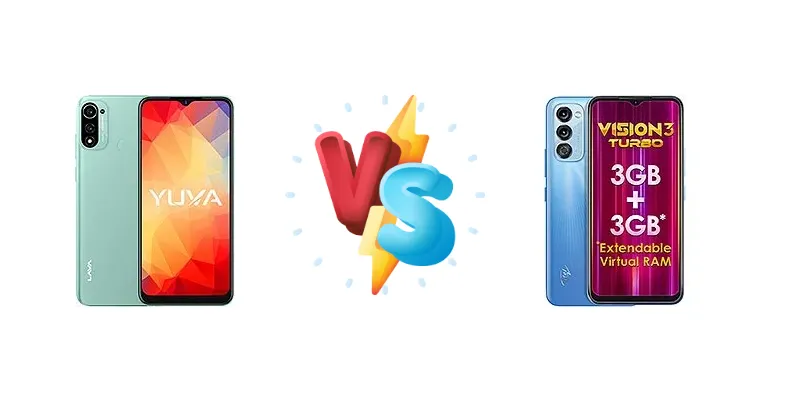
The sub-$100 smartphone market is fiercely competitive. Both the Lava Yuva and the itel Vision 3 Turbo aim to deliver essential smartphone functionality at an incredibly low price point. However, they take different approaches to achieving this, with the Lava Yuva prioritizing a newer, albeit less powerful, chipset architecture, while the itel Vision 3 Turbo focuses on faster charging capabilities. This comparison will dissect the key differences to help you determine which device best suits your needs.
🏆 Quick Verdict
For the average user prioritizing consistent performance and a slightly more modern CPU architecture, the Lava Yuva is the better choice. While the itel Vision 3 Turbo’s 18W charging is appealing, the older, less efficient Unisoc SC9863A chipset and its 28nm process ultimately result in a less refined user experience.
| Network |
|---|
| 2G bands | GSM 900 / 1800 | GSM 850 / 900 / 1800 / 1900 |
| 3G bands | HSDPA 900 / 2100 | HSDPA 850 / 900 / 2100 |
| 4G bands | 1, 3, 5, 8, 40, 41 | LTE |
| Speed | HSPA, LTE | HSPA, LTE |
| Technology | GSM / HSPA / LTE | GSM / HSPA / LTE |
| Launch |
|---|
| Announced | 2021 | 2022 |
| Status | Available. Released 2021 | Available. Released 2022 |
| Body |
|---|
| Dimensions | 164.6 x 75.8 x 9.2 mm (6.48 x 2.98 x 0.36 in) | - |
| SIM | Nano-SIM + Nano-SIM | Dual SIM |
| Weight | 210 g (7.41 oz) | - |
| Display |
|---|
| Resolution | 720 x 1600 pixels, 20:9 ratio (~270 ppi density) | 720 x 1600 pixels, 20:9 ratio (~266 ppi density) |
| Size | 6.5 inches, 102.0 cm2 (~81.8% screen-to-body ratio) | 6.6 inches, 105.2 cm2 |
| Type | IPS LCD | IPS LCD |
| Platform |
|---|
| CPU | Octa-core (4x2.0 GHz Cortex-A53 & 4x1.5 GHz Cortex-A53) | Octa-core (4x1.6 GHz Cortex-A55 & 4x1.2 GHz Cortex-A55) |
| Chipset | Mediatek Helio G25 (12 nm) | Unisoc SC9863A (28 nm) |
| GPU | PowerVR GE8320 | IMG8322 |
| OS | Android 11 (Go edition) | Android 11 (Go edition) |
| Memory |
|---|
| Card slot | microSDXC (dedicated slot) | microSDXC |
| Internal | 32GB 2GB RAM | 64GB 3GB RAM |
| Main Camera |
|---|
| Features | LED flash, HDR | LED flash |
| Single | 8 MP, (wide)
Auxiliary lens | 8 MP (wide)
Auxiliary lens |
| Video | Yes | 1080p@30fps |
| Selfie camera |
|---|
| Single | 5 MP | 5 MP |
| Video | Yes | Yes |
| Sound |
|---|
| 35mm jack | Yes | Yes |
| Loudspeaker | Yes, with stereo speakers | Yes |
| Comms |
|---|
| Bluetooth | 5.0, A2DP | Yes |
| NFC | No | No |
| Positioning | Luster Blue, Luster Green | GPS |
| Radio | FM radio | Unspecified |
| USB | USB Type-C 2.0, OTG | microUSB |
| WLAN | Wi-Fi 802.11 b/g | Yes |
| Features |
|---|
| Sensors | Fingerprint (side-mounted), accelerometer, proximity | Fingerprint (rear-mounted), accelerometer |
| Battery |
|---|
| Charging | 10W wired | 18W wired |
| Type | Li-Ion 4000 mAh | 5000 mAh |
| Misc |
|---|
| Colors | Metallic Black, Metallic Blue, Metallic Grey | Blue |
| SAR | 0.44 W/kg (head) 0.14 W/kg (body) | - |
Lava Yuva
- More modern CPU architecture (Helio G25)
- Potentially better power efficiency (12nm process)
- Likely smoother multitasking
- Slower charging speed (10W)
- Limited information on display quality
itel Vision 3 Turbo
- Faster charging (18W)
- Potentially larger battery capacity
- May offer a slightly larger display
- Older, less efficient chipset (Unisoc SC9863A)
- Larger process node (28nm) – potential for more heat
Display Comparison
Neither Lava nor itel provide display specifications beyond size. Given the price point, both likely utilize LCD panels with 720p+ resolution. The absence of details like peak brightness or color gamut makes direct comparison impossible. However, the itel Vision 3 Turbo’s larger battery (implied by faster charging) *could* suggest a slightly larger display, potentially offering a more immersive viewing experience, but this is speculative.
Camera Comparison
Both phones are expected to feature basic camera setups. Without specific sensor details, it’s difficult to make a meaningful comparison. It’s highly probable both devices include a primary camera and potentially a depth or macro sensor of minimal resolution. Image quality will likely be similar, relying heavily on software processing. The absence of OIS on either device suggests image stabilization will be limited, particularly in low-light conditions. Focusing on megapixel counts would be misleading without knowing sensor size and lens aperture.
Performance
The core difference lies in the chipsets. The Lava Yuva’s Mediatek Helio G25, built on a 12nm process, features Cortex-A53 cores clocked up to 2.0 GHz. This represents a more modern architecture than the itel Vision 3 Turbo’s Unisoc SC9863A, which uses a 28nm process and slower Cortex-A55 cores peaking at 1.6 GHz. While both are octa-core CPUs, the 12nm process and newer architecture of the Helio G25 should translate to better power efficiency and slightly improved performance in everyday tasks. The Unisoc SC9863A’s larger process node will likely result in more heat generation under load, potentially leading to throttling. The Lava Yuva will likely handle basic multitasking and app switching more smoothly.
Battery Life
The itel Vision 3 Turbo’s 18W wired charging is its most significant advantage. While the Lava Yuva is limited to 10W charging, the itel’s faster charging will significantly reduce the time required to replenish the battery. However, the Unisoc SC9863A’s less efficient 28nm process likely means the itel Vision 3 Turbo will drain its battery faster during active use. The actual battery capacity of both devices is unknown, but the faster charging suggests the itel may have a slightly larger capacity to take advantage of the 18W input.
Buying Guide
Buy the Lava Yuva if you need a phone for basic daily tasks like calling, texting, and light social media browsing, and value a more recent CPU architecture for potential software support. Buy the itel Vision 3 Turbo if you frequently find yourself needing to quickly top up your battery and are willing to compromise on overall performance and efficiency due to its 18W charging support.
Frequently Asked Questions
❓ Will the Unisoc SC9863A in the itel Vision 3 Turbo struggle with modern app performance?
Yes, the Unisoc SC9863A is a relatively older chipset built on a less efficient 28nm process. While it can handle basic tasks, you may experience slowdowns and lag when running more demanding apps or multitasking heavily. The Lava Yuva’s Helio G25, despite not being a powerhouse, offers a more modern architecture and should provide a smoother experience.
❓ How long will it take to fully charge the itel Vision 3 Turbo with the 18W charger?
While 18W charging is faster than 10W, the actual charge time depends on the battery capacity, which is currently unknown. However, you can expect a full charge to take between 2 to 3 hours, significantly less than the Lava Yuva’s estimated 3.5 to 4.5 hours with its 10W charger. Keep in mind that the chipset's inefficiency may offset some of the charging speed benefits during use.
❓ Is the Lava Yuva a good option for playing mobile games?
The Lava Yuva is not designed for serious gaming. The Helio G25 can handle very light games, but you’ll likely experience low frame rates and graphical compromises in more demanding titles. The Unisoc SC9863A in the itel Vision 3 Turbo will perform similarly, if not worse, due to its lower clock speeds and older architecture.