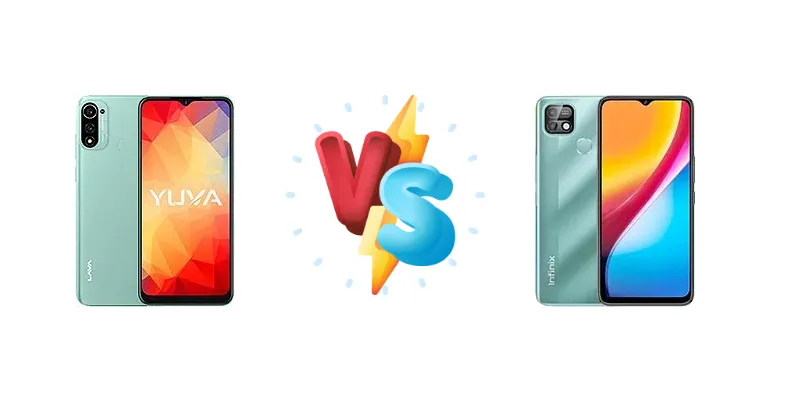
The Lava Yuva and Infinix Smart 5 Pro represent the extreme end of the budget smartphone spectrum, targeting first-time smartphone buyers or those needing a reliable secondary device. Both aim to deliver essential functionality at an incredibly low price point, but they take different approaches to achieving this, primarily in their chipset choices. This comparison will dissect those differences and determine which device offers the best value.
🏆 Quick Verdict
For the average user prioritizing responsiveness and future-proofing, the Lava Yuva is the better choice. Its Mediatek Helio G25, built on a more modern 12nm process, offers a noticeable performance advantage over the Infinix Smart 5 Pro’s older 28nm Unisoc SC9863A, despite similar core counts. While both offer basic functionality, the Yuva’s CPU architecture translates to a smoother user experience.
| Network |
|---|
| 2G bands | GSM 900 / 1800 | GSM 850 / 900 / 1800 / 1900 |
| 3G bands | HSDPA 900 / 2100 | HSDPA 850 / 900 / 2100 |
| 4G bands | 1, 3, 5, 8, 40, 41 | 1, 3, 5, 8, 38, 40, 41 |
| Speed | HSPA, LTE | HSPA 21.1/5.76 Mbps, LTE Cat4 150/50 Mbps |
| Technology | GSM / HSPA / LTE | GSM / HSPA / LTE |
| | - | 1, 2, 3, 4, 5, 7, 8, 20, 28, 38, 41, 40, 66 |
| Launch |
|---|
| Announced | 2021 | 2021, November 17 |
| Status | Available. Released 2021 | Available. Released 2021, November 17 |
| Body |
|---|
| Build | - | Glass front, plastic back, plastic frame |
| Dimensions | 164.6 x 75.8 x 9.2 mm (6.48 x 2.98 x 0.36 in) | 164.4 x 75.6 x 9.5 mm (6.47 x 2.98 x 0.37 in) |
| SIM | Nano-SIM + Nano-SIM | Nano-SIM + Nano-SIM |
| Weight | 210 g (7.41 oz) | - |
| Display |
|---|
| Resolution | 720 x 1600 pixels, 20:9 ratio (~270 ppi density) | 720 x 1600 pixels, 20:9 ratio (~269 ppi density) |
| Size | 6.5 inches, 102.0 cm2 (~81.8% screen-to-body ratio) | 6.52 inches, 102.6 cm2 (~82.6% screen-to-body ratio) |
| Type | IPS LCD | IPS LCD, 500 nits (peak) |
| Platform |
|---|
| CPU | Octa-core (4x2.0 GHz Cortex-A53 & 4x1.5 GHz Cortex-A53) | Octa-core (4x1.6 GHz Cortex-A55 & 4x1.2 GHz Cortex-A55) |
| Chipset | Mediatek Helio G25 (12 nm) | Unisoc SC9863A (28 nm) |
| GPU | PowerVR GE8320 | IMG8322 |
| OS | Android 11 (Go edition) | Android 11 (Go edition), XOS 7.6 |
| Memory |
|---|
| Card slot | microSDXC (dedicated slot) | microSDXC (dedicated slot) |
| Internal | 32GB 2GB RAM | 32GB 2GB RAM |
| | - | eMMC 5.1 |
| Main Camera |
|---|
| Dual | - | 13 MP, f/1.8, AF
Auxiliary lens |
| Features | LED flash, HDR | Quad-LED flash |
| Single | 8 MP, (wide)
Auxiliary lens | 8 MP |
| Video | Yes | 1440p@30fps |
| Selfie camera |
|---|
| Features | - | Dual-LED flash |
| Single | 5 MP | 8 MP |
| Video | Yes | 1080p@30fps |
| Sound |
|---|
| 3.5mm jack | - | Yes |
| 35mm jack | Yes | Yes |
| Loudspeaker | Yes, with stereo speakers | Yes |
| Comms |
|---|
| Bluetooth | 5.0, A2DP | 4.2, A2DP |
| NFC | No | No |
| Positioning | Luster Blue, Luster Green | GPS |
| Radio | FM radio | FM radio |
| USB | USB Type-C 2.0, OTG | microUSB 2.0 |
| WLAN | Wi-Fi 802.11 b/g | Wi-Fi 802.11 b/g/n |
| Features |
|---|
| Sensors | Fingerprint (side-mounted), accelerometer, proximity | Fingerprint (rear-mounted), accelerometer, proximity |
| Battery |
|---|
| Charging | 10W wired | 10W wired |
| Type | Li-Ion 4000 mAh | 6000 mAh |
| Misc |
|---|
| Colors | Metallic Black, Metallic Blue, Metallic Grey | Morandi Green, Heart of Ocean |
| Price | - | About 70 EUR |
| SAR | 0.44 W/kg (head) 0.14 W/kg (body) | - |
Lava Yuva
- More efficient chipset (12nm)
- Newer CPU architecture (Cortex-A53 vs A55)
- Potentially better sustained performance
- May be slightly more expensive
- Limited detailed specifications available
Infinix Smart 5 Pro
- Likely the most affordable option
- Functional for basic tasks
- Acceptable for minimal smartphone usage
- Less efficient chipset (28nm)
- Older CPU architecture (Cortex-A53)
- Potentially slower performance and shorter battery life
Display Comparison
Neither device boasts a standout display. Both are likely to feature LCD panels, typical for this price bracket. However, the lack of detailed display specifications necessitates focusing on the chipset's ability to drive the UI smoothly. A more powerful chipset, like the Yuva’s Helio G25, will contribute to a more fluid scrolling experience, even on a basic panel.
Camera Comparison
Given the price point, camera expectations should be tempered. Both devices likely feature a primary camera alongside basic auxiliary sensors. Without specific sensor details, it’s difficult to make a definitive judgment. However, the Helio G25’s image signal processor (ISP) is likely more capable than the one found in the Unisoc SC9863A, potentially resulting in slightly better image quality and faster processing times. Focusing on the primary sensor resolution (if available) will be more impactful than analyzing the presence of low-resolution macro or depth sensors.
Performance
The core difference lies in the chipsets. The Lava Yuva’s Mediatek Helio G25 (12nm) utilizes Cortex-A53 cores clocked up to 2.0 GHz, while the Infinix Smart 5 Pro’s Unisoc SC9863A (28nm) features Cortex-A55 cores clocked to 1.6 GHz. While both are octa-core, the A55 architecture is more efficient and offers improved performance per clock cycle compared to the older A53. The 28nm process of the Unisoc chip is significantly less efficient than the 12nm process of the Helio G25, meaning the Yuva will likely run cooler and potentially sustain performance for longer periods. This translates to a snappier experience when switching between apps and loading content.
Battery Life
Both phones feature 10W wired charging, indicating similar charging speeds. Battery capacity isn’t specified, but the Helio G25’s superior efficiency suggests the Lava Yuva will likely offer slightly better battery life despite potentially having a similar capacity to the Infinix Smart 5 Pro. The 28nm process of the Unisoc chip will consume more power, impacting overall endurance.
Buying Guide
Buy the Lava Yuva if you need a phone that feels reasonably responsive for everyday tasks like WhatsApp, browsing, and light social media. Its newer chipset provides a better foundation for future Android updates and app compatibility. Buy the Infinix Smart 5 Pro if your primary concern is absolute lowest price and you only need a phone for basic calling and texting, with minimal app usage. The Smart 5 Pro represents a bare-bones experience, but it gets the job done for the most basic of users.
Frequently Asked Questions
❓ Will the Infinix Smart 5 Pro struggle with modern app updates?
The Unisoc SC9863A's older architecture and limited processing power mean it may struggle to run newer versions of popular apps efficiently. App developers are increasingly optimizing for newer chipsets, potentially leaving the Smart 5 Pro behind in terms of compatibility and performance.
❓ Is the 10W charging on either phone fast enough for daily use?
10W charging is quite slow by today's standards. Expect a full charge to take several hours. However, given the likely smaller battery capacities and limited usage scenarios of these phones, it's generally sufficient for overnight charging or topping up throughout the day.
❓ Can the Lava Yuva handle light gaming?
The Helio G25 is a basic gaming chip, but it can handle less demanding 2D games and older 3D titles at lower settings. Don't expect to play graphically intensive games like PUBG Mobile smoothly.
❓ Which phone is better for someone completely new to smartphones?
Both are suitable for first-time smartphone users. However, the Lava Yuva's slightly smoother performance might make the initial learning curve less frustrating. The simpler interface of the Infinix Smart 5 Pro could also be appealing to those unfamiliar with smartphones.