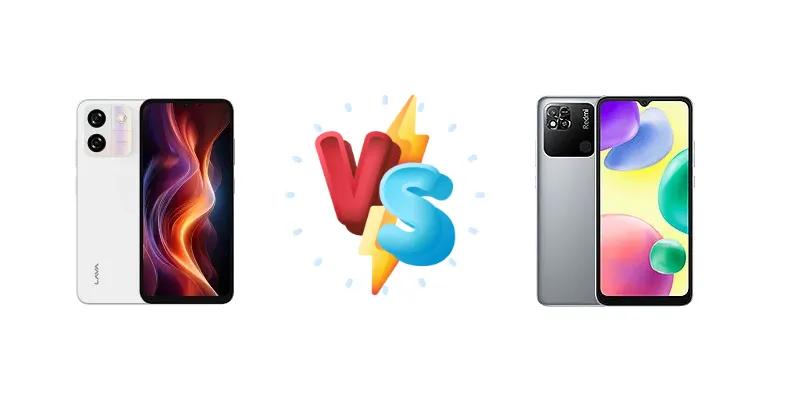
The Lava Yuva Star and Xiaomi Redmi 10A represent the fiercely competitive sub-$150 smartphone market. Both aim to deliver essential smartphone functionality at an incredibly accessible price point. However, they take different approaches to achieving this, primarily through their chipset choices. This comparison dissects those choices and their implications for everyday use.
🏆 Quick Verdict
For the average user prioritizing overall efficiency and slightly better performance, the Xiaomi Redmi 10A is the stronger choice. Its MediaTek Helio G25, built on a 12nm process, offers a noticeable advantage over the Lava Yuva Star’s Unisoc SC9863A, despite similar core counts. However, the Yuva Star remains a viable option for basic tasks.
| Network |
|---|
| 2G bands | GSM 900 / 1800 | GSM 850 / 900 / 1800 / 1900 |
| 3G bands | HSDPA 850 / 900 / 1900 / 2100 | HSDPA 850 / 900 / 2100 |
| 4G bands | 1, 3, 5, 7, 8, 20, 28, 38, 40, 41 | 1, 3, 5, 8, 40, 41 - International |
| Speed | HSPA, LTE | HSPA, LTE |
| Technology | GSM / HSPA / LTE | GSM / HSPA / CDMA2000 / LTE |
| | - | 1, 3, 5, 8, 34, 38, 39, 40, 41 - China |
| Launch |
|---|
| Announced | 2024, August 06 | 2022, March 29 |
| Status | Available. Released 2024, September | Available. Released 2022, March 31 |
| Body |
|---|
| Dimensions | 165 x 76.1 x 8.8 mm (6.50 x 3.00 x 0.35 in) | 164.9 x 77.1 x 9 mm (6.49 x 3.04 x 0.35 in) |
| SIM | Nano-SIM + Nano-SIM | Nano-SIM + Nano-SIM |
| Weight | 193 g (6.81 oz) | 194 g (6.84 oz) |
| Display |
|---|
| Resolution | 720 x 1600 pixels, 20:9 ratio (~260 ppi density) | 720 x 1600 pixels, 20:9 ratio (~269 ppi density) |
| Size | 6.75 inches, 110.0 cm2 (~87.6% screen-to-body ratio) | 6.53 inches, 102.9 cm2 (~81.0% screen-to-body ratio) |
| Type | IPS LCD | IPS LCD, 400 nits (typ) |
| Platform |
|---|
| CPU | Octa-core (4x1.6 GHz Cortex-A55 & 4x1.2 GHz Cortex-A55) | Octa-core (4x2.0 GHz Cortex-A53 & 4x1.5 GHz Cortex-A53) |
| Chipset | Unisoc SC9863A (28 nm) | Mediatek MT6762G Helio G25 (12 nm) |
| GPU | IMG8322 | PowerVR GE8320 |
| OS | Android 14 (Go edition) | Android 11, MIUI 12.5 |
| Memory |
|---|
| Card slot | microSDXC (dedicated slot) | microSDXC |
| Internal | 64GB 3GB RAM, 64GB 4GB RAM | 32GB 2GB RAM, 32GB 3GB RAM, 64GB 3GB RAM, 64GB 4GB RAM, 128GB 4GB RAM, 128GB 6GB RAM |
| Main Camera |
|---|
| Dual | 13 MP, (wide), AF
auxiliary lens | - |
| Features | LED flash, HDR, panorama | LED flash |
| Single | - | 13 MP, f/2.2, (wide), 1.0µm, AF |
| Video | 1080p@30fps | 1080p@30fps |
| Selfie camera |
|---|
| Features | - | HDR |
| Single | 5 MP | 5 MP |
| Video | Yes | 1080p@30fps |
| Sound |
|---|
| 3.5mm jack | - | Yes |
| 35mm jack | Yes | Yes |
| Loudspeaker | Yes | Yes |
| Comms |
|---|
| Bluetooth | 4.2, A2DP | 5.0, A2DP, LE |
| Infrared port | Yes | - |
| NFC | No | No |
| Positioning | GPS, GLONASS | GPS, GLONASS, BDS |
| Radio | FM radio | No |
| USB | USB Type-C 2.0, OTG | microUSB 2.0 |
| WLAN | Wi-Fi 802.11 b/g/n/ac | Wi-Fi 802.11 a/b/g/n, Wi-Fi Direct |
| Features |
|---|
| Sensors | Fingerprint (side-mounted), accelerometer, proximity | Fingerprint (rear-mounted), accelerometer, proximity |
| Battery |
|---|
| Charging | 10W wired | 10W wired |
| Type | Li-Ion 5000 mAh | Li-Ion 5000 mAh |
| Misc |
|---|
| Colors | Glossy Black, Glossy Lavender, Glossy White | Charcoal Black, Sea Blue, Slate Grey |
| Models | LZG409 | 220233L2C, 220233L2G, 220233L2I |
| Price | About 70 EUR | € 60.00 / $ 66.55 |
| SAR | - | 0.90 W/kg (head) 0.65 W/kg (body) |
| SAR EU | - | 0.40 W/kg (head) 0.99 W/kg (body) |
Lava Yuva Star
- Potentially lower price point
- Functional for basic tasks
- May offer longer software support (Lava's commitment is improving)
- Less efficient processor
- Slower performance
- Likely more thermal throttling
Xiaomi Redmi 10A
- More efficient processor (Helio G25)
- Better performance for multitasking
- Potentially better camera image processing
- May be slightly more expensive
- Xiaomi's MIUI can be resource-intensive
- Potential for bloatware
Display Comparison
Neither device boasts a standout display. Both are likely to feature LCD panels, typical for this price bracket. Without specific display specs, we can assume similar resolutions (likely 720p+) and brightness levels. The absence of features like high refresh rates or Gorilla Glass is expected. The user experience will be largely defined by software optimization rather than panel quality.
Camera Comparison
Both phones are expected to feature basic camera setups. Given the price point, image quality will be heavily reliant on software processing. Without detailed sensor information, it’s safe to assume both will include a primary camera and potentially a depth or macro sensor. The Redmi 10A’s image processing algorithms, benefiting from MediaTek’s optimizations, are likely to produce slightly more refined results. The 2MP macro sensors often found in this segment are largely marketing features and offer limited practical benefit on either device.
Performance
The core difference lies in the chipsets. The Redmi 10A’s MediaTek Helio G25, fabricated on a 12nm process, is inherently more efficient than the Lava Yuva Star’s Unisoc SC9863A (28nm). While both are octa-core CPUs, the Helio G25 utilizes Cortex-A53 cores clocked at 2.0 GHz, compared to the Yuva Star’s mix of A55 cores at 1.6 GHz and 1.2 GHz. This translates to faster single-core performance on the Redmi 10A, beneficial for app launch times and general responsiveness. The 12nm process also means less heat generation under load, potentially reducing throttling during sustained tasks. The Yuva Star's larger, less efficient chip will likely struggle with multitasking and more demanding applications.
Battery Life
Both devices feature 10W wired charging, indicating similar charging speeds. The actual battery capacity isn't specified, but typical capacities for this segment are around 5000mAh. However, the Helio G25’s superior efficiency in the Redmi 10A will translate to longer battery life during typical usage. The Unisoc SC9863A in the Yuva Star will consume more power, leading to more frequent charging needs, even with a comparable battery capacity.
Buying Guide
Buy the Lava Yuva Star if you need a phone primarily for calls, texts, and very light app usage, and are looking for the absolute lowest price. It's a functional device for those with minimal smartphone demands. Buy the Xiaomi Redmi 10A if you prefer a phone capable of handling slightly more demanding tasks like social media browsing, occasional gaming, and smoother multitasking, and value a more efficient processor for longer battery life during moderate use.
Frequently Asked Questions
❓ Will the Unisoc SC9863A in the Lava Yuva Star struggle with popular apps like WhatsApp and Facebook?
While the Yuva Star can run these apps, users may experience noticeable lag and slower loading times, especially with multiple apps open simultaneously. The processor is designed for very basic tasks, and these social media apps are becoming increasingly demanding.
❓ Is the Redmi 10A a good option for playing casual games like Candy Crush or Subway Surfers?
Yes, the Helio G25 in the Redmi 10A is capable of handling casual games without significant issues. However, don't expect to play graphically intensive games like PUBG Mobile at high settings. Frame rates will likely be limited, and you may need to lower the graphics settings for a smoother experience.
❓ Does the 10W charging on either phone mean it will take a long time to fully charge the battery?
Yes, 10W charging is relatively slow. Expect a full charge from 0% to 100% to take approximately 3-4 hours. However, the Redmi 10A's more efficient processor means you may not need to charge it as frequently.
❓ Which phone is better suited for an elderly user who primarily needs a phone for calls and texts?
The Lava Yuva Star is likely the better choice for an elderly user with basic needs. Its simplicity and potentially lower price point make it a practical option for calls and texts, without the complexity of more advanced features.